Dimensity 9600 Specs Leak: How MediaTek Plans to Destroy the Snapdragon 8 Elite Gen 6
For years, the premium Android smartphone market has been a two-horse race, with Qualcomm traditionally holding the undisputed performance crown and MediaTek playing the role of the “budget-friendly alternative.” However, the architectural foundation of the mobile industry is fracturing. As Qualcomm struggles with the massive 2nm wafer costs and artificial segmentation of its upcoming Snapdragon 8 Elite Gen 6 lineup, MediaTek is executing a flawless flanking maneuver.
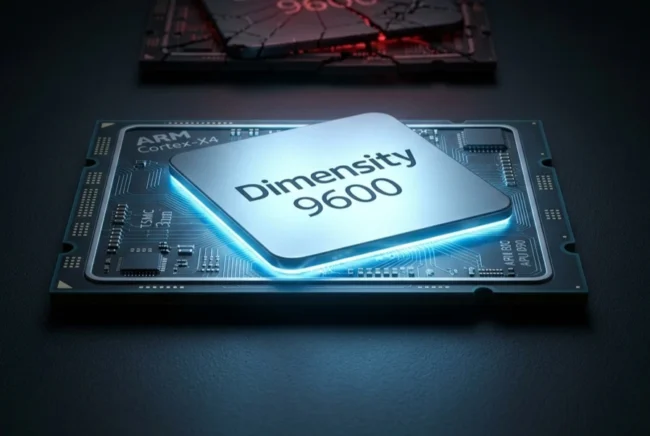
Massive supply chain leaks and insider benchmarks originating from Digital Chat Station on Weibo have revealed the full specifications of the upcoming MediaTek Dimensity 9600 (and its highly anticipated “Pro” variant). The data paints a terrifying picture for Qualcomm: MediaTek isn’t just closing the gap; they are preparing to offer desktop-level processing and massive GPU improvements that could make them the default choice for 2027 Android flagships.
Here is a comprehensive, bulleted breakdown of the leaked Dimensity 9600 architecture, its target performance metrics, and why it poses an existential threat to the Snapdragon monopoly.
The 2+3+3 “All-Big-Core” Revolution
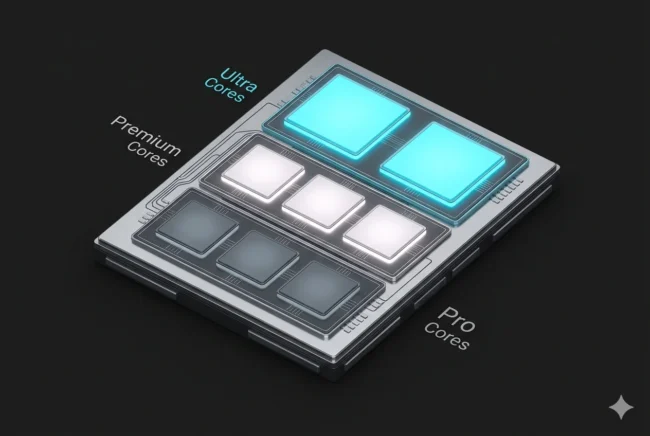
The most shocking revelation regarding the Dimensity 9600 is its total abandonment of traditional efficiency cores. To match Apple’s raw compute power, MediaTek is shifting to an aggressive 2+3+3 architectural layout, spearheaded by not one, but two ultra-large performance cores.
Dual “Canyon” Ultra Cores: For the first time in MediaTek’s history, the Dimensity 9600 Pro will feature two top-tier ARM C2-Ultra cores (internally codenamed “Canyon”). Engineering samples indicate these cores are targeting blistering peak clock speeds of nearly 5.0GHz.
The Supporting Cast: Flanking the dual Ultra cores are three ARM C2-Premium cores (“Gelas-B”) and three ARM C2-Pro cores (“Gelas”). By utilizing eight high-performance cores, MediaTek is ensuring that heavy multi-threaded workloads are distributed without relying on weaker, high-latency efficiency clusters.
TSMC 2nm (N2P) Fabrication: Like its Qualcomm rival, the Dimensity 9600 is confirmed to be utilizing TSMC’s bleeding-edge 2nm N2P process node. This node shrink is the only physical way MediaTek can cram eight massive cores into a smartphone package without triggering thermal throttling, delivering a projected 25% reduction in power consumption.
Desktop-Level Benchmarks: Early Geekbench 6 leaks for the Dimensity 9600 Pro are staggering. Single-core scores are reportedly hovering between 4,200 and 4,300 (a massive 22% leap over the Dimensity 9500), while multi-core scores are pushing 12,000 to 12,500. These numbers do not just beat the Snapdragon 8 Elite Gen 5; they directly rival Apple’s M-class desktop silicon.
The “Magin” GPU: A Generational Leap for Gaming
While raw CPU compute is impressive, modern flagship processors are defined by their graphical rendering capabilities. MediaTek is reportedly integrating ARM’s next-generation flagship GPU to dominate the mobile gaming sector.
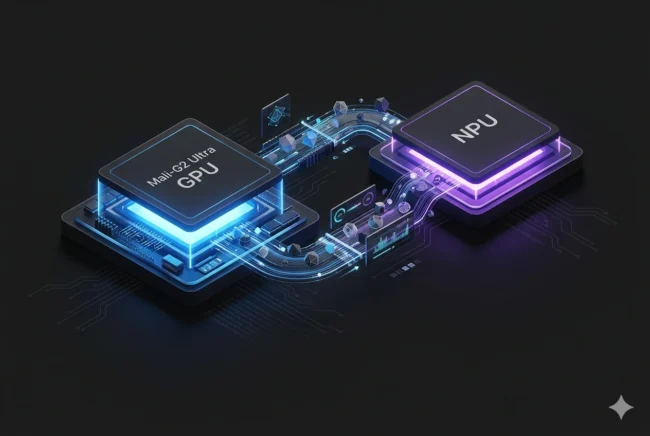
The Mali-G2 Ultra (Magin): Expected to feature 10+ cores, this massive new GPU architecture is physically larger than competing 2nm graphics processors, dedicating immense die space to rendering pipelines.
Hardware-Level Ray Tracing: MediaTek is focusing heavily on pushing ray tracing from a “gimmick” to a playable reality. The Magin GPU is expected to deliver vastly improved ray intersection calculations, allowing for console-quality dynamic lighting and reflections in mobile AAA titles without destroying battery life.
Native Frame Generation: Moving beyond software-based tricks, the Dimensity 9600 will feature silicon-level frame interpolation and super-resolution upscaling. This mirrors NVIDIA’s DLSS technology, allowing the GPU to render at 1080p and intelligently upscale to 1440p at 120Hz.
Neural Shader Scheduler (NSS): A bespoke scheduling system will actively coordinate between the GPU and the NPU. By offloading tasks like motion estimation and frame reconstruction to the AI processor, the Magin GPU can prevent stalls, resulting in flawlessly smooth frame pacing.
The AI Arms Race: SME2 and Dual NPUs
With generative AI moving from the cloud to localized on-device processing, NPU (Neural Processing Unit) density is the new benchmark for 2027 smartphones. MediaTek is heavily investing in matrix math acceleration.
Double the AI Throughput: The Dimensity 9600 will feature second-generation Scalable Matrix Extension (SME2) and upgraded Compute Matrix Engine (CME) instructions. Leaks suggest this will literally double the AI and Machine Learning performance output compared to the Dimensity 9500.
The “OpenAI Phone” Rumor: Esteemed analyst Ming-Chi Kuo recently suggested that MediaTek’s advanced NPU design and integrated Image Signal Processor (ISP) are the primary reasons they have been selected to power the highly rumored hardware collaboration between OpenAI and Jony Ive.
LPDDR6 Integration: Crucially, to keep the massive NPU fed with data for Large Language Models (LLMs), the Dimensity 9600 is fully compatible with the ultra-fast, low-latency LPDDR6 RAM and UFS 5.0 storage standards.
The Price War: Why OEMs Will Jump Ship
As we analyzed in our previous coverage regarding Samsung and Xiaomi’s shifting loyalties, the success of the Dimensity 9600 is not solely based on Geekbench scores; it is deeply rooted in OEM economics.
Avoiding the Qualcomm Tax: Qualcomm’s Snapdragon 8 Elite Gen 6 Pro is expected to push the limits of OEM profit margins due to TSMC’s $30,000 wafer costs. MediaTek, operating with lower overhead and a historical willingness to undercut Qualcomm, offers a financial lifeline.
No Compromise on the “Standard” Tier: Unlike Qualcomm, which is hobbling its “Standard” Gen 6 chip with older LPDDR5X memory, MediaTek is expected to offer LPDDR6 support across both the standard Dimensity 9600 and the Pro variant.
The First Adopters: Expect the Dimensity 9600 to launch in September 2026, slightly ahead of the Snapdragon Summit. Industry leaks point to the Vivo X500 Pro and the Oppo Find X10 series acting as the launch vehicles to showcase this silicon to the global market.
The Verdict: The End of the Default Choice
For years, buying an “Elite” Android phone simply meant ensuring it had a Snapdragon processor. The MediaTek Dimensity 9600 is positioned to completely shatter that paradigm.
By delivering dual 5.0GHz Ultra cores, LPDDR6 memory support, and a massive GPU overhaul on TSMC’s 2nm node, MediaTek is no longer offering a “budget” alternative. They are offering a superior architectural design that does not artificially segment memory bandwidth to protect profit margins.
If you are waiting for a 2027 Android flagship, the most powerful device on the market might just be powered by MediaTek. The reign of the Snapdragon is officially under threat.