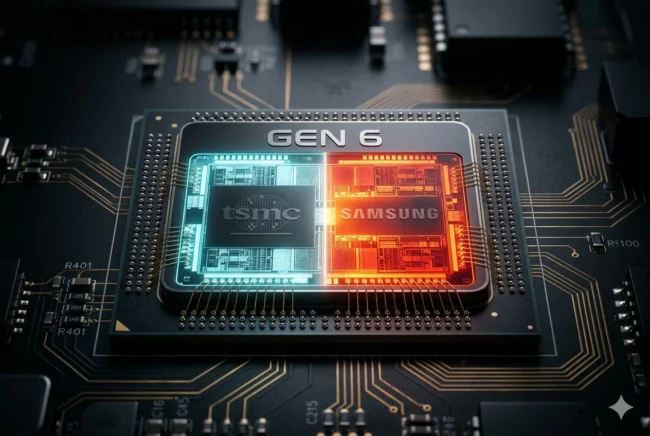
TSMC vs Samsung: The Secret Reason the Standard Snapdragon 8 Elite Gen 6 Might Run Hotter
Just when the enthusiast community thought the structural downgrades of the 2027 Snapdragon lineup were fully mapped out, a massive new supply chain revelation has surfaced. Qualcomm is not just bifurcating the memory architecture and cache of its upcoming mobile silicon; they are reportedly splitting the fundamental manufacturing process between two entirely different foundries.
Following recent high-level meetings between Qualcomm CEO Cristiano Amon and Samsung executives in South Korea, industry insiders indicate that the standard Snapdragon 8 Elite Gen 6 (SM8950) may abandon TSMC in favor of Samsung Foundry.
For the hardware purist, this dual-sourcing strategy is a glaring red flag. If the standard Gen 6 transitions to Samsung’s silicon while the “Pro” variant remains exclusively on TSMC, buyers of standard $999 flagships might be destined to endure significantly higher operating temperatures and aggressive thermal throttling. Here is the comprehensive breakdown of the foundry war and why the standard Gen 6 could run dangerously hot.
The Financial Catalyst: TSMC’s $30,000 Wafer Crisis
To understand why Qualcomm would willingly return to Samsung—a foundry they abandoned in 2022 due to severe overheating issues—you have to look at the unsustainable economics of TSMC’s bleeding-edge nodes.
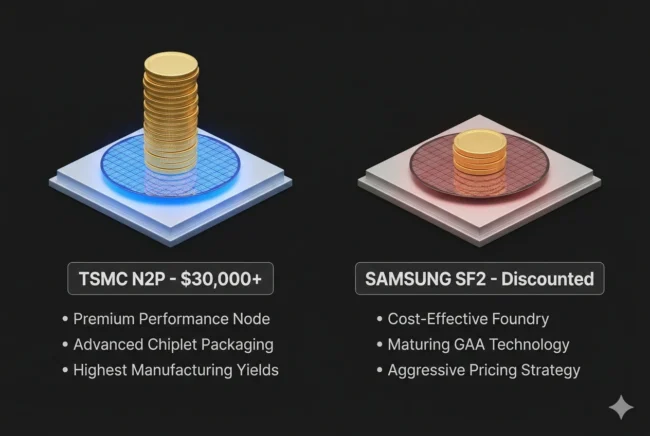
The 2nm Extortion: TSMC’s advanced 2nm (N2P) fabrication node is the most complex silicon manufacturing process in human history. Consequently, TSMC is reportedly charging a staggering $30,000+ per wafer.
The $300 Chipset: If Qualcomm relies entirely on TSMC for the entire Snapdragon 8 Elite Gen 6 lineup, the cost per chipset will easily exceed $300. When combined with the rising costs of LPDDR6 memory and UFS 5.0 storage, the base Bill of Materials (BOM) for OEMs becomes entirely unprofitable for standard flagships.
Samsung’s Bargain: Samsung Foundry, desperate to win back major clients for its second-generation 2nm node (SF2), is reportedly offering Qualcomm massive volume discounts. Moving the higher-volume, lower-tier SM8950 chip to Samsung is a desperate financial lifeline for Qualcomm to protect its margins.
The Foundry Split: Pro vs. Standard
This financial maneuvering results in a deeply anti-consumer reality for the 2027 smartphone market. The “Elite” branding will now mask two entirely different physical products.
The Pro Variant (SM8975): Reserved exclusively for “Ultra” tier phones (e.g., Galaxy S27 Ultra, Xiaomi 18 Ultra). This chip will be manufactured on TSMC’s N2P node, ensuring the highest possible efficiency, lowest leakage current, and maximum sustained performance.
The Standard Variant (SM8950): Destined for base model flagships. This chip will reportedly be manufactured on Samsung’s SF2 (2nm GAA) node. While it will carry the “Snapdragon 8 Elite Gen 6” badge, its physical transistors will behave vastly differently under load compared to the Pro.
The Yield Reality: Samsung claims its 2nm yields have recently improved to the 50-55% threshold. However, TSMC’s mature execution has historically resulted in significantly higher-quality silicon, meaning the variance (the “silicon lottery”) on the Samsung-built chips will likely be much wider.
Samsung SF2 vs. TSMC N2P: The Thermal Threat
Why does the foundry matter if the architectural design (the 2+3+3 core layout) is the same? Because how a transistor is physically printed dictates its electrical leakage and heat dissipation.
Gate-All-Around (GAA) Growing Pains: Samsung transitioned to GAA transistors earlier than TSMC. While GAA theoretically offers better current control, Samsung’s implementation has struggled with high dynamic power consumption. Under heavy gaming or localized AI workloads, the Samsung-built SM8950 will likely draw more wattage to maintain the same clock speeds as its TSMC counterpart.
Thermal Density: If the standard chip draws more power within the exact same physical package size, that excess energy is converted directly into heat.
Aggressive Throttling: Smartphone cooling chambers can only dissipate so much heat. Once the Samsung-built chip hits its thermal ceiling (often around 42°C to 45°C on the battery), the device firmware will aggressively throttle the CPU and Adreno 845 GPU, causing frame drops and stuttering that the TSMC-built Pro version will completely bypass.
The Snapdragon 8 Gen 1 PTSD
For long-time Android power users, this narrative is deeply familiar and entirely unwelcome. History is effectively repeating itself.
The 2022 Disaster: In 2022, Qualcomm utilized Samsung Foundry for the Snapdragon 8 Gen 1. The chip was notoriously hot, turning phones into space heaters and destroying battery life.
The Mid-Cycle Fix: The thermal issues were so severe that Qualcomm was forced to execute an emergency mid-cycle pivot, moving the subsequent Snapdragon 8+ Gen 1 to TSMC. The difference was night and day: the TSMC version ran drastically cooler and faster using the exact same architectural design.
The 2027 Risk: By trusting Samsung with the standard Gen 6, Qualcomm is betting that Samsung has completely resolved its leakage issues. If they haven’t, millions of standard flagship buyers will be stuck with devices that overheat during basic 120Hz multitasking or extended camera use.
Strategic Buying Advice for 2027
The bifurcation of the foundries completely destroys the concept of a “safe” flagship purchase. If you are preparing for an upgrade in late 2026 or 2027, your buying strategy must evolve.
Avoid the Base Models: Unless independent reviews definitively prove that Samsung’s SF2 node has achieved thermal parity with TSMC, you must treat all standard (non-Ultra) flagships with extreme suspicion.
Pay the “Ultra” Tax: If you require uncompromised, blazing fast performance without thermal degradation, you will have to pay the premium for devices explicitly featuring the TSMC-built SM8975 Pro variant.
Look to MediaTek: As we discussed in our Dimensity 9600 coverage, MediaTek is exclusively utilizing TSMC’s 2nm node for its entire high-end lineup. A standard flagship powered by the Dimensity 9600 may actually run significantly cooler and faster than a standard flagship burdened with a Samsung-built Snapdragon.
Final Verdict: A Dangerous Game of Margins
Qualcomm’s decision to potentially dual-source the Snapdragon 8 Elite Gen 6 is a masterclass in corporate margin protection, but it is a massive loss for hardware enthusiasts. By offloading the standard chip to Samsung Foundry, they are gambling with the thermal stability of the entire Android ecosystem.
In 2027, the sticker on the box won’t tell the whole story. The true performance of your phone will be dictated by the invisible factory that printed the silicon inside.