Dimensity 9600 vs Apple A19 Pro: The Multi-Core Benchmark Shock of 2026
For over a decade, the mobile silicon narrative has followed a predictable, almost boring script: Apple announces a new A-series chip, and the Android world spends the next twelve months trying to catch up. The A-series has historically dominated single-core performance while maintaining a comfortable lead in multi-core efficiency. However, as we pass the midpoint of 2026, that narrative has been violently upended.
Recent benchmark leaks pitting MediaTek’s upcoming Dimensity 9600 against early engineering samples of the Apple A19 Pro have sent shockwaves through the enthusiast community. For the first time in modern smartphone history, an Android processor isn’t just closing the gap—it is reportedly decimating Apple’s flagship silicon in multi-threaded workloads.
Here is a comprehensive breakdown of the benchmark leaks, the architectural decisions driving this shift, and why the Dimensity 9600 represents an existential threat to Apple’s silicon supremacy.
The Benchmark Leak: A Paradigm Shift
The raw numbers emerging from trusted supply chain sources (notably Digital Chat Station) paint a picture of a massive architectural leap by MediaTek, contrasting sharply with Apple’s more conservative iterative update.
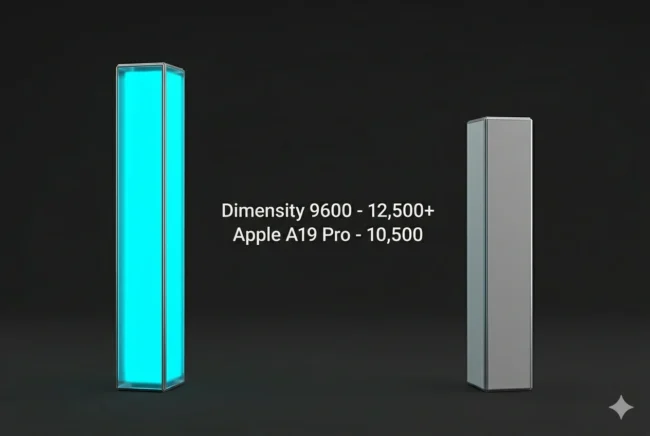
Geekbench 6 Multi-Core Dominance: Early test units of the Dimensity 9600 Pro are consistently scoring between 12,000 and 12,500 in multi-core tests. By contrast, the Apple A19 Pro (destined for the iPhone 18 Pro) is reportedly hovering around 10,200 to 10,500. This isn’t a margin of error; it is a staggering 20% advantage for MediaTek.
The Single-Core Truce: Apple’s traditional stronghold has always been single-core speed. The A19 Pro still holds a slight edge here, scoring around 4,500. However, the Dimensity 9600’s dual “Canyon” Ultra cores are right on its heels, posting scores between 4,200 and 4,300. The “Apple Advantage” has shrunk to less than 5%.
AnTuTu Obliteration: In combined synthetic workloads that stress CPU, GPU, and memory simultaneously, the Dimensity 9600 is allegedly breaking the 3.2 million mark, significantly outpacing current A19 Pro projections.
The Architecture War: 2+3+3 vs. 2+4
The benchmark disparity isn’t magic; it is the direct result of fundamentally different architectural philosophies regarding core density and efficiency.
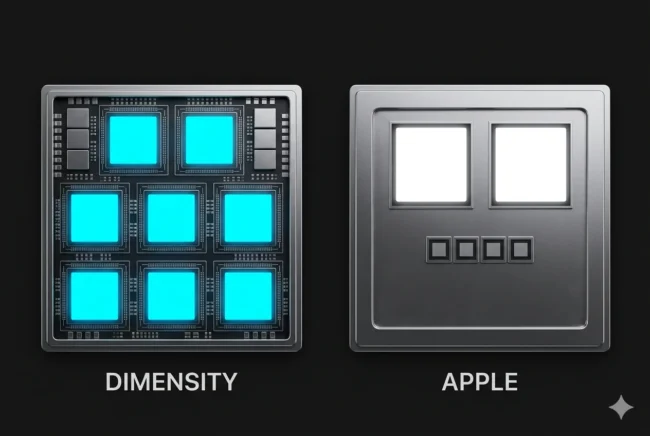
MediaTek’s “All-Big-Core” Brute Force: As we detailed previously, MediaTek has completely abandoned small, high-latency efficiency cores. The Dimensity 9600 utilizes a massive 2+3+3 layout (two 5.0GHz Ultra cores, plus six high-performance cores). When a heavy multi-threaded task (like 4K video rendering or complex emulation) is initiated, MediaTek simply throws eight massive, high-power cores at the problem.
Apple’s Conservative 2+4: Apple is rigidly sticking to its traditional 6-core layout for the A19 Pro—two high-performance cores and four efficiency cores. While this architecture is incredible for battery life during light tasks (scrolling, messaging), it physically lacks the sheer volume of arithmetic logic units (ALUs) necessary to keep up with MediaTek’s 8-core behemoth under heavy, sustained load.
The TSMC 2nm Equalizer: Both chips are utilizing TSMC’s bleeding-edge 2nm N2P process. In the past, Apple enjoyed a full-node advantage by buying up TSMC’s earliest capacity. In 2026, the playing field is level. Without a manufacturing advantage, Apple’s 6-core design is simply outgunned by MediaTek’s 8-core design.
The LPDDR6 Memory Bottleneck
Raw CPU compute is useless if the processor is starved for data. In 2026, the transition to next-generation memory standards is severely penalizing Apple’s conservative roadmap.
MediaTek’s Bandwidth Advantage: The Dimensity 9600 is fully integrated with LPDDR6 memory, capable of speeds up to 14,400 MT/s. This massive pipeline allows the 8 big cores to constantly pull data without stalling.
Apple’s LPDDR5X Stagnation: Supply chain reports strongly suggest Apple is keeping the iPhone 18 Pro chained to LPDDR5X memory. This artificial bottleneck severely limits the A19 Pro’s ability to feed its cores during complex, memory-intensive tasks like localized AI generation or heavy 3D rendering.
The NPU and AI Implications
The multi-core advantage isn’t just about synthetic benchmark scores; it translates directly into the defining feature of 2026/2027 smartphones: localized Artificial Intelligence.
SME2 vs. Neural Engine: MediaTek’s implementation of the second-generation Scalable Matrix Extension (SME2) combined with its dual NPUs is specifically designed to leverage the massive multi-core CPU layout for hybrid AI processing.
Apple Intelligence Limitations: Apple’s localized AI efforts rely heavily on the dedicated 16-core Neural Engine. However, when tasks require “spillover” processing from the NPU to the CPU (such as complex semantic parsing), the A19 Pro’s four small efficiency cores simply cannot process the data as fast as the Dimensity 9600’s massive array of performance cores.
The Real-World Impact: For power users, this means a Dimensity 9600-equipped Android device will likely generate local text (LLMs) or edit photos via AI significantly faster than the iPhone 18 Pro, fundamentally shifting the narrative of which ecosystem offers the superior “smart” experience.
The Sustained Performance Question
While MediaTek dominates the peak multi-core burst benchmarks, the final battleground will be sustained thermal management.
The Heat of 8 Big Cores: Running eight massive cores at high frequencies generates immense thermal density. While TSMC’s 2nm node is efficient, Android manufacturers will need robust vapor chamber cooling to prevent the Dimensity 9600 from throttling after 10 minutes of intense load.
Apple’s Thermal Constraint: The iPhone has historically struggled with sustained cooling, relying heavily on the efficiency of the A-series chip rather than massive internal heatsinks. If the A19 Pro is forced to run its 2 performance cores at maximum frequency to compete, it may actually throttle faster than the Dimensity 9600 simply due to the physical limitations of the iPhone’s chassis.
Final Verdict: The End of the “Apple Tax” Justification
For years, the premium price of an iPhone was partially justified by the undeniable superiority of its silicon. The Apple A-series was the undisputed king of mobile computing. The Dimensity 9600 shatters that reality.
By leveraging TSMC’s 2nm node to its absolute physical limits and abandoning weak efficiency cores, MediaTek has engineered a processor that doesn’t just compete with Apple—it overwhelmingly defeats it in multi-threaded throughput.
If you are a power user deciding between a 2026 Android flagship and the iPhone 18 Pro, the benchmark data is clear: the Dimensity 9600 is the superior engine for heavy, localized compute. The era of Apple’s unquestioned silicon dominance is officially over.