AMD’s GLBE Leak: How Zen 6 Will Finally Fix Multi-CCD Gaming Stutter
For years, PC enthusiasts have accepted a frustrating compromise when building high-end workstations that double as gaming rigs. Buying a massive, 16-core dual-CCD AMD Ryzen processor meant dealing with the dreaded “inter-core latency.” When a game engine accidentally split its rendering threads across two physically separate chiplets (CCDs), the data had to travel across the Infinity Fabric, resulting in catastrophic latency spikes, frame-time inconsistencies, and noticeable stuttering.
Historically, AMD’s solution has been a software band-aid: utilizing the Xbox Game Bar to forcefully “park” the second CCD while gaming. But as we look toward the 2026/2027 release of the Zen 6 architecture (codenamed “Morpheus”), the days of software hacks are over.
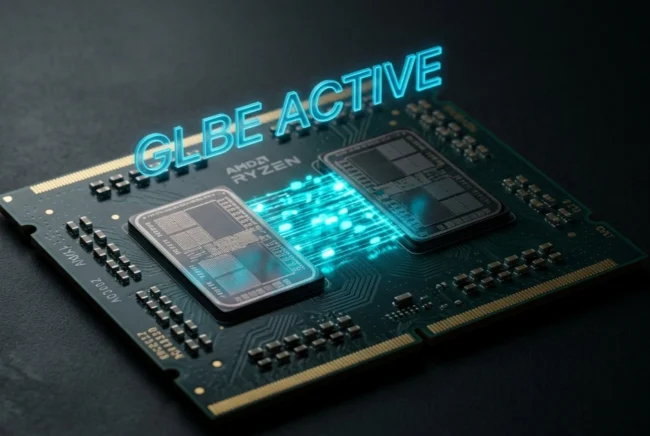
A highly technical leak from AMD’s Platform Quality of Service (PQOS) documentation has revealed a new hardware-level feature: GLBE (Global Bandwidth Enforcement). Combined with a radical redesign of the physical interconnects, Zen 6 is poised to deliver a “latency revolution.”
Here is the comprehensive, deep-dive breakdown of the GLBE leak, the new 12-core CCDs, and how AMD is finally curing multi-CCD gaming stutter.
The Core Issue: Why Dual-CCD CPUs Stutter in Games
To understand the brilliance of GLBE, you must first understand why processors like the Ryzen 9 7950X or 9950X suffer in heavily threaded game engines compared to their single-CCD siblings (like the 7800X3D).
The Infinity Fabric Bottleneck: In a multi-CCD Ryzen chip, the two Core Complex Dies are physically separated. When Thread A on CCD-1 needs data sitting in the L3 cache of CCD-2, the request must travel out of the first chiplet, across the Infinity Fabric on the motherboard substrate, through the I/O die, and into the second chiplet. This massive physical distance introduces severe nanosecond delays.
Bandwidth Starvation: Modern AAA games (especially unoptimized Unreal Engine 5 titles) push massive amounts of texture geometry and physics calculations. If background operating system tasks or secondary game threads on the second CCD suddenly saturate the external memory bandwidth, the primary render thread on the first CCD is “starved” of data, causing the GPU to wait. This wait is visually experienced as a frame-time spike or a stutter.
The Flawed Software Fix: AMD’s current Core Parking technology relies on the Windows Scheduler and Xbox Game Bar whitelists to effectively shut down the second CCD when a game launches. While this prevents cross-CCD latency, it means you are paying top dollar for a 16-core processor only to game on 8 of them, completely wasting the silicon execution units.
The GLBE Leak: Hardware-Level Traffic Control
The leaked AMD64 Zen 6 PQOS Extensions document details a feature that fundamentally changes how the processor manages data traffic across different chiplets. Global Bandwidth Enforcement (GLBE) is a hardware-level traffic controller for L3 external bandwidth.
Cross-Domain QoS: GLBE allows the system software to create a “Control Domain” spanning multiple physically separate CCDs (QOS Domains). This means the processor can explicitly manage and police how much bandwidth every single core is allowed to request, regardless of which chiplet it lives on.
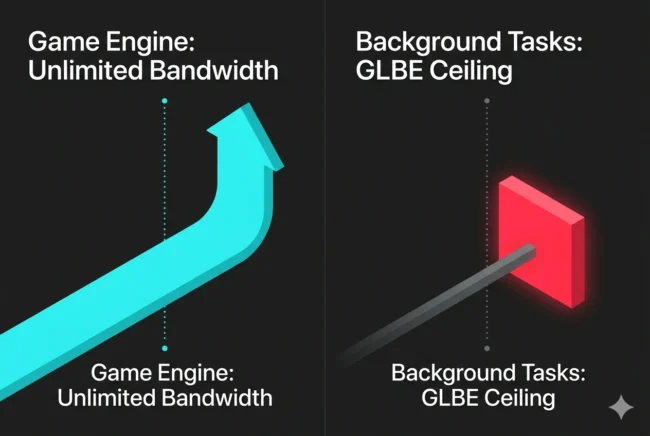
Protecting the Game Thread: In practical terms, GLBE means the Windows Scheduler can flag the primary gaming threads as “Unlimited Bandwidth,” while strictly throttling background tasks (like Discord, OBS recording, or Windows updates) running on the second CCD. The background tasks are physically prevented from saturating the interconnect, guaranteeing the game engine always has priority access to the memory controller.
Eliminating Frame Pacing Issues: By guaranteeing that the memory bandwidth pool is never fully drained by rogue background threads, GLBE stabilizes the data flow to the GPU. This directly translates to flawless 1% and 0.1% low framerates, permanently eliminating the micro-stutters that plague current multi-CCD chips.
The “Bridge Die” Interconnect: Physical Latency Reduction
Software traffic control via GLBE is only half of the Zen 6 solution. AMD is also completely overhauling the physical pathways connecting the chiplets.
Abandoning the Substrate Trace: Since Zen 2, AMD has connected CCDs to the I/O die using microscopic copper traces routed through the organic package substrate. While cheap to manufacture, this method introduces inherent latency due to electrical resistance and physical distance.
The Advanced Bridge Die: Leaks suggest Zen 6 will utilize an advanced “Bridge Die” packaging technology, likely leveraging TSMC’s localized silicon interconnects. Instead of routing data down into the substrate, the CCDs will communicate through an ultra-fast, high-density silicon bridge sitting immediately beneath or adjacent to the chiplets.
Gigabyte-per-Second Uplifts: This localized silicon bridge drastically widens the data pipeline. It allows for immensely faster inter-CCD communication speeds. When an engine thread inevitably does cross from CCD-1 to CCD-2, the latency penalty will be virtually indistinguishable from a single-chiplet operation, masking the multi-die nature of the processor from the game engine entirely.
The 12-Core CCD Paradigm Shift
Perhaps the most brute-force solution to multi-CCD stutter is simply ensuring that games never need to cross over to a second CCD in the first place. Zen 6 achieves this via extreme architectural density.
TSMC 2nm N2P Node: By migrating the “Morpheus” architecture to TSMC’s bleeding-edge 2nm process node, AMD can drastically shrink the size of the individual Zen 6 logic gates without triggering unmanageable thermal throttling.
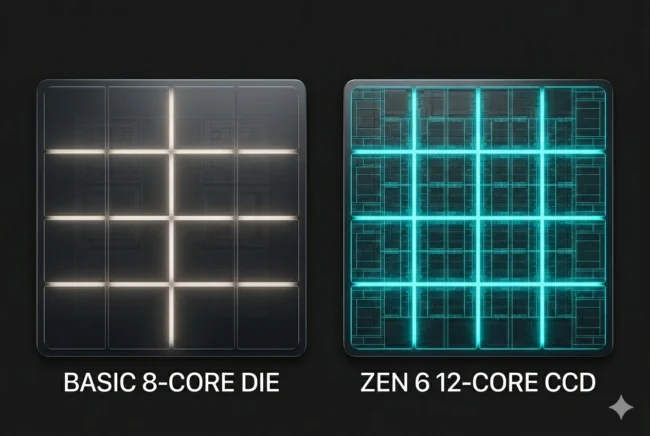
50% More Cores Per Die: This extreme density allows AMD to pack 12 physical cores into a single CCD, up from the historical 8-core limit that has defined Ryzen since its inception.
The Single-CCD Sweet Spot: For PC builders, a 12-core single-CCD processor (potentially the Ryzen 7 10800X) will become the ultimate gaming chip. Modern game engines are only just beginning to saturate 8 physical cores. With 12 cores localized on a single die, the game engine, the background apps, and the streaming software can all run concurrently without ever needing to communicate across a bridge die.
Massive 48MB Base L3 Cache: To feed these 12 cores, the base L3 cache per CCD is reportedly expanding from 32MB to a massive 48MB. Even before factoring in future 3D V-Cache variants, the standard Zen 6 chip will hold significantly more geometry and AI logic directly on the die, drastically reducing reliance on slower system DDR5 memory.
What This Means for 2027 PC Builds
The convergence of GLBE bandwidth enforcement, ultra-low latency bridge dies, and 12-core single-CCD layouts represents a total victory for the enthusiast desktop market.
The True “Do It All” CPU: For the first time, buying a dual-CCD flagship (like the rumored 24-core Ryzen 9 10950X) will not come with a gaming penalty. You will get extreme, desktop-crushing multi-threaded rendering performance for productivity workflows, while GLBE and the Bridge Die ensure the chip plays 1440p and 4K games with the exact same buttery-smooth 1% lows as a dedicated single-CCD gaming chip.
Say Goodbye to Core Parking: PC builders will no longer need to rely on the clunky Xbox Game Bar integration, custom power plans, or BIOS-level core parking. The silicon will intelligently and physically route traffic to prevent starvation, working flawlessly out of the box regardless of background application load.
Final Verdict: The End of the Stutter Era
The “latency revolution” promised by Zen 6 is not just marketing hype; it is deeply rooted in highly technical physical hardware changes. For generations, Intel advocates have accurately pointed out that monolithic dies offer smoother frame pacing than sprawling chiplet designs. With the integration of Global Bandwidth Enforcement, AMD is finally closing that architectural gap.
By hardcoding memory bandwidth priority directly into the silicon logic, Zen 6 ensures that the graphics engine is never left waiting for critical data. If you are a power user heavily sensitive to frame-time stutters in competitive shooters or heavy AAA open-world titles, the late-2026/2027 Zen 6 launch is the uncompromised generational leap you have been waiting for.