2026 RAM Crisis: Why AI is Making Your Next Mobile Flagship 50% More Expensive
The smartphone industry has hit a financial wall. For years, the consumer upgrade cycle was predictable: a slightly faster processor, a brighter display, and a marginally better camera sensor at roughly the same price point. But as we move through 2026, the baseline cost of buying a premium Android device has skyrocketed. If you were planning to purchase a next-generation mobile flagship, prepare for a severe case of sticker shock.
While manufacturers love to blame the rising costs of bleeding-edge 2nm and 3nm processor nodes, the true culprit hiding in the bill of materials (BOM) is system memory. The explosive rise of “Agentic AI”—smartphones running continuous, autonomous background AI models natively on the hardware—has triggered a global semiconductor panic.
We are officially living through the 2026 RAM Crisis. To keep these advanced local AI models from crashing, your next phone doesn’t just need more RAM; it needs a fundamentally different, astronomically expensive grade of memory. Here is the comprehensive, deep-dive breakdown of the memory shortage, the architectural demands of localized AI, and why RAM is making mobile flagships up to 50% more expensive.
The Death of the 8GB Baseline
For nearly half a decade, 8GB of RAM was considered the sweet spot for a standard flagship smartphone. It was more than enough to handle aggressive app multitasking, capture 8K video, and run heavy mobile games. Local AI has completely destroyed that standard.
The Massive Footprint of Local LLMs
The VRAM Requirement: Integrated graphics and Neural Processing Units (NPUs) do not have their own dedicated VRAM like a desktop graphics card; they must carve out a massive chunk of the smartphone’s system RAM to store data.
The Quantization Bottleneck: A standard, highly capable Large Language Model (LLM) compressed (quantized) down to 4-bits still requires a minimum of 4GB to 6GB of memory just to sit idle in the system cache.
The OS Chokehold: When you add the 4GB to 5GB of RAM required purely to run the Android operating system and keep standard apps like WhatsApp or Google Maps in the background, an 8GB phone is completely maxed out before you even execute a single AI prompt.
Turning the “Budget” Tier into a Myth
The 16GB Minimum Mandate: To ensure that a 2026 flagship can successfully run background AI features without forcefully closing the user’s active applications, manufacturers have been forced to establish 16GB of RAM as the absolute baseline.
The 24GB Ultra Tier: Premium “Ultra” models are aggressively moving to 24GB or even 32GB configurations. This sudden, industry-wide doubling of memory capacity requirements has caught the semiconductor supply chain completely off guard, driving global wholesale memory prices to record highs.
Unpacking Agentic AI and the LPDDR5X-9600 Requirement
The price spike isn’t just driven by the sheer quantity of gigabytes being stuffed into the chassis; it is fundamentally dictated by the extreme speed requirements of 2026 AI software architectures.
The Shift from Cloud to Local Execution
The Latency Problem: Early AI features relied entirely on the cloud, sending your voice or text data to an external server and waiting for a response. This introduced immense network latency and serious data privacy concerns.
The Agentic AI Future: 2026 flagships rely on Agentic AI—background models that autonomously monitor your screen context, predict your workflows, and orchestrate complex local device actions without ever pinging an external server.
Why Bandwidth is the Real Bottleneck
Tokens Per Second: The speed at which an AI model generates a response is directly limited by how fast the processor can read the model’s weights from the system memory. This performance metric is measured in tokens per second.
The LPDDR5X-9600 Mandate: Standard LPDDR5X running at 6400 MT/s or 7500 MT/s is far too slow, causing local AI models to feel sluggish and stutter. To deliver a fluid user experience, 2026 flagships require bleeding-edge LPDDR5X running at a blistering 9600 MT/s.
Exorbitant Production Costs: Manufacturing memory capable of maintaining a stable 9600 MT/s data pipeline within a tightly packed mobile motherboard requires incredibly strict silicon binning and advanced thermal insulation. These specialized manufacturing complexities command a massive wholesale premium from memory suppliers like Samsung and SK Hynix.
The HBM Structural War: High-Bandwidth Memory Tricks Mobile
As smartphone manufacturers realize that standard LPDDR architecture is hitting a hard performance ceiling, a silent structural war has broken out regarding how memory is physically packaged inside the phone.
The On-Package Solution
Borrowing from Apple and Laptops: To completely eliminate data latency, mobile chip designers are experimenting with stacking or soldering memory modules directly alongside the primary processor die on a single substrate package.
The Destruction of Component Swapping: This highly integrated packaging methodology optimizes performance, but it represents a nightmare for manufacturing flexibility. If a single memory sector fails during factory testing, the entire expensive 2nm processor die it is attached to must be completely scrapped, driving up factory waste and consumer retail costs.
The LPDDR6 Transition Delays
The Next-Gen Blueprint: The industry’s long-term savior is next-generation LPDDR6 memory, engineered specifically to handle massive AI data paths with built-in power-saving mechanics.
The 2026 Stagnation: However, massive delays in establishing global JEDEC standards and shifting factory lines over to LPDDR6 mean the memory technology won’t see widespread deployment until late 2027. This leaves 2026 flagships trapped using highly tuned, heavily marking-up variants of older LPDDR5X technology.
The Supply Chain Monopoly: How Hynix and Samsung Hold the Cards
The RAM crisis is heavily amplified by an unyielding monopoly at the very top of the global semiconductor supply chain. Mobile OEMs are entirely at the mercy of just two corporate entities.
The Server vs. Mobile Tug-of-War
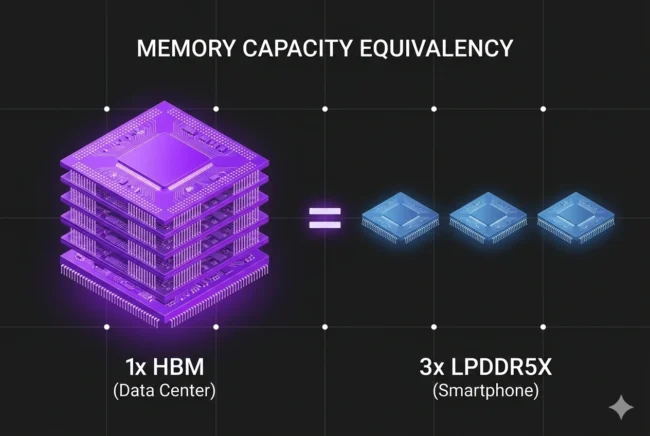
The Enterprise AI Gold Rush: Massive tech conglomerates (like NVIDIA, Microsoft, and Google) are buying up global factory allocations of High-Bandwidth Memory (HBM) for their data center AI clusters at an unprecedented rate.
Starving the Mobile Sector: Because enterprise data center chips carry massive profit margins, memory giants like SK Hynix and Samsung Semiconductor are actively reallocating their production lines away from consumer mobile RAM to satisfy enterprise demand.
The Artificial Shortage: This structural pivot leaves smartphone manufacturers fighting over a severely constrained pool of mobile memory wafers. With supply at a record low and demand doubled due to the 16GB minimum requirement, memory suppliers are dictating exorbitant prices, and smartphone brands have no choice but to pay up.
How the “RAM Tax” Triggers the 50% Retail Price Spike
When you trace the financial shockwave from the factory floor to the retail shelf, it becomes completely clear why the era of the $800 premium flagship is officially dead.
The Brutal Math of the Bill of Materials
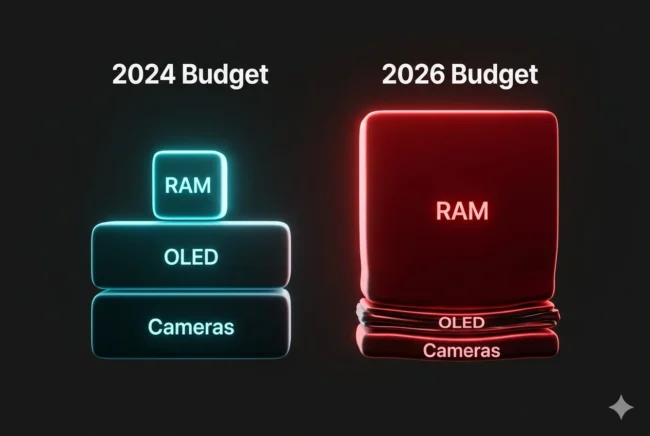
The Component Cost Explosion: In a traditional flagship, the memory typically accounted for roughly 8% to 10% of the phone’s total Bill of Materials. In 2026, a 16GB or 24GB cluster of ultra-high-speed LPDDR5X-9600 memory can consume up to 25% to 30% of the entire component budget.
Compounding Hardware Requirements: Stuffer more high-speed memory into a phone creates a cascade of secondary costs. Operating ultra-fast RAM creates significant electrical resistance and heat. To prevent the chip from thermal throttling, manufacturers must implement massive, highly expensive copper vapor chambers.
The Power Drain Tax: Running 24GB of RAM at 9600 MT/s draws a massive amount of continuous current. To preserve battery life, OEMs are forced to adopt expensive, next-generation Silicon-Carbon battery cells, further inflating the final assembly cost.
The Inevitable Consumer Pass-Through: Smartphone manufacturers cannot absorb these compounding hardware costs without obliterating their profit margins. Every single dollar added by the “RAM tax,” the cooling architecture, and the battery tech is passed directly to the end consumer, instantly transforming what used to be a $900 phone into a $1,350 investment.
The Verdict: The Price of Absolute Progress
The 2026 RAM Crisis is a stark reminder that software innovation never exists in a vacuum. The dream of owning a truly intelligent, autonomous digital assistant that operates entirely on your local hardware is an incredible paradigm shift, but it carries a harsh physical penalty.
We have officially moved past the era of cheap, iterative hardware refreshes. If you demand a smartphone capable of navigating the bleeding-edge world of local Agentic AI, you must look past the processor specs and recognize the hidden memory engine driving it. Until the global semiconductor supply chain stabilizes and LPDDR6 enters mass factory production, the “RAM tax” will remain a permanent, expensive reality of the modern mobile landscape.
Tech ReviewerFounder & Publisher: Sole operator and lead technical architect of MultiCore Performance
Areas of Expertise:
Silicon & Hardware Benchmarking: Firsthand performance testing and analysis of flagship processors specifically evaluating thermal and rendering capabilities in gaming and video editing workloads.,