The 18-Core Windows Laptop: Why Qualcomm’s Leaked “Project Glymur” Terrifies Intel
The transition to Windows on ARM was never supposed to happen this fast. When Qualcomm launched the original Snapdragon X Elite, the traditional x86 establishment—namely Intel and AMD—brushed it off as a first-generation experiment. They assumed Qualcomm would hit a thermal and architectural wall before posing a true threat to flagship laptops.
They were profoundly wrong.
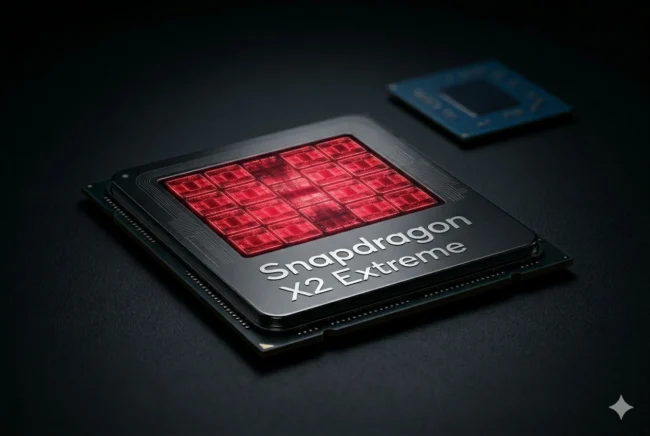
Recent supply chain manifests, import databases, and leaked internal benchmark data have blown the lid off Qualcomm’s highly classified second-generation silicon, codenamed “Project Glymur.” Officially set to debut in the first half of 2026 as the Snapdragon X2 Elite Extreme (SC8480XP), this processor is an absolute monster. It completely abandons the cautious approach of its predecessor, opting instead for a brute-force architectural layout designed to systematically dismantle Intel’s flagship Core Ultra lineup.
Featuring a staggering 18-core CPU, ultra-wide memory bandwidth, and an NPU that doubles the industry standard, Project Glymur is not just a processor refresh; it is an existential threat to the x86 laptop market. Here is the comprehensive, highly technical breakdown of the Project Glymur leaks, the raw benchmark data, and exactly why Intel is terrified of the 2026 Windows laptop landscape.
The Oryon V3 Architecture: An 18-Core Behemoth
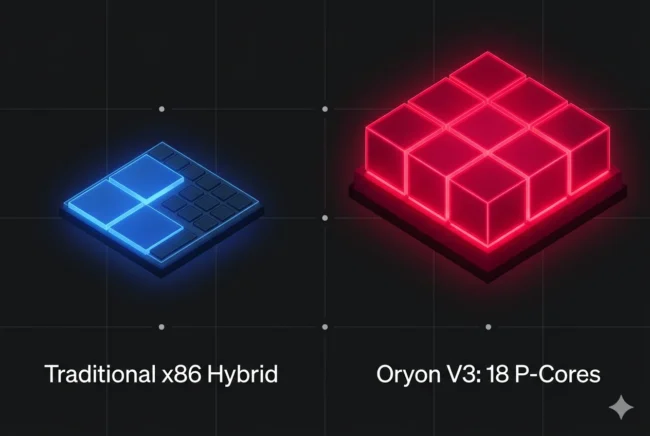
At the core of Project Glymur is a fundamental rejection of the standard mobile processor layout. While Intel continues to juggle complex hybrid architectures consisting of P-cores, E-cores, and LP E-cores, Qualcomm is doubling down on a unified, high-performance approach.
Abandoning the 12-Core Ceiling
The 18-Core Layout: The flagship Snapdragon X2 Elite Extreme will feature a jaw-dropping 18 physical CPU cores. This is a 50% increase over the 12-core ceiling of the first-generation X Elite. More importantly, leaks suggest these are all high-performance Oryon V3 cores derived from Qualcomm’s NUVIA acquisition, completely omitting weak efficiency cores.
The 5.0 GHz Threshold: Pushing an 18-core ARM processor in a laptop chassis is an engineering nightmare, yet Qualcomm has reportedly tuned the top two cores of the X2 Elite Extreme to hit a peak boost frequency of 5.0 GHz.
Scalable Matrix Extensions (SME): The new Oryon V3 architecture officially supports ARM Scalable Matrix Extensions. This is a massive hardware-level addition that accelerating complex matrix operations native to heavy scientific computing and localized AI workloads, an area where x86 has historically held an advantage with AVX-512.
The Thermal Envelope and Desktop Testing
The 120mm AIO Leaks: Perhaps the most terrifying aspect of Project Glymur for competitors is how it is being tested. Prominent hardware leakers uncovered testing manifests showing the SC8480XP running not just in thin-and-light laptop chassis, but on test benches equipped with full desktop-class 120mm All-In-One (AIO) liquid coolers.
Scaling Beyond Mobile: While the chip is destined for premium Windows laptops, testing it with desktop-tier thermals implies that Qualcomm is actively preparing to scale the X2 Elite architecture up to 65W+ TDPs. If Qualcomm releases a compact desktop or mini-PC variant of this 18-core chip, it will directly cannibalize Intel’s high-margin enterprise and creator workstation markets.
Memory and Bandwidth: The Apple Silicon Strategy
A processor packing 18 high-performance cores will instantly choke if it cannot fetch data fast enough. To solve this, Qualcomm is taking a page directly out of Apple’s M-Series playbook, aggressively widening the data pipeline and moving the memory onto the package.
The 192-Bit Memory Bus
System-in-Package (SiP) Design: Project Glymur abandons traditional motherboard-mounted RAM. The chip utilizes a System-in-Package design, embedding up to 64GB of ultra-fast LPDDR5X directly alongside the CPU logic die. This drastically reduces physical distance, cutting memory latency to near-zero.
9523 MT/s Speeds: The onboard memory is heavily binned to run at an astonishing 9,523 Megatransfers per second (MT/s).
The 192-bit Interface: Standard laptop chips generally rely on a 128-bit memory bus. By expanding the X2 Elite Extreme to a 192-bit bus, Qualcomm provides a massive, highway-sized pipeline capable of feeding the 18 CPU cores and the integrated Adreno GPU simultaneously without triggering a bandwidth bottleneck.
Why This Destroys the Intel Core Ultra
Intel’s upcoming Lunar Lake and Panther Lake architectures are highly capable, but their standard SKUs are often severely constrained by memory bandwidth. When an Intel user tries to run a heavy local LLM (Large Language Model) while simultaneously rendering 4K video, the x86 CPU and the integrated Arc GPU fight over the same limited memory pool, causing massive frame-time spikes.
Qualcomm’s 192-bit bus and SiP memory design entirely mitigate this bottleneck, allowing the X2 Elite Extreme to offer a level of sustained multitasking previously exclusive to the M-Series MacBook Pro.
The Benchmark Annihilation: Crushing x86
Specifications on a leaked shipping manifest are one thing, but actual performance numbers are what dictate the market. Early Geekbench 6.5 metrics surfacing from Qualcomm reference designs show a silicon architecture that is pulling away from the pack at an alarming rate.
Single-Core Supremacy
The 4,000 Point Barrier: Early leaks show the Snapdragon X2 Elite Extreme achieving a single-core score of roughly 4,080. For context, this completely shatters the first-generation X Elite (which scored around 2,900) and represents a massive 39% generational uplift.
Beating Arrow Lake: Intel’s premium Core Ultra 9 285H (Arrow Lake-H) struggles to break the 3,050 mark in the same test. Qualcomm is outperforming Intel’s finest mobile architecture by over 30% in single-threaded burst workloads, making the Windows UI, web browsing, and standard application launching feel noticeably faster on ARM.
Multi-Core Domination
The 18-Core Advantage: In the Geekbench 6.5 multi-core test, the 18 Oryon V3 cores flex their muscle, posting an incredible score of 23,491.
Doubling the Competition: This multi-core score doesn’t just beat Intel; it humiliates them. The Core Ultra 9 288V scores roughly 11,400. The Snapdragon X2 Elite Extreme is functionally delivering twice the multi-threaded rendering performance of Intel’s top-tier thin-and-light silicon. For video editors, 3D modelers, and software compilers, the performance delta is so vast it fundamentally alters the purchase decision.
The AI Engine: 85 TOPS and Copilot+
The defining software feature of Windows in 2026 is Microsoft’s deep integration of local, Agentic AI. The processor that handles these workloads the most efficiently will win the enterprise market. Project Glymur is engineered specifically to monopolize this space.
The Hexagon NPU Overhaul
85 TOPS Baseline: The NPU inside the X2 Elite Extreme is rated for a massive 85 TOPS (Trillions of Operations Per Second). This is well above the Microsoft Copilot+ requirement of 40 TOPS, ensuring the laptop is future-proofed for next-generation generative AI tasks.
Geekbench AI Metrics: In localized AI inferencing tests (Geekbench AI 1.5), the X2 Elite Extreme reportedly scored an 88,615. This allows the processor to effortlessly run complex 8-billion parameter models locally without ever waking up the power-hungry CPU or GPU cores.
The Power Draw Reality: Intel processors can technically run heavy AI models, but they must utilize the GPU to do so, draining the battery in under two hours. Qualcomm’s 85 TOPS NPU can run the exact same models while drawing single-digit wattage, giving users true all-day battery life even while running continuous background AI tasks.
The Verdict: Intel’s Worst Nightmare Realized
For decades, Intel’s defense against ARM processors was software compatibility. “Sure, it’s efficient, but it can’t run native x86 Windows apps.” With Microsoft’s Prism translation layer maturing rapidly, that defense has completely evaporated.
The Snapdragon X2 Elite Extreme—Project Glymur—strips away Intel’s last remaining advantage: raw, brute-force performance. By packing 18 high-performance Oryon V3 cores, 64GB of on-package memory running on a massive 192-bit bus, and an industry-leading NPU into a highly efficient ARM architecture, Qualcomm has built the ultimate mobile processor.
If these leaked benchmarks translate to retail hardware in the first half of 2026, Intel isn’t just looking at a minor loss of market share. They are facing an architectural reckoning. The 18-core Windows laptop has arrived, and it speaks ARM.