The desktop PC building community has operated under a cynical, but largely accurate, assumption for the better part of a decade: Intel changes its CPU sockets more often than most enthusiasts change their thermal paste. For years, the “Blue Team” strictly adhered to a rigid, two-generation lifespan for its motherboards. You buy a flagship board, you get one architectural refresh, and then the platform is declared dead, forcing you to buy an entirely new motherboard if you want the next tier of performance.
Meanwhile, AMD built immense goodwill—and staggering market share—by supporting the legendary AM4 socket for half a decade, and applying that same longevity to the current AM5 platform.
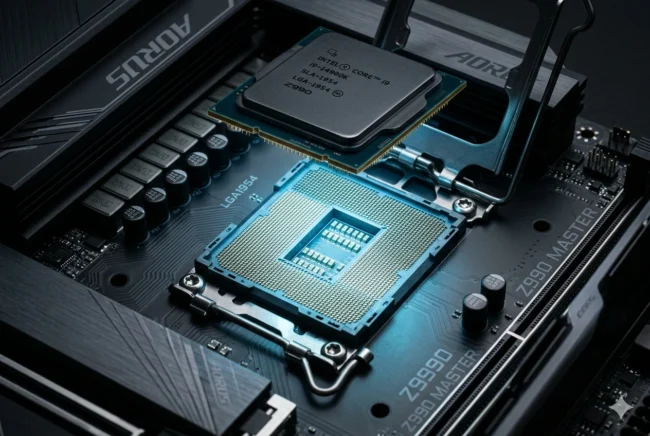
But as the calendar rolls deep into 2026, the landscape is experiencing a massive seismic shift. Supply chain leaks, motherboard schematics, and direct statements from Intel executives confirm that with the upcoming Nova Lake architecture, the old rules are dead. Intel is introducing the LGA-1954 socket, and for the first time since the LGA 775 days of the Core 2 Quad, they are designing a platform built to survive. Here is the comprehensive, highly technical breakdown of the LGA-1954 architecture, the new 900-series chipsets, and why Intel is finally adopting AMD’s long-term socket strategy.
The End of the Two-Generation Limit
To understand the magnitude of this shift, we must look at Intel’s recent, highly fragmented socket history. The LGA 1700 platform stretched admirably from Alder Lake to Raptor Lake Refresh, but the subsequent LGA 1851 socket (housing the Arrow Lake processors) is already facing an agonizingly short lifespan.
With LGA-1954, Intel is executing a complete strategic pivot aimed directly at the DIY PC builder.
Mimicking the AM4 and AM5 Blueprint
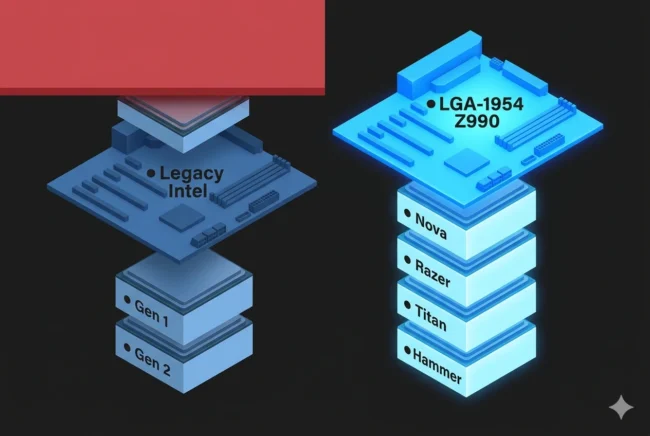
The Four-Generation Roadmap: According to heavily corroborated leaks from hardware insiders and supply chain manifests, Intel intends for the LGA-1954 socket to support up to four distinct CPU generations.
The Architecture Lineup: If the roadmaps hold true, a user purchasing an ultra-premium Z990 motherboard in early 2027 for a Nova Lake processor will eventually be able to drop in future Razer Lake, Titan Lake, and potentially Hammer Lake CPUs without ever needing to unseat their motherboard or reinstall Windows.
The Executive Confirmation: This is not just blind speculation. Intel VP Robert Hallock recently confirmed in interviews that the company is actively listening to enthusiast feedback regarding socket fatigue. While carefully avoiding specific product names, he acknowledged that a future where Intel sockets support significantly more CPU generations is the definitive path forward.
Winning Back the DIY Market
The Upgrade Math: Currently, an enthusiast building a high-end system faces a brutal financial reality with Intel. Upgrading to a new processor architecture inherently means a $250 to $500 tax to replace the motherboard. By adopting AMD’s drop-in upgrade philosophy, Intel dramatically lowers the barrier to entry for their future silicon.
Combating the X3D Threat: AMD’s Ryzen 7 7800X3D and newer 9800X3D chips dominate the gaming market largely because users know they can invest heavily in an AM5 motherboard and simply upgrade the chip later. Intel’s multi-generation LGA-1954 commitment is a direct, calculated maneuver to neutralize AMD’s platform value advantage.
Decoding the LGA-1954 Architecture
A socket designed to last for four generations cannot just be a simple pin-bump. It must be engineered with massive electrical and data bandwidth overhead to accommodate future technologies that haven’t even been finalized yet. The sheer scale of LGA-1954 reflects this necessity.
The 900-Series Chipset Stack
The Tiered Rollout: The launch of Nova Lake will coincide with an entirely new motherboard ecosystem. The leaked stack includes the flagship Z990, the high-end Z970, the workstation-class W980, the corporate Q970, and the mainstream B960.
Massive PCIe Expansion: To future-proof the platform, the 900-series chipsets are expanding the data superhighway. Leaks point to motherboards supporting up to 48 total PCIe lanes, allowing enthusiasts to populate multiple PCIe 5.0 M.2 NVMe SSDs alongside next-generation graphics cards without suffering from lane-splitting bottlenecks.
The B-Series Overclocking: Interestingly, rumors suggest the B960 chipset may retain memory overclocking capabilities, ensuring that budget-conscious builders can still push their high-speed DDR5 kits to their absolute limits without paying the Z-series premium.
The 2L-ILM (Two-Lever Independent Loading Mechanism)
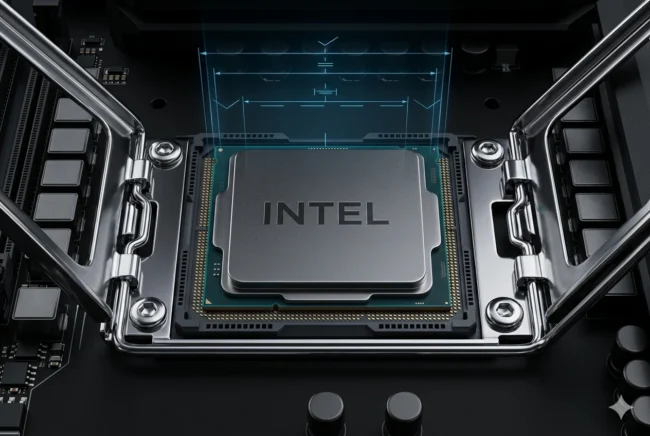
Solving the Bending Crisis: One of the most infamous flaws of the LGA 1700 socket was uneven mounting pressure, causing the CPU’s Integrated Heat Spreader (IHS) to physically warp and degrade cooling performance. Enthusiasts were forced to buy aftermarket contact frames to fix Intel’s design flaw.
The Server-Grade Solution: For the premium Z990 and W980 motherboards, Intel is introducing the 2L-ILM. Taking inspiration from their massive enterprise LGA 2011 Xeon sockets, this mechanism utilizes two separate retention levers flanking the CPU.
The Dual-Compute Tile and Extreme Power Delivery
The primary reason LGA-1954 needs an over-engineered socket layout and the new 2L-ILM mechanism is the sheer brute force of the Nova Lake silicon it will house. Intel is abandoning traditional monolithic scaling in favor of massive, parallel tile architectures.
The 52-Core Behemoth
Unprecedented Core Counts: The flagship Nova Lake-S desktop processor is rumored to pack an astonishing 52 total cores. This includes up to 16 Coyote Cove P-Cores, 32 Arctic Wolf E-Cores, and 4 ultra-low-power LP-E cores located on a separate SoC tile.
The bLLC Cache: To combat AMD’s 3D V-Cache dominance, Intel is implementing up to 288 MB of “bLLC” (Base-Level Cache) integrated directly into the packaging. This massive pool of high-speed memory ensures that the 52 cores are never starved for data during heavy gaming or emulation workloads.
The 700W Thermal Ceiling
Breaking the Power Limits: Providing electricity to 52 cores and a massive cache pool requires unprecedented voltage regulation. Current Arrow Lake CPUs peak around 250W to 425W depending on the extreme power profiles.
The Extreme Profile: Leaks suggest that the LGA-1954 socket is designed to handle dual-compute tile Nova Lake SKUs that can draw a theoretical, momentary peak of over 700 Watts under absolute maximum synthetic load. While normal gaming will draw significantly less, the motherboard’s VRMs (Voltage Regulator Modules) and the 1954 socket pins must be physically robust enough to survive these violent electrical spikes without melting.
Cooler Compatibility and the Cost of Upgrading
Historically, changing the CPU socket meant fundamentally changing the physical dimensions of the processor, resulting in broken compatibility with existing AIO liquid coolers and massive air towers. In a rare display of consumer-friendly engineering, Intel is avoiding this trap.
The 45 x 37.5mm Footprint
The Thermaltake Leak: A recently leaked product installation manual from cooling giant Thermaltake officially confirmed that the physical dimensions of the LGA-1954 package are exactly 45 x 37.5mm.
Cross-Generational Mounting: This measurement is identical to the current LGA 1851 socket, and heavily mirrors the older LGA 1700 footprint. This means that if you invested $200 in a premium 360mm AIO liquid cooler for your 13th Gen or 14th Gen build, you will be able to bolt it directly onto your 2027 Nova Lake system.
Preventing E-Waste: By retaining cooler compatibility while expanding socket longevity, Intel is significantly reducing the hidden costs of PC building and preventing millions of perfectly functional copper heatsinks from ending up in landfills.
The DDR5 vs DDR6 Dilemma
If there is one potential vulnerability in Intel’s master plan for a four-generation socket, it lies in the volatile timeline of global system memory standards.
The Timing Mismatch
The Arrival of DDR6: The LGA-1954 socket is scheduled to launch in early 2027. This places it dangerously close to the projected enterprise rollout of next-generation DDR6 memory in 2028/2029.
The DDR5-8000+ Commitment: For the LGA-1954 socket to survive four CPU generations, it cannot rely on early, slow DDR5. Motherboard manufacturers are heavily optimizing the signal traces on Z990 and Z970 boards to natively support blistering DDR5-8000 to DDR5-10000 MT/s speeds right out of the box.
Bridging the Gap
By ensuring the socket can push current DDR5 technology to its absolute physical limits, Intel can provide the massive bandwidth required by Razer Lake and Titan Lake without forcing users to adopt hyper-expensive, first-generation DDR6 modules. The LGA-1954 platform will serve as the ultimate, highly-refined swansong for the DDR5 era, offering stability and extreme speeds while the industry transitions.
The Verdict: A Necessary Evolution
For the last five years, Intel has fought a grueling war of attrition against AMD’s superior platform value. You can build the fastest processor on the planet, but if a consumer knows the motherboard it sits in will be obsolete in 18 months, they will logically spend their money elsewhere.
The confirmation of the LGA-1954 socket’s longevity is the most important desktop PC news of the decade for the Blue Team. By pairing the insane 52-core potential of the Nova Lake architecture with a dual-lever mounting system, retaining cooler compatibility, and committing to a four-generation lifespan, Intel is finally giving PC builders a reason to invest long-term.
If they can successfully execute this roadmap, the LGA-1954 platform won’t just be an answer to AMD’s AM5 socket; it will be the foundation of Intel’s ultimate redemption in the DIY desktop market.