
Leak: Why the Snapdragon 8 Elite Gen 6 Pro Could Make 2027 Flagships Unaffordable
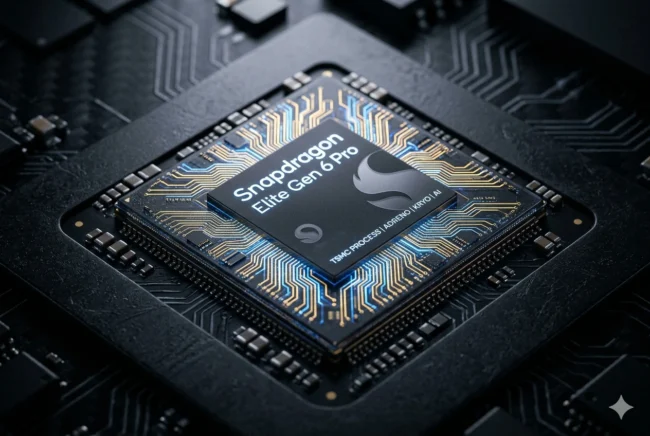
The semiconductor industry is buzzing with early reports regarding Qualcomm’s roadmap for 2027. While we are still navigating the current excellence of 2nm-adjacent technology, new leaks surrounding the Snapdragon 8 Elite Gen 6 Pro suggest a massive leap in performance—and an equally massive leap in price.
If the latest supply chain data is accurate, the “Golden Age” of the $999 flagship may officially come to an end.
The 2nm Precision: A Costly Engineering Marvel
The primary driver behind the projected price hike is the transition to TSMC’s refined 2nm (N2P) process node. While 2nm promises a 15% performance boost and a 25% reduction in power consumption compared to the previous generation, the manufacturing complexity is unprecedented.
Why the “Gen 6 Pro” Costs More:

The “AI Tax” and Integrated AGI
By 2027, “AI features” will no longer be marketing gimmicks; they will be the core OS. The Snapdragon 8 Elite Gen 6 Pro is leaked to feature a dedicated Large Language Model (LLM) Accelerator directly on the die.
”The Gen 6 Pro isn’t just a processor; it’s a localized brain. It’s designed to run 30B+ parameter models locally without hitting the cloud. That level of NPU (Neural Processing Unit) density requires massive amounts of high-speed cache, which is incredibly expensive to produce.”
Projected Technical Specifications
| Feature | Snapdragon 8 Elite Gen 5 (2026) | Snapdragon 8 Elite Gen 6 Pro (2027) |
|---|---|---|
| Node Process | 3nm (N3P) | 2nm (N2P) |
| Primary Core | Oryon V4 (4.3GHz) | Oryon V5 (4.9GHz) |
| NPU Performance | 80 TOPS | 145+ TOPS |
| Memory Support | LPDDR6 | LPDDR6X (Ultra-Low Latency) |

The Manufacturer’s Dilemma: Samsung vs. Xiaomi vs. Sony
Smartphone OEMs (Original Equipment Manufacturers) are already feeling the heat. If Qualcomm raises the price of the Snapdragon 8 Elite Gen 6 Pro by the rumored 25–30%, brands will be forced to make a difficult choice:
Verdict: Is the Performance Worth the Premium?
For the average consumer, the sticker shock of 2027 flagships will be significant. However, for power users, the Snapdragon 8 Elite Gen 6 Pro represents a paradigm shift. We are looking at a chip capable of desktop-class multitasking, real-time generative video editing, and console-level gaming without a fan.
The leak serves as a warning: Start saving now. The 2027 flagship won’t just be a phone; it will be the most expensive—and powerful—computer you’ve ever carried in your pocket.