
The Hidden Downgrade in the Standard Snapdragon 8 Elite Gen 6 Nobody is Talking About
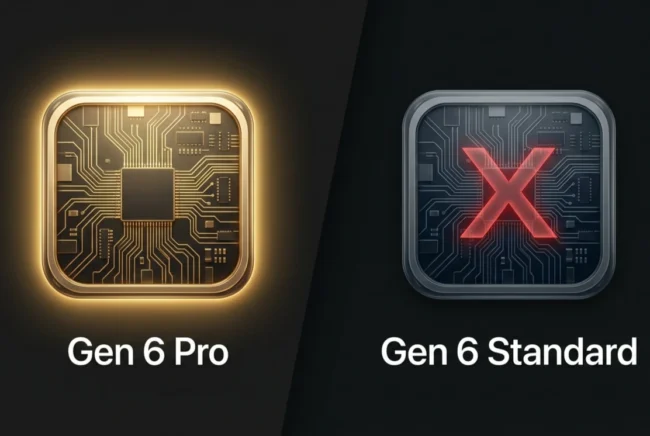
The semiconductor industry loves a shiny object. Right now, every leaked benchmark and supply chain rumor is hyper-focused on the jaw-dropping capabilities of Qualcomm’s upcoming Snapdragon 8 Elite Gen 6 Pro (SM8975). But amid the hype surrounding TSMC’s advanced 2nm node and desktop-class clock speeds, a deeply concerning narrative is being buried by the marketing machine.
If you are planning to buy a standard $999 flagship in 2027, you aren’t getting an “Elite” processor. You are getting the standard Snapdragon 8 Elite Gen 6 (SM8950)—a chip that has been mathematically and architecturally hobbled to protect the premium tier. Qualcomm is heavily adopting a rigid segmentation strategy, and the hardware compromises are severe.
The Artificial Bandwidth Ceiling
The most glaring downgrade in the standard Gen 6 is the memory controller. While the Pro variant makes the highly anticipated generational leap to LPDDR6 (pushing a blistering 14,400 MT/s), the standard SM8950 remains securely chained to older LPDDR5X technology.
This isn’t just a minor specification difference on a spec sheet; it is a fundamental architectural bottleneck that restricts the entire system.
For a processor launching in 2027, capping memory speeds at 8,533 MT/s is a deliberate castration designed to upsell consumers to the “Ultra” phone models

The Cache Deficit: A Latency Nightmare
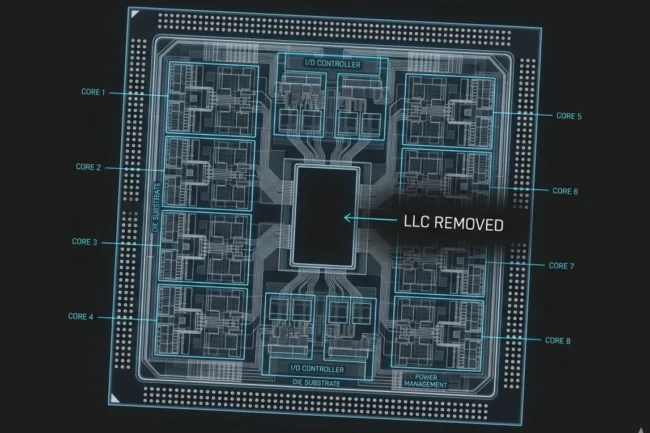
When a processor lacks raw memory bandwidth, it relies heavily on on-die cache to keep the CPU cores fed without hitting the system RAM. Unfortunately, Qualcomm has aggressively stripped the cache from the standard Gen 6 to further widen the performance gap.
The Pro variant features a dedicated 8MB Last Level Cache (LLC) sitting on top of the L2 cache, acting as a high-speed bridge for localized data. The standard Gen 6 completely drops this LLC
The GPU Compounding Effect
| Specification | Snapdragon 8 Elite Gen 6 (Standard) | Snapdragon 8 Elite Gen 6 Pro |
|---|---|---|
| System Cache (LLC) | None | 8MB |
| GPU GMEM | 12GB | 18GB |
| Memory Standard | LPDDR5X (8533 MT/s) | LPDDR6 (14400 MT/s) |
| Architecture Goal | Margin protection / Cost saving | Maximum localized throughput |
When the Adreno 845 runs out of its limited 12MB GMEM during heavy rendering or intensive emulation, it is forced to fetch data from the system RAM. Because that system RAM is the slower LPDDR5X, it creates a punishing latency loop. Frame rates will stutter under load, and the TSMC 2nm efficiency gains will be rapidly squandered as the memory controller works overtime
Sustained Performance vs. Burst Processing
Without the 8MB LLC buffer, the standard SM8950 will likely perform admirably in short, burst-oriented benchmark tests like Geekbench, giving the illusion of parity with the Pro chip. However, in real-world, sustained workloads—such as rendering a 4K video project, playing a complex 3D title at 120Hz, or utilizing heavy background AI tasks—the lack of cache will cause rapid performance degradation. The chip will be forced to continuously push data through a slower pipeline, generating excess heat and throttling the experience
The “Elite” Illusion
For years, the unspoken agreement with top-tier Android devices was simple: if your phone had a flagship Snapdragon 8-series chip, you had the absolute pinnacle of mobile silicon. There was no “Lite” version pretending to be the best.
The standard Snapdragon 8 Elite Gen 6 breaks that trust. By stripping away the LLC, shrinking the GPU cache, and severely bottlenecking the memory controller, Qualcomm has ensured that the SM8950 cannot deliver the blazing fast, uncompromising performance power users demand. It is an upper-mid-range chip masquerading under an “Elite” badge to justify the static $999 price tags of modern smartphones.
If you are a hardware enthusiast who demands perfectly optimized, lightweight execution without bloated load times or thermal throttling, the standard 2027 flagship is a trap. The true generational leap is locked behind the “Pro” paywall. Save your money, or prepare to pay the Ultra tax.