80 TOPS on a Budget: Why the Snapdragon X2 Plus Beats Intel Core Ultra 7
The 2026 laptop market has established a new baseline for what constitutes a “capable” machine. As local Artificial Intelligence moves from a novelty to a mandatory operating system requirement, the silicon powering the $799 to $1,299 mainstream laptop segment is undergoing a radical transformation.
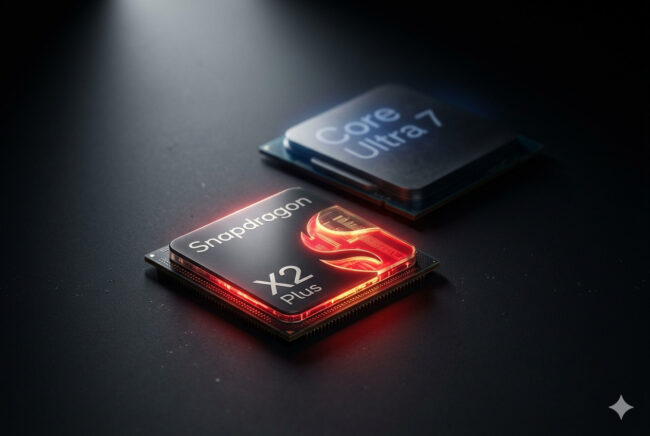
At the forefront of this shift is Qualcomm’s newly released Snapdragon X2 Plus. Positioned directly against Intel’s upcoming Panther Lake Core Ultra 7 Series 3 processors, the X2 Plus is executing a devastating flanking maneuver. By bringing flagship-tier NPU (Neural Processing Unit) performance to the mainstream market, Qualcomm is rewriting the value proposition for Copilot+ PCs.
For the power user, developer, and everyday professional, here is the comprehensive breakdown of why the Snapdragon X2 Plus fundamentally outclasses the Intel Core Ultra 7 in the 2026 budget tier.
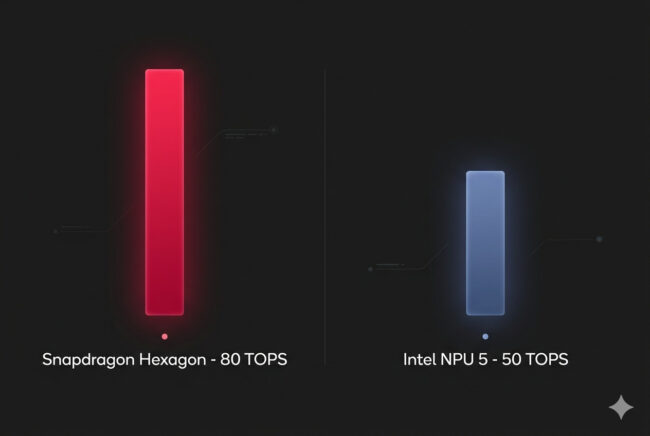
The NPU War: 80 TOPS vs. 50 TOPS
The defining metric for mainstream laptops in 2026 is no longer raw CPU clock speeds; it is INT8 AI inferencing throughput. In this arena, Qualcomm is offering unprecedented silicon generosity.
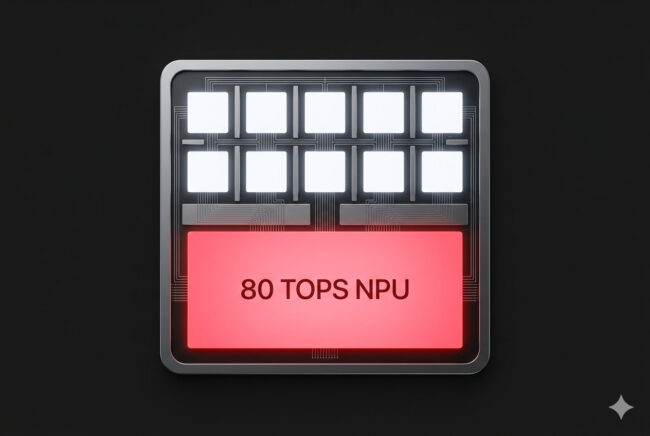
The Hexagon Advantage: Qualcomm has chosen to equip the budget-focused Snapdragon X2 Plus with the exact same Hexagon NPU found in its $2,000 Elite Extreme tier. This delivers a massive 80 Trillion Operations Per Second (TOPS) directly to the mainstream user.
Intel’s Panther Lake Deficit: Intel’s upcoming Core Ultra 7 processors (such as the 356H and 366H) utilize the new NPU 5 architecture. While highly efficient, it peaks at 50 TOPS. To reach higher AI compute numbers, Intel relies on roping in the integrated Arc Xe3 GPU, which drains battery life significantly faster than a dedicated NPU.
Agentic AI Performance: Modern Copilot+ features rely on “Agentic AI”—background tasks that constantly monitor, summarize, and translate data without user prompting. The 80 TOPS throughput of the X2 Plus ensures these models run completely transparently, whereas the Core Ultra 7’s 50 TOPS limit will force the system to aggressively juggle resources, leading to noticeable UI stuttering.
Future-Proofing Local LLMs: Running a quantized 8-billion parameter Large Language Model (LLM) locally requires immense NPU overhead. The 60% NPU advantage held by the Snapdragon X2 Plus guarantees that the laptop will remain functional as Windows OS AI requirements inevitably bloat over the next three years.
The Architectural Reality: 3nm vs. 18A
The manufacturing nodes dictate the thermal efficiency of these chips, and the benchmarks reveal a stark contrast in how these processors handle sustained workloads.
Oryon Gen 3 on TSMC 3nm: The Snapdragon X2 Plus (specifically the 10-core X2P-64-100 variant) utilizes a refined 3nm fabrication process. Qualcomm’s internal telemetry and independent Geekbench 6.5 tests confirm it achieves up to 3.5x the CPU performance of competing Intel Core Ultra 7 chips at ISO-power (identical wattage).
The Efficiency Ceiling: To match the peak multi-core performance of the 10-core Snapdragon X2 Plus, Intel’s processors reportedly require over 4.4x more wattage. In a thin-and-light laptop chassis, this translates directly to screaming fans, thermal throttling, and degraded battery life for the Intel machine.
The “All-Prime” 6-Core Option: Even the lower-tier 6-core Snapdragon X2 Plus (X2P-42-100) utilizes a pure “Prime Core” layout peaking at 4.0GHz. By abandoning weak efficiency cores, Qualcomm ensures that when a heavy burst workload is required, the execution is instantaneous and uncompromising.
Fanless Viability: Because the Snapdragon X2 Plus can deliver blazing-fast web rendering and code compiling at sub-15W power draws, OEMs can build completely fanless, silent $800 laptops that perform like $1,500 workstations. Intel’s Panther Lake H-series requires active, audible cooling to maintain its 25W base / 80W turbo envelopes.
The Memory Bandwidth Superiority
AI processing is heavily memory-bound. If the NPU cannot fetch data from the RAM fast enough, the 80 TOPS rating becomes a useless theoretical number.
LPDDR5X at 9523 MT/s: The Snapdragon X2 Plus natively supports ultra-fast LPDDR5X memory running at 9,523 MT/s, delivering up to 152 GB/s of total bandwidth. This is a massive leap over the previous generation’s 8448 MT/s limit.
The Intel Bottleneck: While high-end Intel Core Ultra 7 Panther Lake chips support fast memory, lower-tier or budget implementations of the Core Ultra Series 3 often pair the chip with cheaper, slower RAM to meet the sub-$1,000 price point, artificially starving the NPU of necessary data throughput.
Unified AI Memory: Because the Hexagon NPU and the Adreno X2-45 GPU share this 152 GB/s pool efficiently, tasks like hardware-accelerated ray tracing and real-time video upscaling experience near-zero latency on the Qualcomm platform.
Media Engine and Connectivity
For content creators on a budget, the auxiliary silicon surrounding the CPU cores is often the deciding factor in a purchase.
AV1 Encoding Dominance: The Snapdragon X2 Plus has received a massive media engine upgrade, now supporting 4K 60fps and 8K 15fps AV1 encoding, alongside 8K 60fps decoding. This makes it a shockingly capable machine for high-resolution video editors and live streamers operating on battery power.
Wi-Fi 7 and 5G Integration: The integration of the FastConnect 7800 system ensures native Wi-Fi 7 and Bluetooth 5.4 support. More importantly, the X2 Plus supports the Snapdragon X75 5G modem, allowing OEMs to offer cellular-connected laptops at the $899 price point—a market segment Intel has historically struggled to service efficiently.
Display Output: The budget-friendly X2 Plus easily drives up to three simultaneous 4K displays at 144Hz via USB4 / DisplayPort 2.1, providing desktop-class workstation setups without requiring an expensive external dock.
Total Cost of Ownership
The true victory of the Snapdragon X2 Plus lies in its disruption of the premium pricing model.
The $799 Sweet Spot: Qualcomm is aggressively targeting the $799 to $1,299 segment with the X2 Plus. To get 80 TOPS of AI performance and multi-day battery life on an Intel platform, consumers would have to wait for top-tier, ultra-expensive SKUs that won’t see wide availability until later in 2026.
Enterprise Adoption: With native support for Microsoft Pluton, out-of-band remote manageability, and biometric presence detection, the X2 Plus is breaking Intel vPro’s monopoly in the budget enterprise sector.
The Verdict: Unmatched Lightweight Execution
Intel’s Core Ultra 7 Panther Lake series is a remarkable piece of engineering, but it is fundamentally built on a legacy x86 power curve. The Snapdragon X2 Plus represents the future of mobile computing: a ruthlessly efficient, ARM-based architecture that prioritizes AI throughput and battery life above all else.
If you are buying a mainstream laptop in 2026, do not pay a premium for an Intel badge that delivers 30 fewer TOPS and requires a cooling fan. The Snapdragon X2 Plus delivers the uncompromised, blazing-fast, and deeply integrated AI experience that the modern Windows 11 ecosystem demands, and it does so at a price that permanently alters the market landscape.
Tech ReviewerFounder & Publisher: Sole operator and lead technical architect of MultiCore Performance
Areas of Expertise:
Silicon & Hardware Benchmarking: Firsthand performance testing and analysis of flagship processors specifically evaluating thermal and rendering capabilities in gaming and video editing workloads.,

I doesn’t matter X2 series because it’s not such so helpful for us i think because of not proper optimization.