The OpenAI Smartphone Leak: Why Sam Altman Chose the Dimensity 9600 Over Snapdragon
The rumors surrounding OpenAI’s foray into consumer hardware have circulated for years, but late May 2026 has finally brought the concrete supply chain leaks the industry has been waiting for. The collaboration between OpenAI CEO Sam Altman and legendary former Apple designer Jony Ive—operating under the newly merged entity “io”—is moving beyond the prototype phase.
However, the biggest shock from analyst Ming-Chi Kuo’s latest report isn’t the device’s “app-less” interface or its ambient AI OS; it is the silicon powering it. OpenAI has reportedly bypassed Qualcomm’s highly anticipated Snapdragon 8 Elite Gen 6 lineup, choosing instead to co-develop their flagship AI device using the architecture of the MediaTek Dimensity 9600.
For a device attempting to redefine the smartphone and challenge the Apple/Google duopoly, opting for MediaTek is a massive statement. Here is the comprehensive breakdown of why the Dimensity 9600 is the perfect engine for the OpenAI phone, and why Qualcomm’s 2027 roadmap failed to meet Jony Ive’s stringent demands.
The “Open Resource” Requirement
Jony Ive’s design philosophy at Apple was rooted in absolute control over both hardware and software. Building a revolutionary AI device requires silicon that can be molded to the operating system, not the other way around.
MediaTek’s Customization Architecture: MediaTek has a long-standing initiative called the Dimensity 5G Open Resource Architecture. This allows OEMs (and partners like OpenAI) deeply customized, root-level access to tweak the CPU scheduler, NPU allocations, and image signal processing.
Qualcomm’s “Black Box” Approach: Qualcomm traditionally sells its Snapdragon chips as rigid, locked-down ecosystems. You buy the chip, you use their software layers. For a company like OpenAI building a ground-up “Agentic OS” that replaces traditional apps, Qualcomm’s rigid firmware restrictions were reportedly a massive friction point.
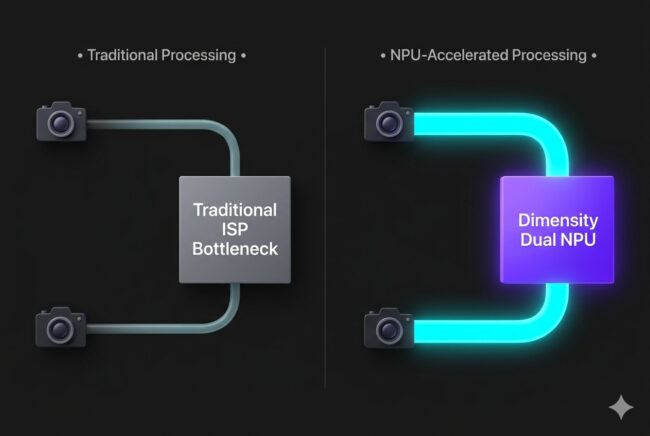
The ISP Bypass: The OpenAI device is heavily reliant on real-time visual processing (using cameras to “see” the world like GPT-4o). MediaTek allowed Ive’s engineering team to directly bypass standard Image Signal Processor (ISP) photography pipelines to feed raw visual data instantly into the NPU, minimizing latency.
The NPU Synergy: SME2 vs. Hexagon
An “app-less” smartphone requires an AI that is always listening, always seeing, and always processing context in the background without draining the battery in three hours.
The Dual NPU Advantage: As detailed in our previous Dimensity 9600 teardown, MediaTek’s upcoming flagship features a dual-NPU design equipped with second-generation Scalable Matrix Extension (SME2) instructions. This layout is mathematically perfect for running continuous, low-precision (INT4/FP8) transformer models in the background.
Agentic AI Demands: OpenAI’s OS relies on “AI Agents” that navigate the web and execute tasks for you. This requires massive localized inferencing. MediaTek’s localized compute engine essentially doubles the AI throughput of the previous generation, perfectly aligning with OpenAI’s requirement for on-device reasoning.
Qualcomm’s Thermal Ceiling: While the Snapdragon Adreno and Hexagon combination is powerful, running sustained, localized Large Language Models (LLMs) on Qualcomm’s architecture has historically led to rapid thermal throttling. MediaTek’s highly efficient NPU scheduler prevents the heat buildup that would otherwise ruin a sleek, potentially screenless or minimal-screen device.
The LPDDR6 Memory Wall
If there is one technical specification that likely sealed the deal for MediaTek, it is memory bandwidth. An AI agent is completely useless if it cannot access its localized neural network weights instantly.
Universal LPDDR6 Support: Localized LLMs are entirely memory-bound. The Dimensity 9600 platform natively and universally supports ultra-fast LPDDR6 memory at 14,400 MT/s. This provides the massive data pipeline required to keep OpenAI’s localized models fed without stuttering.
Qualcomm’s Artificial Bottleneck: As we have extensively covered, Qualcomm is artificially limiting the standard Snapdragon 8 Elite Gen 6 (SM8950) to slower LPDDR5X memory to protect its “Pro” tier margins. OpenAI could not risk building an ambient AI device that randomly stutters because it hit a memory wall, making Qualcomm’s standard chip a non-starter.
The Pro Tier Cost: While Qualcomm’s Pro chip supports LPDDR6, it is too expensive to use in a brand-new, unproven consumer hardware category. MediaTek offered the memory bandwidth of a $1,300 Ultra-flagship at a substantially lower wholesale cost.
The Economics of the Hardware Subscription
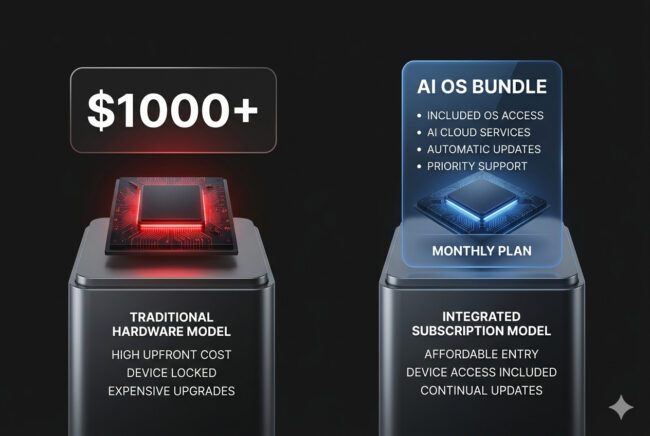
OpenAI is not fundamentally a hardware company; they are a software and subscription company. The physical device is merely a vehicle to lock users into a massive, lifelong ChatGPT Plus (or equivalent) ecosystem.
The “Loss Leader” Strategy: To gain rapid market share against the iPhone, analysts expect OpenAI to heavily subsidize the initial cost of the device, bundling it with a premium AI subscription.
Avoiding the Qualcomm Tax: Subsidizing hardware requires keeping the Bill of Materials (BOM) as low as possible. Qualcomm’s TSMC 2nm wafer costs are astronomical. Partnering with MediaTek allows OpenAI to secure top-tier 2nm performance without paying the exorbitant “Qualcomm Tax,” keeping the retail price disruptive.
Long-Term Replacement Demand: Ming-Chi Kuo notes that by acting as a co-development partner, MediaTek secures a massive, long-term pipeline of demand, ensuring they aren’t just selling chips, but actively building the reference architecture for the post-smartphone era.
The Threat to the Old Guard
The alliance between Sam Altman, Jony Ive, and MediaTek is the most credible threat to the smartphone status quo since the launch of the original iPhone.
Bypassing the App Store: If the OpenAI device succeeds, it renders the iOS App Store and Google Play Store obsolete. You don’t download an Uber app; you just tell the device you need a ride.
MediaTek’s Brand Elevation: For MediaTek, this is the ultimate validation. Powering the most highly anticipated tech product of the decade permanently erases their historical “budget” stigma. They are now the silicon architects of the AI revolution.
Final Verdict: Form Follows Silicon
Jony Ive is famous for stating that design is not just what it looks like, but how it works. For the OpenAI hardware project to work, it needed silicon that was flexible, massively powerful in matrix math, incredibly memory-efficient, and economically viable at scale.
Qualcomm’s 2027 segmentation strategy actively worked against all of these requirements. The MediaTek Dimensity 9600 was not just the cheaper choice; architecturally, it was the only choice capable of realizing OpenAI’s vision for an ambient, agentic future.