Ryzen Z2 Extreme Leaks: Will the ROG Ally 2 Finally Hit 1080p 60FPS in AAA Games?
The handheld PC gaming revolution, kickstarted by the Steam Deck and accelerated by the original ASUS ROG Ally, has fundamentally changed how we interact with our Steam libraries. However, despite the impressive capabilities of the Ryzen Z1 Extreme, a hard truth emerged for enthusiasts: native 1080p at a locked 60 frames per second in heavy AAA titles remained a pipe dream. To get playable framerates in games like Cyberpunk 2077 or Starfield, users were forced to drop resolutions to 720p or 900p and lean heavily on aggressive upscaling.
But the landscape is about to shift dramatically. Massive supply chain leaks, combined with recent FCC certification filings, have laid bare the specifications for both AMD’s upcoming Ryzen Z2 Extreme APU and the highly anticipated ASUS ROG Ally 2.
With a redesigned core architecture, a massive graphical bump, and some shocking RAM configurations, the question on every gamer’s mind is simple: Is this the generation that finally delivers uncompromised 1080p 60FPS handheld gaming? Here is the comprehensive, technical breakdown of the leaks.
The Ryzen Z2 Extreme: A Surgical Architectural Shift
AMD is not just throwing more power at the wall; they are fundamentally restructuring how the mobile APU handles the balance between battery life and peak rendering performance. The Z2 Extreme (internally based on the ‘Strix Point’ architecture) is a masterpiece of specialized silicon.
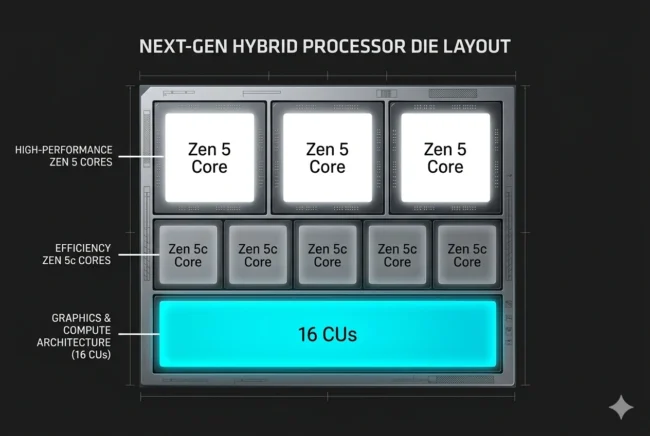
The 3+5 Core Configuration: Unlike the upcoming desktop processors that push massive core counts, the Z2 Extreme is dialing back the raw thread count to prioritize efficiency. Leaks confirm it will utilize an 8-core setup consisting of three high-performance Zen 5 cores and five high-efficiency Zen 5c cores. This is a brilliant move. Eight cores are more than enough to feed a mobile GPU, and dedicating die space to the Zen 5c architecture ensures the device sips power during lightweight 2D gaming or OS navigation.
The Radeon 890M GPU (16 CUs): This is the heart of the 1080p dream. The Z1 Extreme maxed out at 12 Compute Units (CUs) on the RDNA 3 architecture. The Z2 Extreme leaps to 16 CUs built on the newer RDNA 3.5 architecture. This represents a massive 33% increase in raw hardware execution units, instantly elevating the chip’s ability to render complex geometries and high-resolution textures.
Target Frequencies and Thermal Headroom: Engineering samples of the Z2 Extreme are reportedly boosting up to 5.0 GHz on the Zen 5 cores and roughly 2.9 GHz on the GPU. Because the Zen 5c cores run so efficiently, the APU can route a significantly larger portion of the 28W–36W power budget directly to the graphics engine, preventing the aggressive thermal throttling that plagued earlier handhelds.
XDNA 2 NPU Excluded? Interestingly, deep-dive spec leaks suggest the Z2 Extreme might omit the heavy 50 TOPS XDNA 2 Neural Processing Unit found in its laptop counterparts (like the Ryzen AI 9 HX 370). For a pure gaming device, this is actually a massive win. Removing the NPU frees up physical die space and power budget, ensuring 100% of the silicon is dedicated to pushing frames.
Will It Actually Hit 1080p 60FPS?
The jump from 12 CUs to 16 CUs is significant, but hardware alone doesn’t guarantee a locked 60FPS at 1080p. The true magic lies in how the Z2 Extreme interacts with the rest of the system, specifically memory bandwidth.
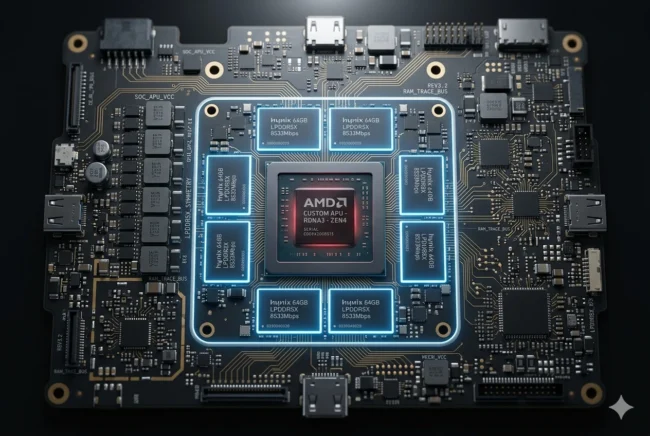
The LPDDR5X-8533 Bottleneck Lifted: Integrated graphics (iGPUs) do not have their own dedicated VRAM; they must share system RAM. The original ROG Ally was often bottlenecked by memory speeds. Leaks indicate the ROG Ally 2 will support LPDDR5X memory running at a blistering 8533 MT/s. This massive increase in bandwidth is the exact metric required to feed 16 RDNA 3.5 Compute Units without stalling, making native 1080p rendering vastly more viable.
RDNA 3.5 Efficiency Curve: The RDNA 3.5 architecture was specifically engineered by AMD to maximize performance-per-watt at the 15W to 28W range. While the Z1 Extreme struggled to separate itself from cheaper chips at 15W, the Z2 Extreme is projected to offer a 20-30% graphical uplift even at mid-tier TDPs.
The AFMF 2 and FSR 3.1 Synergy: To hit 60FPS in the heaviest, unoptimized Unreal Engine 5 titles, software will still play a role. However, the combination of 16 CUs and AMD’s mature Fluid Motion Frames (AFMF 2) means the baseline framerate before generation will be significantly higher. Generating frames from a 45FPS baseline yields a buttery-smooth, artifact-free 60+ FPS experience at 1080p, something the older hardware struggled to maintain.
ASUS ROG Ally 2: The Hardware Redesign
A powerful APU is useless if the chassis cannot support it. Thanks to recent FCC certification leaks (complete with prototype photographs), we have a clear picture of how ASUS is evolving the physical hardware to tame the Z2 Extreme.
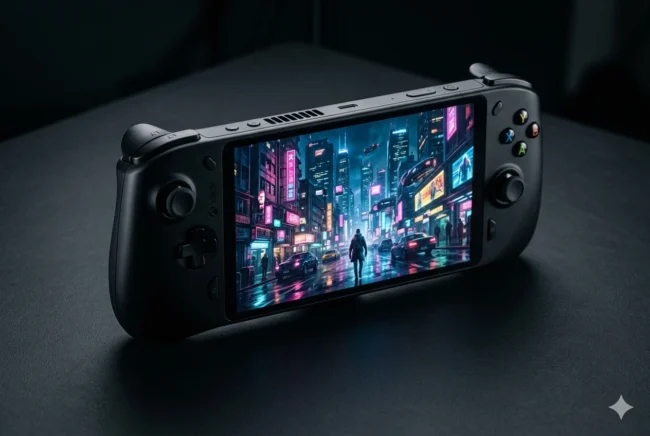
Ergonomic Overhaul and “GameCube” Grips: The most common complaint regarding the original ROG Ally was its flat, cramp-inducing profile. The leaked photos of the ROG Ally 2 showcase vastly improved, deeper controller-like grips. This ergonomic overhaul is mandatory, as players will be holding a device that is likely heavier due to advanced cooling requirements.
The 64GB RAM Shock: In a leak that stunned the hardware community, the premium version of the ROG Ally 2 was certified with a staggering 64GB of RAM. While this sounds like extreme overkill, it is a masterstroke for an APU-driven device. Users will be able to permanently allocate 16GB of RAM as dedicated VRAM for the Radeon 890M GPU, leaving 48GB for Windows 11 and heavy background applications. This completely eliminates the “stuttering” caused by memory swapping in texture-heavy AAA games.
The “Xbox Edition” Split: The leaks reveal two distinct models: a white model and a premium black model featuring dedicated Xbox branding. The standard white model may utilize a weaker, 4-core APU (codenamed Aeirth Plus) to hit a budget price point, while the Black “Xbox Edition” will house the flagship Z2 Extreme and the massive 64GB RAM pool.
Battery and OLED Display Upgrades: While the FCC leaks focus on the chassis, prominent supply chain rumors suggest ASUS is finally moving to a 144Hz OLED panel, catching up to the Steam Deck OLED’s visual fidelity. Furthermore, to combat the 36W TDP capabilities of the Z2 Extreme, battery capacities are expected to jump into the 80Wh to 85Wh range, effectively doubling the physical battery size of the first-generation device.
The Verdict: The 1080p Dream is Realized
The math is undeniable. When you combine a 33% increase in physical GPU cores (moving to 16 CUs), the architectural refinements of RDNA 3.5, and the massive bandwidth of LPDDR5X-8533 memory, the theoretical performance ceiling of the Ryzen Z2 Extreme is staggering.
Will it play every unoptimized, ray-traced AAA game at a native 1080p 60FPS without upscaling? No. Modern game engines are too demanding. However, for 90% of the Steam library, and with the intelligent application of FSR 3.1 in the heaviest titles, the ASUS ROG Ally 2 will absolutely break the 1080p 60FPS barrier that held back the previous generation.
If you have been holding off on the handheld PC craze, waiting for a device that doesn’t force you to compromise on resolution, the 2026 launch of the Z2 Extreme-powered ROG Ally 2 is exactly what you have been waiting for.