Arc B360 vs B380: Unpacking Intel’s 2026 Handheld APU Architecture
The handheld PC gaming market has evolved from a niche enthusiast experiment into a multi-billion dollar primary battlefield for silicon manufacturers. While AMD has historically dominated this space with its highly successful “Z” series APUs (powering devices like the ROG Ally and Lenovo Legion Go), 2026 marks the year Intel executes a highly targeted, aggressive counter-offensive.
Recent leaks originating from the supply chain and hardware certification databases have detailed Intel’s upcoming Core Ultra G3 “Panther Lake” processors. Designed specifically for the handheld form factor and slated for a Q2 2026 release, this silicon is not a repurposed laptop chip—it is a bespoke SoC engineered to maximize gaming performance within a brutal 15W to 25W thermal envelope.
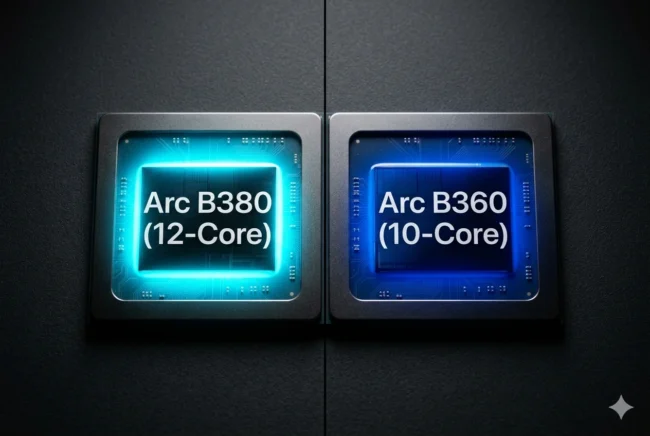
At the heart of the G3 lineup are two distinct integrated graphics processors built on the next-generation Xe3 (Celestial) architecture: the Arc B380 and the Arc B360. If you are planning to purchase a next-generation handheld, understanding the architectural differences between these two iGPUs is crucial. Here is the comprehensive, highly technical breakdown of Intel’s 2026 handheld graphics architecture.
The Panther Lake G3 CPU Foundation
Before comparing the graphics cores, it is essential to understand the CPU architecture feeding them. Both the G3 Extreme and the standard G3 share an identical, highly unconventional processor layout designed on Intel’s bleeding-edge 18A node.
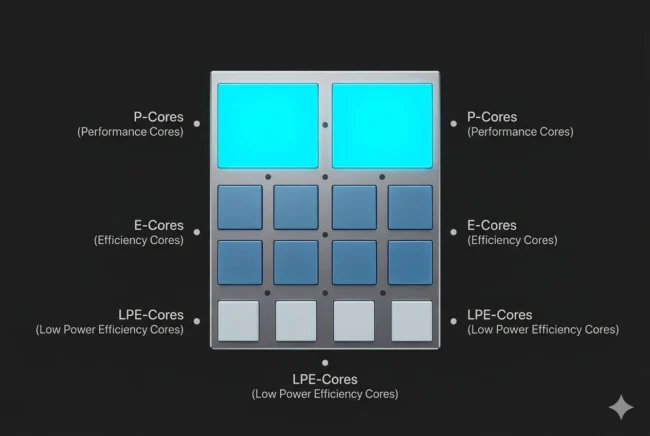
The 14-Core Configuration: Both SKUs feature a 14-core layout consisting of 2 P-Cores (Performance), 8 E-Cores (Efficient), and 4 LPE-Cores (Low-Power Efficient).
The 2 P-Core Philosophy: To a traditional PC builder, having only two Performance cores sounds alarming. However, in a power-starved handheld environment, P-Cores are incredibly inefficient, consuming massive amounts of wattage for marginal gaming gains. By limiting the silicon to just two P-Cores, Intel prevents the CPU from cannibalizing the thermal budget.
E-Core Dominance: The eight E-Cores are the true workhorses of this SoC. At sub-25W TDPs, Intel’s E-Cores offer significantly better performance-per-watt than P-Cores. They are more than capable of handling modern game engine logic, physics calculations, and operating system overhead without starving the GPU of necessary power.
The LPE Island: The four Low-Power Efficient cores are dedicated entirely to background tasks, OS navigation, and media playback. When you suspend a game or browse the SteamOS UI, the heavier cores power down entirely, handing control to the LPE cluster to drastically extend battery life.
The Arc B380: The “G3 Extreme” Flagship
The Arc B380 is the halo iGPU for Intel’s 2026 handheld lineup, destined for premium devices like the highly anticipated next-generation MSI Claw Extreme. It is designed to deliver uncompromised 1080p performance.
12 Xe3 (Celestial) Cores: The B380 features a massive array of 12 next-generation Xe3 cores. This is identical in core count to the flagship 45W laptop processors (like the Core Ultra 9 388H), meaning Intel is bringing their absolute best mobile silicon to the handheld space.
2.3 GHz Peak Frequency: To fit within the handheld thermal envelope, the maximum boost clock is dialed back slightly to 2.3 GHz (a minor 200 MHz reduction from the laptop variants). This prevents the chip from hitting the brutal efficiency wall that occurs at higher voltages.
Performance Expectations: Early PassMark leaks suggest the G3 Extreme chip will deliver multi-core CPU scores approaching 29,600 points. More importantly, the 12-core Xe3 array is mathematically projected to outperform AMD’s current Radeon 890M, offering a solid 60FPS in heavy AAA titles at 1080p when paired with smart upscaling.
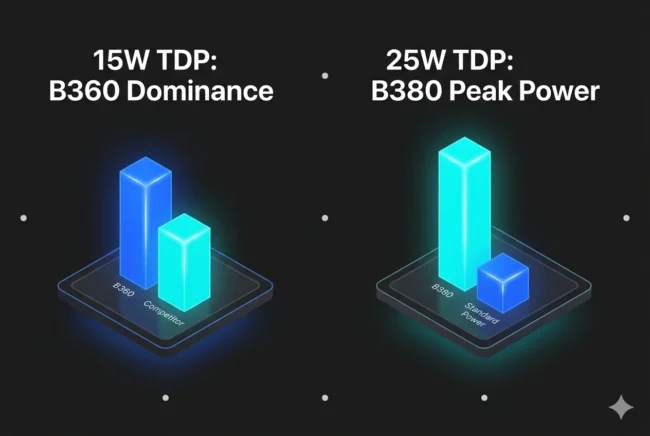
The 25W Sweet Spot: The Arc B380 is engineered to stretch its legs at the 25W to 30W TDP range. This is where the 12 cores have enough voltage to remain active simultaneously, making it the perfect architecture for docked gameplay or users who prioritize maximum fidelity over battery longevity.
The Arc B360: The “Standard G3” Battery Champion
While the B380 grabs the performance headlines, the standard Arc B360 is arguably the more important chip for the future of portable gaming. It is engineered specifically to win the battery life war.
10 Xe3 (Celestial) Cores: The B360 drops two Xe3 cores, bringing the total execution unit count down to 10. By physically fusing off these logic blocks, the silicon reduces its baseline power leakage significantly.
2.2 GHz Peak Frequency: The maximum graphics clock is also capped at 2.2 GHz. By restricting the peak voltage requirements, the B360 maintains a much flatter, more predictable power curve.
The 15W Mastery: Handhelds like the Steam Deck gained massive popularity not by being the most powerful, but by offering incredible performance at a highly efficient 15W TDP. The Arc B360 is perfectly optimized for this sub-20W range. At 15W, the 10-core configuration will likely outperform the 12-core B380, as the 12-core variant would be heavily power-starved and forced to aggressively downclock.
Cost Efficiency: The standard G3 equipped with the B360 will allow OEMs to build highly competitive handhelds in the mainstream price bracket, making top-tier Xe3 architecture accessible to a wider audience.
The Xe3 Architectural Upgrades
Both the B380 and B360 benefit from the foundational improvements of Intel’s “Celestial” graphics architecture, which completely overhauls how the chip handles modern rendering workloads.
Dedicated XMX Matrix Engines: Unlike AMD’s RDNA 3.5 architecture which relies on general shader compute for upscaling, the Xe3 iGPUs feature dedicated XMX hardware matrix engines. These engines run Intel’s XeSS (Xe Super Sampling) algorithm natively, offering superior image reconstruction and temporal stability with near-zero latency.
Hardware-Accelerated Frame Generation: Running games at 1080p natively is brutal on a handheld battery. The dedicated XMX engines on both the B380 and B360 allow for efficient, silicon-level multi-frame generation. This allows the APU to render internally at a power-sipping 720p and generate intermediate frames, presenting a fluid 1080p 60FPS image to the display while saving massive amounts of battery.
Improved Ray Tracing Efficiency: While ray tracing is generally avoided on handhelds, the Xe3 architecture features redesigned Ray Tracing Units (RTUs) that handle bounding volume hierarchy (BVH) traversal much more efficiently. This means localized reflections in older or better-optimized titles won’t instantly tank the framerate.
Memory Bandwidth and the LPDDR5X Requirement
The single most critical bottleneck for any integrated graphics architecture is memory bandwidth. Intel has engineered the Panther Lake G3 platform to eliminate this hurdle.
LPDDR5X Integration: Supply chain leaks confirm that both the G3 Extreme and standard G3 will be paired exclusively with ultra-fast LPDDR5X memory. While the exact speeds vary by OEM design, the platform supports highly dense memory configurations.
Feeding the Xe3 Cores: The 12-core Arc B380 requires immense data throughput. Utilizing ultra-fast LPDDR5X ensures that the iGPU is not starved for texture data, preventing the severe 1% low frame-time spikes that plagued older generation handhelds.
Unified Memory Pools: Because the 14-core CPU cluster and the Arc iGPU share this high-speed memory pool, latency between the game engine logic and the rendering pipeline is virtually non-existent, ensuring buttery-smooth frame pacing in competitive titles.
Final Verdict: Tailored Silicon for the Handheld Future
Intel’s approach with the Panther Lake G3 series demonstrates a profound understanding of the handheld market’s unique constraints. Instead of shoehorning a laptop processor into a plastic chassis, they have surgically engineered the silicon to prioritize GPU power over unnecessary CPU bloat.
If you are a gamer looking for the ultimate docked experience and maximum uncompromised visual fidelity, the Arc B380 (G3 Extreme) will be the definitive choice for 2026. However, if your priority is long battery life during flights or commutes, the heavily optimized Arc B360 (Standard G3) running at a cool 15W will offer the best performance-per-watt balance in the industry. The handheld wars have never been this competitive, and Intel is bringing a formidable arsenal.
Tech ReviewerFounder & Publisher: Sole operator and lead technical architect of MultiCore Performance
Areas of Expertise:
Silicon & Hardware Benchmarking: Firsthand performance testing and analysis of flagship processors specifically evaluating thermal and rendering capabilities in gaming and video editing workloads.,