Intel Panther Lake G3 Leaked: Will the Arc B380 iGPU Finally Perfect Switch Emulation?
The mobile emulation community is famously uncompromising. While standard AAA PC gaming relies on natively compiled code, running complex hardware translation layers—such as those required for Nintendo Switch or PlayStation 3 emulation—demands an entirely different level of silicon synergy. For years, the gold standard in the handheld and thin-and-light laptop space has been AMD’s RDNA architectures. Intel’s integrated graphics, while dramatically improving with the Meteor Lake series, often stumbled on Vulkan driver quirks and sheer memory bandwidth starvation when pushed to emulate complex consoles.
However, massive architectural leaks regarding Intel’s upcoming Panther Lake G3 (Core Ultra Series 3) APU suggest a paradigm shift. Featuring the highly anticipated Arc B380 iGPU built on the next-generation Xe3 (Celestial) architecture, Intel is not just aiming to close the gap; they are engineering silicon specifically designed to muscle through heavy translation layers.
Here is the deep-dive technical breakdown of the Panther Lake G3 leaks, the specific architectural upgrades to the Arc B380, and why 2026 might be the year Intel finally achieves uncompromised, 60FPS Switch emulation on mobile power budgets.
The Xe3 (Celestial) Architecture: A Foundation for Emulation
The Arc B380 iGPU is not an iterative update to the current Alchemist or Battlemage designs. The “Xe3” architecture, codenamed Celestial, represents Intel’s most aggressive push into high-performance mobile graphics.
The 12-Core Configuration: The flagship Panther Lake G3 processors (the high-end “H-series”) will reportedly feature up to 12 Xe3 Cores. This is a massive density increase over previous generations, providing a significantly wider execution engine capable of parallelizing the immense arithmetic logic required to translate non-native console instructions on the fly.
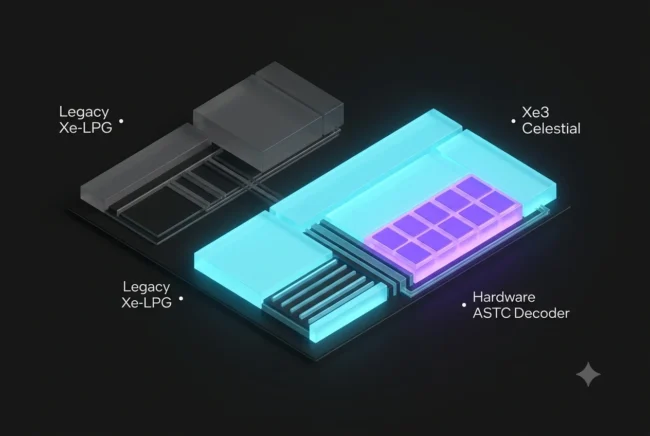
Vector Engine Expansion: Switch emulation, particularly in heavy open-world titles, relies heavily on rapid floating-point calculations. Leaks suggest the Xe3 Vector Engines have been widened and fundamentally redesigned to process complex floating-point geometry significantly faster than the older Xe-LPG architecture, directly addressing the stuttering seen in titles like Tears of the Kingdom on older Intel hardware.
Hardware-Level ASTC Decoding: Modern console emulation is notoriously taxing on VRAM due to unique texture compression formats like Adaptive Scalable Texture Compression (ASTC). The Arc B380 is rumored to feature dedicated, hardware-level ASTC decoding blocks. Instead of forcing the CPU to brute-force decompress these textures (causing massive stutter and latency), the iGPU handles it natively, resulting in buttery-smooth texture streaming in emulators like Yuzu or Ryujinx.
The LPDDR5X-9523 Bandwidth Lifeline
Integrated graphics live and die by system memory bandwidth. You can have the most advanced GPU architecture in the world, but if it is starved for data, emulation frame rates will tank.
Massive Throughput: Intel is pairing the Panther Lake G3 specifically with next-generation LPDDR5X memory running at an astonishing 9,523 MT/s. This provides a massive data pipeline exceeding 150 GB/s.
The Shared Cache Advantage: In console emulation, the CPU and GPU must constantly communicate to sync frames and logic. The massive memory bandwidth ensures that the host CPU cores (the “Cougar Cove” P-cores) and the Arc B380 iGPU can rapidly access the same memory pool without stalling, drastically reducing frame-pacing inconsistencies.
Intel Foveros 3D Integration: By utilizing Intel’s Foveros 3D packaging, the distance between the compute tile and the memory controllers is minimized. This ultra-low latency pathway is crucial when a translation layer requires instant access to system RAM to mimic a console’s unified memory architecture.
The Driver Stack: Vulkan Mastery is Mandatory
Silicon specs are meaningless in the emulation world without a robust, mature software stack. Intel’s historical weakness has always been its driver maturity, but the landscape is changing.
The Vulkan Requirement: Advanced emulators lean almost entirely on the Vulkan API for maximum performance. In the past, Intel’s Vulkan implementation was riddled with visual glitches and poor scaling.
The Battlemage Foundation: Intel has spent the last two years aggressively rewriting its Vulkan driver stack for the desktop Battlemage GPUs. The Arc B380 will inherit this entirely rebuilt, highly optimized driver foundation on day one.
Open-Source Collaboration: Intel’s Linux driver team has been remarkably active in collaborating directly with the open-source emulation community (such as the Mesa drivers). This direct collaboration means the Arc B380 will likely launch with specific compiler optimizations tailored for the most popular emulators, bypassing the “teething issues” that plagued the Meteor Lake launch.
The 25W Thermal Sweet Spot
Emulation on a handheld PC (like an MSI Claw successor) or a thin-and-light laptop requires sustained performance, not just peak benchmark bursts.
Intel 18A Node Efficiency: The Panther Lake compute tile is fabricated on Intel’s bleeding-edge 18A process node. This massive leap in manufacturing technology allows the Arc B380 to hit high clock speeds (rumored to approach 2.8GHz) at significantly lower voltages.
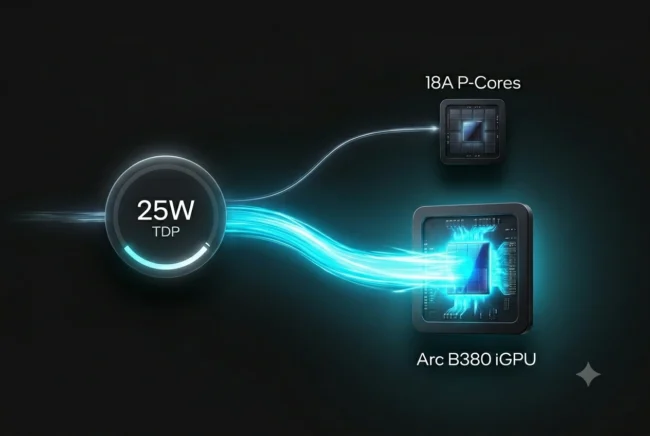
The Power Shift: Because the 18A P-cores are so efficient, the Panther Lake G3 can dynamically shift a much larger percentage of its 25W thermal budget directly to the iGPU during heavy graphical loads.
Sustained 60FPS: This thermal headroom is what separates a playable emulation experience from a frustrating one. The Arc B380 can maintain the high frequencies required to lock complex Switch titles at a native 1080p 60FPS, without the aggressive thermal throttling that ruins the experience after 20 minutes of gameplay.
The XMX AI Integration (XeSS)
While native emulation is the goal, intelligent upscaling is the reality for handhelds. The Arc B380 brings Intel’s dedicated AI hardware into the fold.
XMX Matrix Engines: Unlike AMD’s FSR, which relies on standard shader compute, the Arc B380 includes dedicated XMX AI matrix engines. This hardware is explicitly designed to run XeSS (Xe Super Sampling).
The Emulation Synergy: Emulators are increasingly integrating upscaling directly into the pipeline. By rendering a complex console game at 720p internally, and utilizing the dedicated XMX engines to intelligently upscale to 1080p or 1440p via XeSS, the overall system load is drastically reduced. The result is a pristine, anti-aliased image that runs significantly cooler and extends battery life, completely circumventing the raw brute-force requirements of native rendering.
The Verdict: Intel’s Emulation Redemption
For the past several years, recommending an Intel-based thin-and-light laptop or handheld for heavy emulation required a litany of caveats and workarounds. The Panther Lake G3 and its Arc B380 iGPU represent the end of those compromises.
By combining the aggressive architectural changes of the Xe3 Celestial design, the extreme memory bandwidth of LPDDR5X-9523, and a completely rebuilt Vulkan driver stack, Intel has engineered an APU that specifically targets the heaviest workloads the mobile space can offer.
If you are a power user waiting for a device capable of flawlessly translating the heaviest Switch titles at locked 60FPS without generating uncomfortable chassis heat, the late-2026 Panther Lake G3 is the silicon leap you have been anticipating. The crown for the ultimate mobile emulation architecture is officially up for grabs.