Is the Gen 6 Too Hot? Why 2027 “Flagship Killers” Are Downgrading Their Processors
For over a decade, the formula for a “Flagship Killer” has been beautifully simple: take the absolute best, most current Qualcomm Snapdragon processor available, wrap it in a cost-effective chassis with decent cameras, and sell it for half the price of a Samsung Galaxy Ultra. It is the strategy that built entire brands like OnePlus, Poco, and iQOO.
However, as we look toward the 2027 smartphone release cycle, that sacred formula is actively collapsing. A wave of supply chain leaks and insider testing reports indicate that the next generation of $500 to $600 performance phones will deliberately avoid Qualcomm’s standard Snapdragon 8 Elite Gen 6 (SM8950).
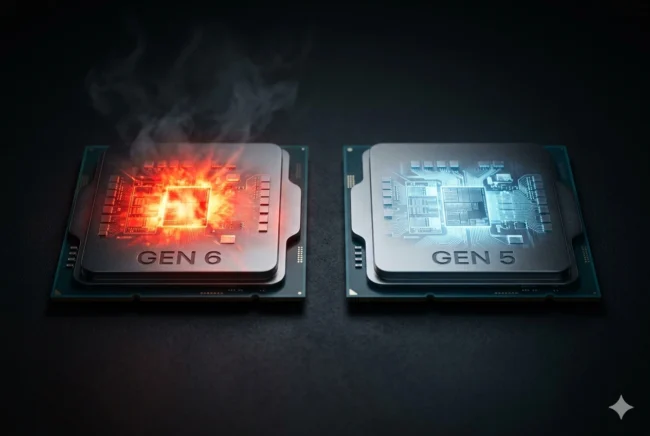
Instead of adopting the newest silicon, manufacturers are making the unprecedented decision to “downgrade” their upcoming devices, opting for older processors or shifting architectures entirely. This isn’t just about saving a few dollars; it is a desperate bid to save the devices from catastrophic overheating. Here is the comprehensive breakdown of why the standard Gen 6 is too hot to handle, and why the 2027 flagship killer is fundamentally changing its engine.
The 5.0GHz Thermal Wall
The pursuit of marketing metrics has pushed mobile silicon to the absolute brink of physical thermodynamics. The standard Snapdragon 8 Elite Gen 6 is a victim of its own raw clock speed.
The 5.0GHz Baseline: Leaks confirm that Qualcomm has tuned the standard Gen 6 to hit a peak CPU frequency of 5.0GHz across its prime cores. While this looks fantastic on a Geekbench 6 spec sheet, sustaining 5.0GHz on a microscopic mobile die generates a terrifying amount of localized thermal energy.
The Chassis Limitation: True $1,300 flagships can afford to implement massive, complex vapor chambers and exotic cooling materials to tame this heat. A $500 flagship killer simply does not have the bill of materials (BOM) budget to include elite-tier cooling. Dropping a 5.0GHz processor into a cost-cut plastic or thin aluminum chassis transforms the phone into a space heater within minutes of launching a heavy game.
Aggressive Throttling: When the standard Gen 6 hits its thermal ceiling in these budget chassis, the firmware forcefully slams the brakes. The resulting link-state thermal throttling causes massive frame-time spikes. A phone that markets itself on “esports performance” becomes unplayable due to micro-stutters, completely defeating the purpose of buying a flagship killer in the first place.
The “Heat Pass Block” (HPB) Exclusivity
Qualcomm is fully aware of the heat generated by the Gen 6 architecture, and they have engineered a hardware-level solution. The problem? They are locking that solution behind the “Pro” paywall.
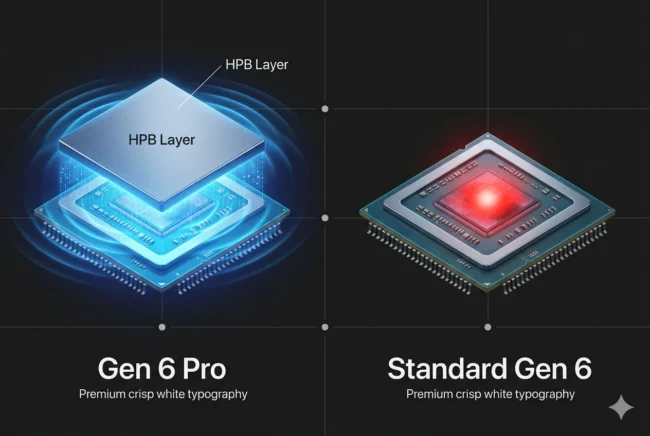
Borrowing from Exynos: Leaked internal diagrams reveal that Qualcomm is adopting a technology pioneered by Samsung called the Heat Pass Block (HPB). This is a dedicated, highly conductive layer integrated directly into the processor packaging that rapidly pulls heat away from the silicon die and disperses it to the phone’s vapor chamber.
The Pro-Only Privilege: Crucially, supply chain insiders (including Fixed Focus Digital) report that the HPB technology is physically reserved for the Snapdragon 8 Elite Gen 6 Pro (SM8975).
Leaving the Standard Gen 6 to Roast: Because the standard Gen 6 (SM8950) allegedly lacks this integrated Heat Pass Block, it is entirely reliant on the smartphone manufacturer’s external cooling solution. For budget-conscious OEMs building flagship killers, the omission of HPB makes the standard Gen 6 an active thermal liability that they cannot afford to mitigate.
The $300 Silicon Tax
Beyond the physical heat, the financial heat generated by the Gen 6 platform is incinerating the profit margins of the mid-range sector.
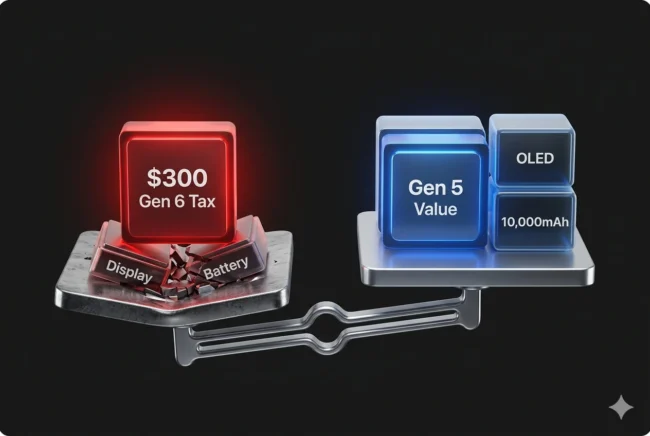
The Cost of 2nm: TSMC’s bleeding-edge 2nm (N2) node is astonishingly expensive. Recent supply chain pricing leaks suggest Qualcomm may charge OEMs upwards of $300 per unit for the standard Gen 6 processor.
The Broken Math: If a manufacturer’s target retail price for a Poco or an iQOO Neo is $499, spending $300 purely on the processor is economic suicide. It leaves zero budget for a high-refresh-rate OLED display, LPDDR5X RAM, or a battery large enough to feed the chip.
The Samsung Foundry Risk: As we explored previously, there are heavy rumors that Qualcomm may offload the standard SM8950 to Samsung Foundry’s SF2 node to cut costs. Given Samsung Foundry’s historical struggles with gate leakage and high dynamic power consumption (the Snapdragon 8 Gen 1 disaster), OEMs are terrified of committing their 2027 volume to a potentially flawed, overheating node.
The Strategic Downgrade: The Gen 5 Renaissance
Faced with a processor that is too expensive and too hot, manufacturers are making a brilliant, highly pragmatic pivot: they are reusing the Snapdragon 8 Elite Gen 5.
Mature, Stable Silicon: The Gen 5 is a known, highly stable quantity. It delivers incredible performance (peaking at a much more manageable 4.6GHz to 4.7GHz) without the catastrophic thermal spikes associated with the 5.0GHz Gen 6 architecture.
Discounted Volume Pricing: As Qualcomm shifts its marketing focus to the Gen 6, the wholesale price of the Gen 5 will plummet. OEMs can acquire this elite, flagship-grade silicon for a fraction of the cost, allowing them to reinvest that money into vastly superior displays, premium chassis materials, and larger batteries.
The “Sustained” Victory: In real-world gaming, a cool Snapdragon 8 Elite Gen 5 running at 100% capacity will consistently outperform a thermal-throttled Gen 6 running at 60% capacity. By “downgrading,” these 2027 flagship killers will actually deliver a smoother, more reliable gaming experience than standard Gen 6 devices that lack proper cooling.
The MediaTek Flanking Maneuver
For OEMs that absolutely refuse to use “last year’s chip” on their marketing materials, the alternative to the Gen 6 isn’t a downgrade at all—it is a lateral move to MediaTek.
The Dimensity 8600 Threat: As detailed in our previous coverage, MediaTek’s upcoming Dimensity 8600 is specifically designed to dominate the $500 price bracket. By utilizing a highly efficient 3nm node and an all-big-core architecture, it offers performance rivaling the Elite Gen 5 but with superior modern efficiency.
The LPDDR6 Advantage: While the standard Gen 6 is artificially restricted to older LPDDR5X memory to protect the “Pro” tier, MediaTek is expected to offer wider support for faster memory standards, making it the superior choice for localized AI tasks and heavy graphics rendering in the mid-range sector.
The Verdict: Smarter Phones, Cooler Silicon
The era of blindly purchasing a smartphone simply because it features the highest numerical processor badge is over. In 2027, the standard Snapdragon 8 Elite Gen 6 represents a dangerous intersection of extreme clock speeds, omitted cooling technologies (like the HPB), and exorbitant costs.
The decision by “Flagship Killer” brands to downgrade to the Snapdragon 8 Elite Gen 5 or pivot to the Dimensity 8600 is not a failure; it is a masterclass in hardware optimization. By rejecting silicon that runs too hot for their chassis, these brands are ensuring that the $500 smartphone market remains the absolute best value in the tech industry, prioritizing sustained, buttery-smooth execution over theoretical benchmark bursts.