Why the POCO F9 Pro is Skipping the Snapdragon 8 Gen 6 for a Massive 8500mAh Battery
For years, the POCO F-series has operated on a single, uncompromising philosophy: provide the absolute fastest flagship processor available at a mid-range price, regardless of the compromises required in design or camera hardware. It is the strategy that birthed the “Flagship Killer” moniker. However, the smartphone landscape in 2027 is undergoing a radical paradigm shift, and POCO is making a highly controversial, yet brilliant, pivot.
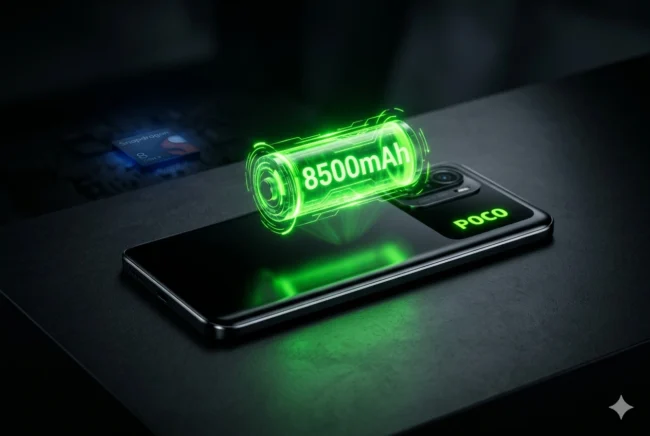
According to the latest supply chain leaks surrounding the Redmi K100 series (which serves as the hardware foundation for the global POCO F9 lineup), the upcoming POCO F9 Pro will deliberately skip the bleeding-edge Snapdragon 8 Elite Gen 6. Instead, the company is opting for the highly stable Snapdragon 8 Elite Gen 5, using the physical space and financial savings to integrate a jaw-dropping 8500mAh battery.
To the spec-sheet purist, skipping the newest processor sounds like blasphemy. But for the hardcore mobile gamer and power user, this is the most exciting hardware decision of the decade. Here is the comprehensive breakdown of why the POCO F9 Pro is downgrading its silicon to deliver the ultimate endurance flagship.
The Thermal Reality of the Snapdragon 8 Elite Gen 6
As we have analyzed in the broader industry shift away from the standard Gen 6 processor, Qualcomm’s newest silicon is a thermal liability for budget-conscious manufacturers. POCO’s decision to avoid it is rooted purely in sustained performance.
The 5.0GHz Heat Problem: The standard Snapdragon 8 Elite Gen 6 is tuned to hit a blistering 5.0GHz. In a $1,300 ultra-premium phone with exotic cooling materials, this is manageable. In a $500 POCO device built with cost-effective chassis materials, that level of thermal density turns the phone into a space heater.
Missing Heat Pass Block (HPB): Qualcomm restricts its advanced Heat Pass Block technology to the “Pro” tier of the Gen 6 lineup. Without this critical hardware-level heat dissipation layer, the standard Gen 6 traps heat inside the logic board.
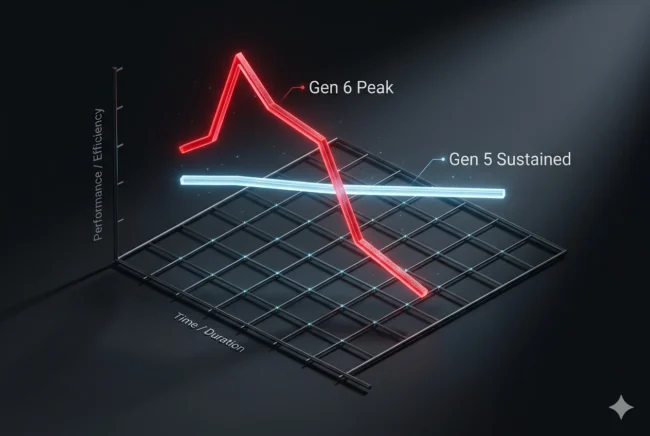
The Gaming Death Sentence: POCO phones are primarily purchased for mobile gaming. When a processor overheats, it triggers link-state thermal throttling, causing massive frame-time spikes and micro-stutters. A processor that scores 3.5 million on AnTuTu but throttles to 50% performance after 10 minutes of Genshin Impact is entirely useless to the POCO demographic.
The Silicon-Carbon Battery Revolution
The physical space required to cool a Gen 6 processor is massive. By stepping back to a cooler chip, POCO engineers have freed up internal chassis volume, and they are filling every available millimeter with high-density power.
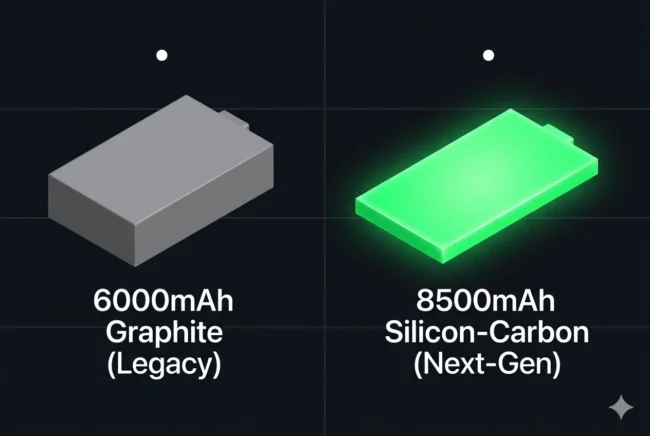
Silicon-Carbon (Si/C) Technology: Traditional lithium-ion batteries using graphite anodes have reached their theoretical density limit. The POCO F9 Pro will utilize next-generation Silicon-Carbon anodes, which can hold significantly more lithium ions. This allows POCO to pack an 8500mAh capacity into a cell roughly the same physical size as a traditional 6000mAh battery.
Redmi K100 Series Leaks: Supply chain leaks confirm that Xiaomi (POCO’s parent company) has been aggressively testing batteries ranging from 8000mAh to over 10,000mAh for the Redmi K100 series. The POCO F9 Pro appears to be settling on an optimized 8500mAh cell to maintain a reasonable device weight while destroying the competition in endurance.
Eliminating Range Anxiety: For the power user, an 8500mAh battery fundamentally changes how the device is used. It transforms the POCO F9 Pro into a true “two-day” heavy-use smartphone, allowing for extended 120Hz gaming sessions, continuous GPS navigation, and 5G hotspot usage without ever needing to carry a power bank.
Why the Snapdragon 8 Elite Gen 5 is the Perfect Engine
Calling the use of the Snapdragon 8 Elite Gen 5 a “downgrade” is technically accurate on a timeline, but it is a massive functional upgrade for this specific device.
Unmatched Stability: The Gen 5 architecture is a known, mature, and highly stable platform. Peaking at around 4.3GHz to 4.7GHz, it requires significantly less voltage than the Gen 6. This flatter power curve means the phone stays comfortably cool in the hands during extended gaming marathons.
Sustained Performance Champion: Because it runs cooler, the Gen 5 will not aggressively thermal throttle. In a real-world, one-hour gaming stress test, a well-cooled Gen 5 will actually output higher average frame rates than a thermally choked Gen 6.
Mature Emulation Drivers: For the handheld emulation community, the Adreno drivers for the Gen 5 have had an extra year of aggressive optimization. Switch and PC emulation layers will run flawlessly out of the box, whereas the Gen 6 will inevitably suffer from early-adoption graphical glitches and driver crashes.
The Economics of the Flagship Killer
Building a smartphone is a zero-sum game of budgeting. You cannot put $1,000 worth of parts into a device and sell it for $500. POCO had to make a financial choice.
The TSMC 2nm Tax: The Snapdragon 8 Elite Gen 6 is built on TSMC’s 2nm node, carrying a rumored wholesale cost exceeding $300 per unit. If POCO used this chip, the retail price of the F9 Pro would have to jump to $700+, completely alienating their core fanbase.
Reinvesting the Savings: By utilizing the now-discounted Gen 5 processor, POCO saves a massive amount on their Bill of Materials (BOM). They are directly reinvesting these savings into the expensive Silicon-Carbon battery tech, 100W HyperCharge infrastructure, and a premium 1.5K display.
Protecting the Price Bracket: This strategic component swapping ensures that the POCO F9 Pro can launch at the expected sub-$550 price point, maintaining its status as the undisputed king of value.
Rumored POCO F9 Pro Specifications
Based on the latest leaks from the Chinese manufacturing lines, here is what the complete package of the POCO F9 Pro is expected to look like when it hits global markets in Q1 2027:
Processor: Qualcomm Snapdragon 8 Elite Gen 5 (4nm node).
Memory & Storage: Up to 16GB LPDDR5X RAM and 1TB of UFS 4.0 storage.
Battery & Charging: 8500mAh Silicon-Carbon cell with 100W wired HyperCharge (expected 0-100% in roughly 55 minutes despite the massive size).
Cameras: 50MP primary sensor (OIS) utilizing the Light Fusion 800 sensor, paired with a functional 8MP ultrawide, finally dropping the useless 2MP macro lens.
Build: IP68 water and dust resistance, with an upgraded aluminum mid-frame replacing the plastic rails of previous generations.
The Verdict: Endurance is the New Benchmark
The smartphone industry has been trapped in a toxic cycle of chasing synthetic benchmark scores that offer zero tangible benefits in daily use. The POCO F9 Pro represents a brilliant, consumer-first rejection of that cycle.
By skipping the overheating, overly expensive Snapdragon 8 Gen 6 in favor of a mature Gen 5 processor and a colossal 8500mAh battery, POCO is delivering exactly what gamers and power users actually want: a phone that runs fast, stays cool, and refuses to die. The era of the “benchmark killer” is fading; the era of the “endurance flagship” has officially arrived.