The 2K LTPS Display Leak: Are 2027 Android Flagships Pushing Refresh Rates Too Far?
For the past several hardware generations, the smartphone display market has operated under a universally accepted set of rules. Premium devices use LTPO backplanes to save battery, 120Hz is the gold standard for fluidity, and 2K resolution is reserved for the absolute top-tier “Ultra” models. However, the smartphone industry is preparing for a violent disruption. As we look toward the 2027 Android flagship cycle, supply chain leaks indicate that manufacturers are systematically tearing up the old rulebook.
According to explosive reports from prominent industry leakers, including Digital Chat Station, upcoming devices like the OnePlus 16 and the iQOO Neo 11 Pro are pioneering a radical new display philosophy. We are witnessing the return of LTPS technology, the standardization of 2K resolutions, and an absolute arms race pushing refresh rates to an astonishing 240Hz.
This dramatic shift in display architecture is not happening in a vacuum; it is the direct result of massive underlying changes in battery chemistry and mobile processing power. Here is the comprehensive, highly technical deep-dive into the 2027 display leaks, the physics of LTPS vs. LTPO, and whether an Android UI running at 185Hz is a necessary evolution or pure spec-sheet overkill.
The Death of LTPO and the LTPS Revival
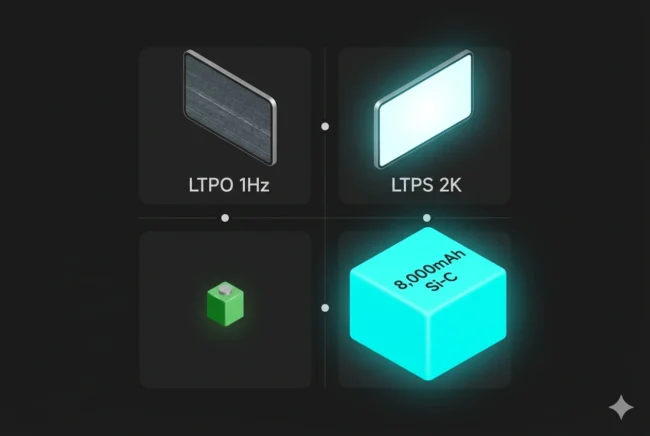
Perhaps the most shocking revelation from the recent display leaks is the active abandonment of LTPO (Low-Temperature Polycrystalline Oxide) technology in favor of older LTPS (Low-Temperature Polycrystalline Silicon) backplanes. To understand why this is a massive paradigm shift, we must look at how these panels handle electrical current.
The Original LTPO Promise
The 1Hz Requirement: LTPO was originally championed by the industry because it allowed displays to dynamically drop their refresh rate all the way down to 1Hz when viewing static content. This aggressive throttling saved immense amounts of battery life, which was strictly necessary when phones were capped at 5,000mAh capacities.
The Visual Compromise: However, LTPO is not perfect. Combining oxide with silicon introduces minor visual compromises, including slight color shifting at off-axis viewing angles and an increased reliance on high-frequency PWM (Pulse-Width Modulation) dimming, which can cause eye strain for sensitive users at low brightness levels.
The LTPS Superiority
Pristine Electron Mobility: LTPS backplanes possess significantly higher electron mobility than LTPO. This allows for vastly superior uniformity in color and brightness across the panel, completely eliminating the granular noise sometimes visible in dark gray backgrounds on modern OLEDs.
Hardware-Level Eye Protection: Because LTPS naturally handles current more uniformly, panel manufacturers like BOE can implement true hardware-level DC dimming without relying on aggressive PWM tricks. This results in a fundamentally cleaner, safer viewing experience.
The Silicon-Carbon Enabler
Why are OEMs suddenly willing to sacrifice the battery-saving features of LTPO? Because battery anxiety is dead. As we approach 2027, the integration of ultra-dense Silicon-Carbon (Si-C) batteries has pushed standard capacities to 8,000mAh and even 10,000mAh. With such a massive power reserve, smartphone manufacturers no longer need to rely on the display panel to save power. They are freely reverting to LTPS to deliver absolute visual perfection, happily paying the slight electrical penalty knowing the massive battery can absorb it.
2K Resolution and the Symmetrical Aesthetic
The era of 1080p and 1.5K resolutions serving as the “sweet spot” is coming to a close. The 2027 leaks confirm that custom 6.78-inch and 6.83-inch panels from manufacturers like BOE are moving 2K (QHD+) into the mainstream flagship tier.
Pushing Pixel Density
The Clarity Threshold: At 6.8 inches, a 2K resolution pushes the pixel density well past the 500 PPI (Pixels Per Inch) mark. This density is crucial for rendering impossibly sharp text, highly detailed UI vectors, and ensuring that fine elements in desktop-class applications remain legible on a mobile screen.
BT.2020 Color Standards: Leaks suggest these new BOE X5 panels are targeting the BT.2020 color gamut—a standard typically reserved for high-end mastering monitors and premium home theater televisions. This provides an astronomically wider spectrum of reds and greens, allowing HDR10+ and Dolby Vision content to render with terrifying accuracy.
The Minimalist 1mm Bezel
Achieving Visual Purity: The display upgrades are not limited to the active pixels. Manufacturers are aggressively refining the structural packaging. Leaks point to the OnePlus 16 utilizing a custom flat display with ultra-narrow, ~1mm uniform bezels on all four sides.
The Premium Hardware Curve: This push for absolute symmetry mimics the pristine, minimalist aesthetic typically associated with premium Apple-style hardware. By eliminating the heavy bottom “chin” and utilizing perfectly balanced, sweeping corner radiuses, the display essentially bleeds off the edge of the chassis. It creates an immersive, distraction-free canvas that prioritizes pure content delivery over flashy, curved-glass gimmicks.
The 185Hz – 240Hz Refresh Rate Arms Race
While the return to LTPS and 2K resolution is a welcome quality upgrade, the most controversial aspect of the 2027 leaks is the sheer speed of the panels. We are officially moving past 120Hz and entering the realm of extreme high-frequency refresh rates.
The 185Hz UI Standard
Beyond Fluidity: According to supply chain analysts, the standard refresh rate for the Android user interface on these upcoming flagships will be locked at 185Hz.
Animation Physics: Driving an operating system at 185 frames per second fundamentally alters the perception of digital interaction. Physics-based animations, scroll inertia, and gesture tracking become mathematically flawless. There is absolutely zero perceptible ghosting or trailing behind text when scrolling rapidly through dense web pages or technical documentation.
The 240Hz Gaming Overdrive
The Burst Mode: While the UI hovers at 185Hz, these displays are equipped with a hardware overdrive mode that pushes the panel to a staggering 240Hz during supported gaming workloads.
The Input Latency Eradication: At 240Hz, a new frame is drawn every 4.16 milliseconds. This effectively eradicates input latency, giving competitive gamers a distinct, measurable hardware advantage in fast-paced shooters and twitch-reaction titles.
AAA Emulation and Perfect Frame Pacing
For the average user checking email, 240Hz is undeniable overkill. However, for the hardcore mobile performance enthusiast, these extreme refresh rates solve a highly specific, deeply technical problem: AAA gaming emulation.
The Emulation Stutter Problem
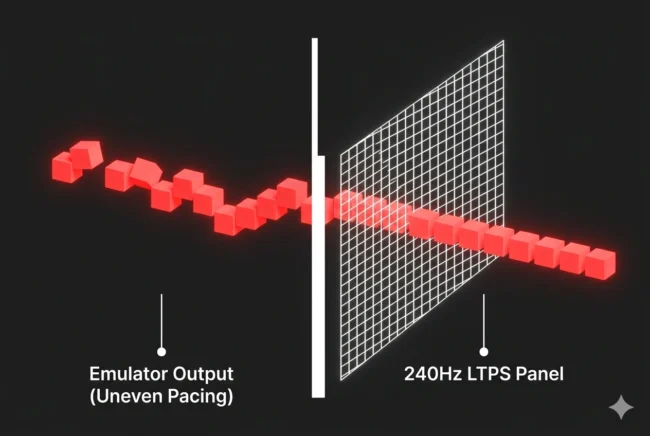
When utilizing translation layers (like Prism or Winlator) to run PC games or Nintendo Switch titles on ARM architecture, frame pacing is notoriously unstable. Even if the Snapdragon 8 Elite Gen 6 Pro has the brute force to render a game at 60FPS, the translated frames are rarely delivered to the display at perfect 16.6ms intervals. This causes the jarring micro-stutters that ruin the emulation experience.
The Headroom Solution
Bypassing V-Sync Penalties: A 240Hz LTPS display provides immense refresh headroom. Because the screen is updating so rapidly, an irregularly paced frame from a heavy emulator will naturally align much closer to a physical display refresh cycle.
Tearing Elimination: This massive refresh window eliminates the need for software-level V-sync, which introduces heavy input lag. The 240Hz panel essentially brute-forces smooth frame pacing by simply updating faster than the emulator can stutter, resulting in an incredibly fluid, console-like experience on a handheld device.
The Silicon Toll: Driving the Pixels
Pushing a 2K resolution LTPS display at 240Hz is an incredibly demanding computational task. It requires a flawless data pipeline and extreme graphics processing power.
The Display Controller Bottleneck: Pushing this amount of pixel data requires massive bandwidth. The upcoming Snapdragon 8 Elite Gen 6 Pro (SM8975) is uniquely equipped for this, utilizing its Adreno 850 GPU and massive 18MB GMEM to handle the display pipeline without dropping frames or triggering thermal limits.
Software Overhead: To maintain 185Hz flawlessly in the UI, Android skins must be exceptionally optimized. Heavy, bloated software overlays will choke the CPU, causing dropped frames that are incredibly obvious at 185Hz. OEMs will be forced to adopt extremely lightweight, highly optimized codebases to ensure the hardware can stretch its legs without stuttering.
The Verdict: Are We Pushing Too Far?
Is a 2K LTPS display running at 240Hz absolutely necessary for a smartphone? If we view the smartphone purely as a communication tool, the answer is no. Human visual perception suffers from severe diminishing returns past 120Hz, and the extreme specifications border on marketing excess.
However, if we view the 2027 Android flagship as a pocket-sized supercomputer—a device tasked with rendering 4K video timelines, emulating desktop-class AAA game engines, and serving as a portal for high-fidelity localized AI—then the display must evolve to match the silicon.
By combining the pristine visual accuracy of LTPS technology, the massive power reserves of 8,000mAh batteries, and the brutal processing power of TSMC’s 2nm node, the 2027 display leaks represent a zero-compromise approach to mobile engineering. We aren’t just pushing refresh rates too far; we are finally building screens capable of keeping up with the processors beneath them.