UFS 5.0 and Active Cooling: Why the Snapdragon 8 Elite Gen 6 Pro Mandates a 10,000mAh Battery
The mobile hardware industry has operated under a fragile equilibrium for years. Silicon foundries would shrink the manufacturing node, generating efficiency gains that OEMs would immediately consume by pushing higher clock speeds or brighter displays. The net result was a stagnant 5,000mAh battery standard that barely got power users through a heavy workday. As we enter the second half of 2026, that equilibrium has completely violently shattered.
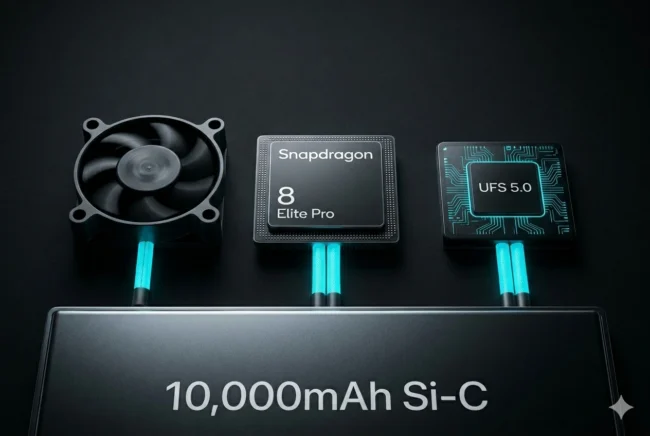
The upcoming wave of ultra-flagships, led by the absolute bleeding edge of Qualcomm’s engineering, is fundamentally changing the calculus of mobile power consumption. The transition to local Agentic AI, desktop-class emulation, and high-fidelity rendering has triggered a massive hardware arms race. We are now looking at devices equipped with the uncompromised Snapdragon 8 Elite Gen 6 Pro (SM8975), blistering UFS 5.0 storage, and physical active cooling fans.
To fuel this unprecedented convergence of high-wattage hardware, manufacturers are executing a brute-force solution: the 10,000mAh Silicon-Carbon battery. Here is the highly technical, comprehensive breakdown of why the era of 5,000mAh is dead, the thermal realities of the new 2nm node, and why UFS 5.0 requires a massive power reserve to function.
UFS 5.0: The 10.8 GB/s Data Pipeline
To understand the sudden demand for massive battery capacities, we must first look at the memory subsystem. The processor is only as fast as the data feeding it, and in 2026, the data pipeline has expanded into a superhighway.
Breaking the Storage Bottleneck
The MIPI M-PHY v6.0 Upgrade: The newly standardized UFS 5.0 specification represents a monumental leap in storage performance. Utilizing the HS-GEAR6 mode, UFS 5.0 delivers a staggering 46.6 Gbps per lane.
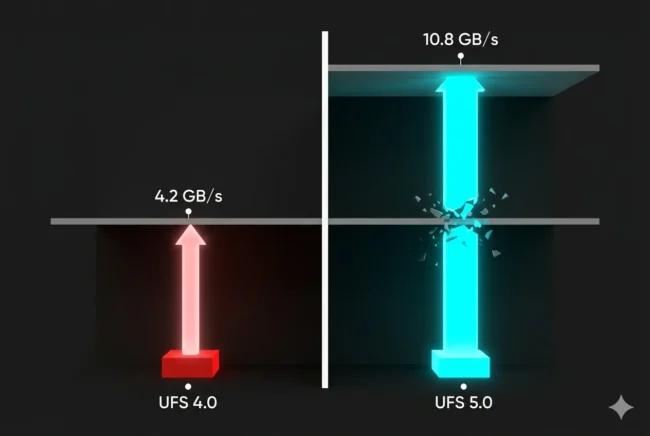
10.8 GB/s Throughput: By combining two lanes, top-tier flash memory from suppliers like Kioxia achieves an effective sequential read/write speed of 10.8 GB/s. This completely obliterates the 4.2 GB/s limit of standard UFS 4.0, effectively putting PCIe Gen 4 desktop SSD performance directly into a smartphone chassis.
The Power Penalty of Speed: Moving data at nearly 11 Gigabytes per second requires a massive, sustained electrical current. The integrated link equalization and the sheer voltage required to drive the MIPI M-PHY v6.0 physical layer consume significantly more peak wattage during heavy read/write bursts than any previous mobile storage standard.
Local AI and the RAG Database Drain
Loading Massive LLMs: The primary driving force behind UFS 5.0 is on-device Artificial Intelligence. Loading a complex, 10-gigabyte Large Language Model (LLM) into system memory from a UFS 4.0 drive takes multiple seconds, creating jarring latency for the user. UFS 5.0 handles this instantly.
Retrieval-Augmented Generation (RAG): Modern Agentic AI relies on localized RAG databases—a continuous, highly active storage sector that the AI constantly queries to formulate autonomous actions. This means the UFS 5.0 drive is never truly idle. It is constantly being pinged at maximum speed in the background, creating a continuous, low-level battery drain that completely overwhelms traditional 5,000mAh graphite cells.
The Snapdragon 8 Elite Gen 6 Pro (SM8975)
The engine driving these massive storage arrays is Qualcomm’s most aggressive piece of silicon to date. The Snapdragon 8 Elite Gen 6 Pro is not built for efficiency; it is built for absolute, uncompromising computing supremacy.
The 2nm Thermal Reality
TSMC N2P Architecture: Built on TSMC’s bleeding-edge 2nm process, the SM8975 packs an unprecedented density of transistors. While the node is technically more efficient at baseline operations, Qualcomm is utilizing that thermal headroom to push clock speeds into desktop territory.
The 2+3+3 Configuration: The CPU relies on a brutal 2+3+3 Oryon core layout, featuring two massive Prime cores that draw immense peak wattage when spooling up for heavy single-threaded tasks like x86 emulation or heavy game engine logic.
LPDDR6 and Adreno 850: As we explored in the SM8975 leak breakdown, the Pro variant utilizes a massive 18MB GMEM block for its Adreno 850 GPU and relies on next-generation LPDDR6 memory. Driving this wider memory bus and maintaining the 18MB graphics buffer demands a constant, highly stable flow of high-voltage power from the battery controller.
The Thermal Density Problem
Concentrated Heat: Because the 2nm die is so small and so dense, it creates an extreme localized thermal hotspot. When the Adreno 850 GPU and the Oryon Prime cores are heavily utilized—such as running a native 2K game at an unlocked framerate—the heat generated cannot be passively dissipated fast enough through a standard glass smartphone back.
Link-State Throttling: If the processor hits its thermal ceiling, it instantly aggressively throttles clock speeds, ruining the flagship experience. To survive the SM8975, OEMs are being forced to adopt physical hardware interventions.
The Return of Active Cooling
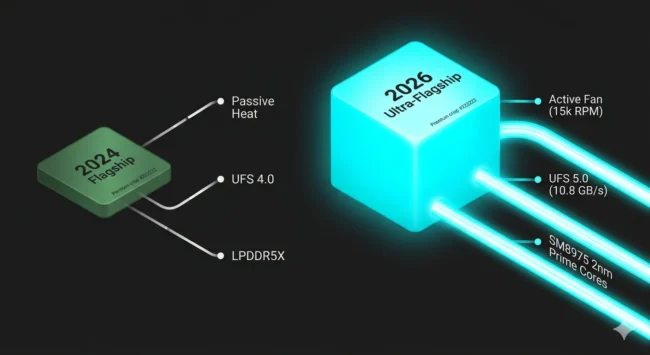
To tame the 2nm thermal density and maintain the extreme 10.8 GB/s bandwidth of UFS 5.0, smartphone manufacturers are resurrecting a feature previously reserved for niche gaming devices: active mechanical cooling fans.
Engineering the Fan
Physical Heat Exhaust: Upcoming engineering prototypes, heavily rumored to be the iQOO 16 and the Honor WIN 2, are integrating micro-centrifugal fans directly into the logic board housing. These fans pull ambient air across a massive copper vapor chamber and physically exhaust the localized heat generated by the SM8975.
Sustained Peak Performance: This active cooling allows the Snapdragon 8 Elite Gen 6 Pro to maintain its absolute maximum boost clocks indefinitely without thermal throttling. It ensures that 3D emulation runs flawlessly and that the LPDDR6 memory doesn’t degrade under thermal stress.
The Massive Battery Toll
A Dual Drain: While active cooling solves the heat problem, it creates an immediate power crisis. A mechanical fan spinning at 15,000 RPM draws a massive, continuous current directly from the battery.
The Ultimate Power Sink: When you combine a 2nm processor running at peak boost clocks, the relentless data fetching of a UFS 5.0 storage drive, a 185Hz 2K display pushing high-fidelity frames, and an active physical fan trying to cool it all, a 5,000mAh battery will literally die in under two hours.
The 10,000mAh Silicon-Carbon Mandate
The only mathematical way to power this ultra-flagship convergence is to fundamentally rewrite the rules of mobile battery capacity. Welcome to the era of the 10,000mAh standard.
Overcoming Physical Constraints
The Si-C Revolution: A 10,000mAh battery built with traditional graphite anodes would make a smartphone as thick as a brick. The solution is the rapid adoption of Silicon-Carbon (Si-C) battery chemistry. Silicon can theoretically hold up to ten times the amount of lithium ions as graphite, resulting in a massive leap in volumetric energy density.
Premium Form Factors: This advanced Si-C chemistry allows OEMs to pack a staggering 10,000mAh (or 8,500mAh in slightly smaller models) into a chassis that remains sleek, premium, and comfortably under the 240-gram weight threshold.
Supplying the 100W Baseline
Stable High-Voltage Output: The massive capacity isn’t just about longevity; it is about voltage stability. The SM8975 Pro and the UFS 5.0 drive demand aggressive, sudden spikes in power. A 10,000mAh cell possesses the immense chemical reserves required to deliver these rapid power bursts without suffering from voltage sag, which can cause random system reboots.
Rapid Replenishment: To make a 10,000mAh battery practical, the industry has standardized highly aggressive 100W to 120W charging protocols. Advanced polymer separators within the Si-C cells allow these massive batteries to safely absorb immense wattage, pushing a dead phone to a highly usable 5,000mAh charge in less than 20 minutes.
The Verdict: The Cost of Uncompromised Hardware
The smartphone market in late 2026 is aggressively bifurcating. There will be standard, highly efficient devices meant for the masses, and then there will be the ultra-flagships.
If you want the absolute peak of mobile engineering—the blistering 10.8 GB/s speed of UFS 5.0, the uncompromised 2nm rendering power of the Snapdragon 8 Elite Gen 6 Pro, and the thermal stability of active cooling—you must accept the physical reality of powering them. The 10,000mAh Si-C battery is not a gimmick; it is a strict, non-negotiable engineering mandate required to keep the most advanced mobile hardware on the planet from dying before lunch. The era of range anxiety is over, replaced by an era of raw, brute-force capacity.