Snapdragon 8s Gen 4 vs Dimensity 9400 Plus: Comparison Specs Sheet And Review
⚡ Quick Verdict:
MediaTek Dimensity 9400 Plus is an absolute 3nm computational monster, obliterating the Snapdragon 8s Gen 4 with double the graphics horsepower (+110% FP32) and an All-Big-Core CPU layout. But here’s the catch: that ultra-flagship power demands a massive 11.4W power surge, causing stability to drop to 65.0% under heavy stress. Qualcomm’s sub-flagship 8s Gen 4 takes the opposite route, drawing a modest 5.5W to deliver a rock-solid 76.6% stability rating and class-leading battery efficiency. The bottom line: Choose MediaTek for unstoppable raw peaks and 8K video recording; choose Qualcomm for cool, sustained daily endurance that won’t cook your hands. Read on to see how these divergent philosophies hold up under real thermal loads.
MultiCore Metric
Calculated Index: Geekbench 6 Multi-Core split directly against Peak Power Draw to isolate true performance-per-watt efficiency
MultiCore Efficiency Index (MCEI) True Performance Per Watt Effeciency Score
8 Gen 5
Manufacturer: Qualcomm
Model Number: SM8735
Release/Date Quarter: Q2 2025 (April 2025)
Class/Tier: Sub-Flagship / Premium Mid-Tier
Official Page: qualcomm.com/snapdragon-8s-gen-4
Dimensity 9400
Manufacturer: MediaTek
Model Number: MT6991
Release/Date Quarter: Q2 2025 (April 2025)
Class/Tier: Ultra Flagship
Official Page: mediatek.com/mediatek-dimensity-9400
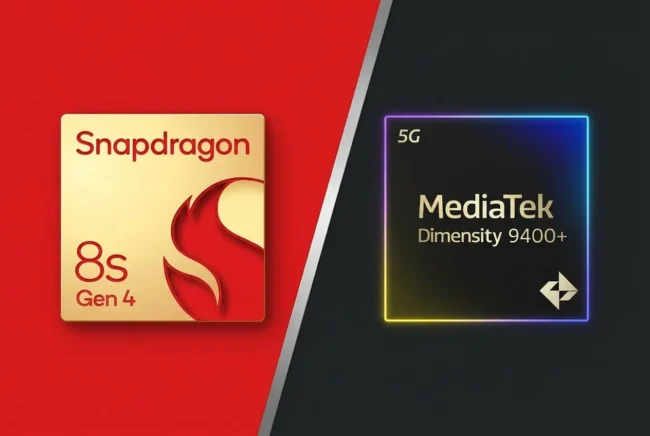
Snapdragon 8s Gen 4 vs MediaTek Dimensity 9400 Plus⚡Dimensity 9400+ dominates every benchmark — but does it actually feel faster day-to-day?
⚡ Quick Answer: Yes, under heavy loads.
Its All-Big-Core CPU and 22 MB cache give an 18.8% multi‑core lead and snappier app installs. But for simple scrolling and messaging, both chips feel similarly fluid.
✅ Power users will notice the Dimensity’s edge; casual users won’t see a huge difference.
🧠 I care about on‑device AI features. Which chip handles them better?
⚡ Quick Answer: Dimensity 9400+.
Its NPU 890 (50 TOPS) and 85.3 GB/s memory bandwidth accelerate local LLMs like DeepSeek‑R1. Snapdragon’s 76.8 GB/s pipe and lower TOPS limit token generation speed.
✅ For heavy on‑device AI, the Dimensity is the clear winner.
📸 Can the Snapdragon 8s Gen 4 shoot 8K video like the Dimensity?
❄️ Which chip runs cooler and saves more battery?
⚡ Quick Answer: Snapdragon 8s Gen 4.
It draws only 5.5 W peak vs. Dimensity’s 11.4 W, and its efficiency score is 1,295.1 vs. 742.4. The Dimensity heats up noticeably under sustained heavy tasks.
✅ For a cooler phone and longer battery during daily use, Snapdragon is far better.
📶 Is there a meaningful difference in connectivity and download speeds?
⚡ Quick Answer: Yes — Dimensity leads.
Its modem supports 4CC‑CA for 7.3 Gbps downloads and 10 km Bluetooth range. Snapdragon’s X75 peaks at 4.2 Gbps.
✅ In areas with strong carrier aggregation, Dimensity pulls ahead in network speed.
🏆 MultiCore Performance Overall Score
Overview & Core Features
Architecture & Fabrication
CPU Capabilities (Granular)
GPU & Graphics
NPU & AI Engine
Memory & Storage Support
ISP and Camera
Display and Multimedia
Connectivity and Modem
Benchmarks
Thermals and Effeciency
OVERALL SCORE
🦾 Architecture & Fabrication
Defines the silicon lithography and foundational instruction set.
Architecture & Fabrication Details
Data Review:
Qualcomm relies on a staggered layout to prioritize thermal headroom during idle operational states. Conversely, MediaTek’s aggressive 3nm “All-Big-Core” philosophy delivers devastatingly superior multi-threaded execution and IPC throughput, obliterating heavy computational workloads at the cost of higher peak active power draw.
🖥️ CPU Capabilities (Granular)
Evaluates raw processing power, core clustering, and cache layout.
CPU Cores & Clock Speed Layout
Data Review:
The architectural divergence here is profound. MediaTek completely eliminates efficiency cores and bolsters its Cortex-X925 with a massive 22MB total cache hierarchy (L3 + SLC) to prevent data stalling. Qualcomm deliberately avoids ultra-low-power A520 cores, using under-clocked A720s to ensure the sub-flagship CPU maintains a higher baseline of efficiency-tier performance.
🎮 GPU & Graphics
Highlights graphics rendering power, ray tracing, and gaming capabilities.
GPU & Gaming Graphics Engine
Data Review:
The Immortalis-G925 MC12 represents a masterclass in mobile graphics, providing 110.3% higher FP32 mathematical throughput than the Adreno 825. By utilizing hardware-backed Opacity Micromaps (OMM), the Dimensity effectively doubles its ray-tracing efficiency when rendering lifelike lighting, vegetation, and particle physics.
💾 Memory & Storage Support
Specifies memory bandwidth, RAM generations, and storage interface speeds
RAM & Storage Support
RAM Max Frequency
RAM Max Bandwidth
Data Review:
MediaTek widens its data pipeline considerably with 5333 MHz frequencies and UFS 4.1 Multi-Circular Queue (MCQ) support. This enables the storage controller to handle multiple read/write requests simultaneously without blocking the CPU, drastically reducing load times compared to the Snapdragon’s 76.8 GB/s limits.
🤖 NPU & AI Engine
Measures on-device machine learning capabilities and total compute TOPS
NPU & AI Processing Power
Data Review:
Local Large Language Model (LLM) execution fluidity is heavily dictated by TOPS density and memory bandwidth. MediaTek’s verifiable 50 TOPS guarantees instantaneous on-device agentic AI inference and native support for DeepSeek-R1-Distill. Qualcomm’s Hexagon setup remains competent for background semantic segmentation, but its lack of verifiable high-end TOPS restricts foundational local AI execution.
🎥 ISP and Camera
Details image signal processing, sensor support, and video encoding
Camera ISP & Video Capabilities
Data Review:
To maintain strict market segmentation between its flagship and sub-flagship tiers, Qualcomm deliberately hard-caps the 8s Gen 4’s maximum video capture at 4K @ 60 FPS. Conversely, the Dimensity 9400 Plus is unconstrained, supporting immense optical pipelines capable of 8K @ 60 FPS video capture and hardware-level AI segmentation.
📺 Display and Multimedia
Outlines on-device display resolution, external monitor support, and decoding
Display Resolution & Multimedia
Data Review:
Display telemetry strongly highlights the ultra-flagship nature of the MediaTek chip. While the Snapdragon comfortably supports WQHD+ at 144 Hz, the Dimensity 9400 Plus drives WQHD+ panels up to a smoother 180 Hz and features a specialized Tri-port MIPI interface engineered specifically to manage pixel routing on next-generation tri-fold screens.
🌐 Connectivity and Modem
Covers cellular modem capabilities, Wi-Fi standards, and network speeds
5G Modem & Wireless Connectivity
Data Review:
To manage costs, the Snapdragon 8s Gen 4 restricts the X75 modem strictly to Sub-6 GHz frequencies, omitting mmWave and capping the theoretical downlink at 4.2 Gbps. MediaTek pushes 7.3 Gbps downlinks utilizing 4-Component Carrier Aggregation and features a proprietary 10km direct phone-to-phone Bluetooth connection protocol.
Benchmarks & Performance Metrics
Analyzes synthetic test scores across popular performance benchmarking platforms
AnTuTu v11 Score
The AnTuTu Benchmark measures CPU, GPU, RAM, and I/O performance in different scenarios to reveal real-world bottlenecks and latency issues.
CPU
GPU
Memory
UX
Data Review:
Dimensity 9400 Plus shatters the 2.8 million point barrier, securing a monumental 19.2% aggregate victory over the Snapdragon 8s Gen 4. MediaTek’s FP32 throughput yields a 26.4% higher graphical score, while a 14.8% UX advantage ensures marginally more fluid daily database and UI scrolling navigation.
Geekbench 6
The GeekBench test shows raw single-threaded and multithreaded CPU performance, providing precise data on computational throughput and efficiency under load.
Single-Core
Multi-Core
Data Review:
Cortex-X925 core in the Dimensity dominates the Snapdragon’s Cortex-X4, yielding a 21.8% single-core advantage. In multi-core workloads, the absolute absence of low-power efficiency cores allows MediaTek to push parallel pipelines resulting in an 18.8% superior completion rate.
3D Mark
A cross-platform benchmark that assesses graphics performance in Vulkan (Metal) ensures fair GPU comparisons across operating systems and hardware configurations.
3DMark Steel Nomad Light
3DMark Solar Bay
3DMark Wild Life Extreme
Data Review:
MediaTek’s astonishing +126.0% lead in Solar Bay and +115.2% gap in Wild Life Extreme dictates that the Dimensity 9400 Plus will render top-tier mobile titles effortlessly. Conversely, the Snapdragon 8s Gen 4’s metrics highlight a strict capability ceiling designed for current-gen rasterization rather than aggressive forward-looking ray-traced engines.
PCMark 3.0
Benchmark for evaluating overall system performance in everyday workloads ties all results together, simulating real tasks for a holistic view of responsiveness and daily computing speed clearly.
Web Score
Video Editing Score
Photo Editing Score
Writing Score
Data Review:
The 11.4% total score advantage for the Dimensity indicates that even in everyday Android tasks that do not push the CPU to 100% utilization, the 3nm lithography and faster LPDDR5X RAM contribute to noticeably quicker completion times.
🌡️ Thermals and Effeciency
Measures sustained workload stability and peak power consumption metrics
Thermals, Power Draw & Efficiency
3D Mark Stability
Power Draw
Data Review:
The Qualcomm Snapdragon 8s Gen 4 achieves a definitive architectural victory in thermal management. By intentionally capping peak clocks and utilizing a smaller GPU footprint, it draws an incredibly frugal 5.5W, sustaining a 76.6% stability rating. The Dimensity 9400 Plus draws up to 11.4W under peak load, saturating cooling chambers and triggering aggressive thermal throttling that drops stability to 65.0%.
🏆 MultiCore Performance Final Verdict
| CRITERIA | 8s GEN 4 | DIMENSITY 9400+ | EXPLANATION |
|---|---|---|---|
| Peak CPU Burst | ⭐⭐⭐⭐ | ⭐⭐⭐⭐⭐ | Dimensity. Cortex-X925 core and All-Big-Core layout lead Geekbench multi-core by 18.8%. |
| Sustained Gaming | ⭐⭐⭐⭐⭐ | ⭐⭐⭐ | Snapdragon. Capping power at 5.5W holds 76.6% stability, avoiding the aggressive throttling of the 11.4W Dimensity. |
| Thermal Efficiency | ⭐⭐⭐⭐⭐ | ⭐⭐⭐ | Snapdragon. MCEI of 1295.1 vs 742.4. Consumes 51.8% less peak wattage, keeping the chassis significantly cooler. |
| Cache Integration | ⭐⭐⭐ | ⭐⭐⭐⭐⭐ | Dimensity. A massive 22MB L3+SLC cache block prevents memory bus latency during heavy workloads. |
| Data Memory Bandwidth | ⭐⭐⭐⭐ | ⭐⭐⭐⭐⭐ | Dimensity. 5333 MHz LPDDR5X controller delivers 85.3 GB/s bandwidth for fast local AI token generation. |
| Connectivity Standards | ⭐⭐⭐⭐ | ⭐⭐⭐⭐⭐ | Dimensity. 4CC-CA modem pushes 7.3 Gbps download speeds and features 10km direct Bluetooth. |
| Platform Workload Flow | ⭐⭐⭐⭐ | ⭐⭐⭐⭐⭐ | Dimensity. Wins PCMark Work 3.0 across all sub-scores thanks to 3nm N3E lithography. |
chip name: Who Is It For?
| 🚀 CHOOSE THE SNAPDRAGON 8s GEN 4 IF YOU… | 🎮 CHOOSE THE DIMENSITY 9400+ IF YOU… |
|---|---|
| Want a cool comfortable phone during extended gaming sessions with 5.5W low power draw. | Demand absolute maximum graphics throughput and 126% faster ray tracing in heavy AAA titles. |
| Seek an affordable “flagship killer” device that maintains smooth daily OS navigation. | Run local Large Language Models (LLMs) requiring 50 INT8 TOPS and 85.3 GB/s memory bandwidth. |
| Value high battery longevity and sustained 76.6% thermal stability over synthetic peaks. | Require high-end video recording capabilities including 8K60 capture and 320MP camera support. |
The Bottom Line: Final Summary
💡Pro Tip For Users
Snapdragon 8s Gen 4 owners: Keep the phone’s software up to date — Qualcomm’s driver updates often improve app compatibility and idle drain. Use the built‑in battery‑bypass charging (if available) when plugged in for long periods to reduce heat and preserve battery health.
Dimensity 9400+ owners: To manage the 11.4 W heat, avoid using heavy apps while fast‑charging. Enable Wi‑Fi 7 Tri‑Band for faster, cooler downloads, and activate the Adaptive Battery setting to restrict background AI tasks that spike power draw.
Both platforms: After every major OS update, clear the system cache partition and let the phone idle on Wi‑Fi for an hour to complete background optimization. This simple habit restores smooth performance and prevents post‑update stutter.