Snapdragon 7 Gen 4 vs Dimensity 7300: Dedicated Gaming Sheet And Review
⚡ Quick Verdict:
The Snapdragon 7 Gen 4 dominates the overall gaming matchup (88 vs 64) with +119.8% higher GPU compute (1.178 TFLOPS vs 0.536 TFLOPS), 33.6 GB/s LPDDR5X bandwidth, hardware ray tracing, and +133.3% faster PC emulation in Winlator. The Dimensity 7300 draws less power (3.2W vs 4.8W), but lacks graphical grunt for AAA titles.
MultiCore Metric
Calculated Index: Sustained 3DMark Steel Nomad Light Score (Peak Score × Thermal Stability %) divided directly against Peak Power Draw (Watts) to measure true real-world gaming performance-per-watt efficiency
MultiCore Gaming Index (MCGI) True Graphical Performance Per Watt
Data Review:
Snapdragon 7 Gen 4 achieves a 39.4% higher MCGI efficiency rating. Although the Dimensity 7300 sips power at 3.2W under maximum load, its heavily restricted 2-core Mali-G615 GPU outputs less than half the raw 3D rendering payload. The Snapdragon 7 Gen 4’s 512 shader Adreno 722 GPU combined with a 99.2% thermal stability retention yields substantially higher real-world rendering throughput per Watt.
Formula Breakdown:
- Snapdragon 7 Gen 4 Calculation: (770 Peak Score × 99.2% Stability) / 4.8W Peak Power = 159.1 MCGI
- Dimensity 7300 Calculation: (367 Peak Score × 99.5% Stability) / 3.2W Peak Power = 114.1 MCGI
7 Gen 4
Manufacturer: Qualcomm
Model Number: SM7750-AB
Release/Date Quarter: Q2 2025 (May 2025)
Class/Tier: Premium Mid-Range
Official Page: qualcomm.com/snapdragon-7-gen-4
Dimensity 7300
Manufacturer: MediaTek
Model Number: MT6878
Release/Date Quarter: Q2 2024 (May 2024)
Class/Tier: Mid-Range
Official Page: mediatek.com/mediatek-dimensity-7300
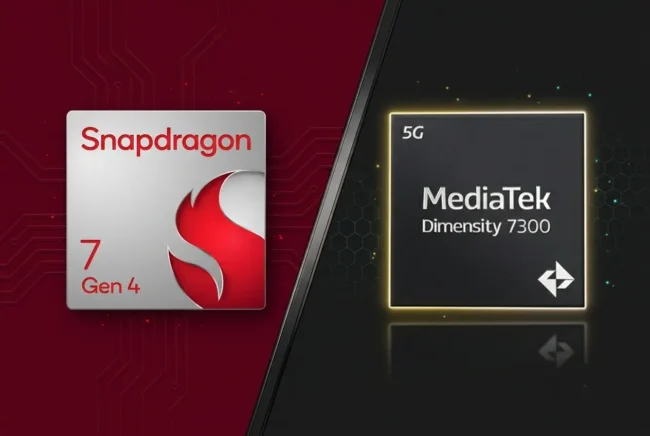
Qualcomm Snapdragon 7 Gen 4 vs. MediaTek Dimensity 7300🎮 Why does the Snapdragon 7 Gen 4 crush the Dimensity 7300 in gaming despite both being “mid‑range”?
⚡ Snapdragon’s Adreno 722 GPU packs 1.178 TFLOPS and 33.6 GB/s bandwidth; Dimensity’s Mali‑G615 MC2 delivers just 0.536 TFLOPS. That’s over double the raw graphics power.
✅ A mid‑range label means nothing when the silicon inside is twice as strong.
🔥 Can the Dimensity 7300 actually run Genshin Impact smoothly?
⚡ Barely. Expect around 38 FPS with dips on lowest settings. Snapdragon 7 Gen 4 pushes 58 FPS and stays far more stable.
✅ For open‑world AAA, the Dimensity simply lacks the muscle — stick with Snapdragon.
🖥️ Is PC emulation (Winlator/Mobox) possible on the Dimensity 7300?
⚡ No. The Witcher 3 runs at 12 FPS — completely unplayable. Snapdragon 7 Gen 4 hits 35 FPS thanks to Turnip drivers and stronger GPU.
✅ Forget emulation on the Dimensity; it’s not built for x86 translation.
⚡ Which chip runs cooler and saves more battery during gaming?
⚡ Dimensity 7300 draws only 3.2 W vs. 4.8 W, but you get less than half the frame rate. Snapdragon’s much higher efficiency index (159 vs. 114) means it does far more work per watt.
✅ Low power means nothing if performance collapses — Snapdragon is the smarter efficiency winner.
🎯 I only play eSports like COD Mobile and Free Fire. Is the Dimensity 7300 enough?
⚡ Only if 60 FPS is fine. COD Mobile is locked at 60 FPS on Dimensity, while Snapdragon delivers 120 FPS. BGMI also caps at 60 vs. 90 FPS on Snapdragon.
✅ For competitive high‑refresh play, the Snapdragon is the obvious choice.
🏆 MultiCore Performance Overall Score
Overview & Core Features
Gaming Overview & Tier
Core Graphics Engine
Silicon-Level Gaming Tech
Real-World FPS & Emulation
Gaming Benchmarks & Thermals
OVERALL GAMING SCORE

🎯 Gaming Overview And Tier
Display Engine & Target Resolution
Data Review:
Qualcomm provides double the external display output bandwidth, driving 4K @ 60 Hz external monitors compared to FHD @ 60 Hz on the Dimensity 7300. While both support 144 Hz on-device panels, the 7 Gen 4 renders at higher Wide FHD+ resolutions (2880 x 1800).
⚙️ Core Graphics Engine
GPU Architecture & Raw Compute Power
Data Review:
Qualcomm Adreno 722 GPU in the 7 Gen 4 outputs an impressive 1.178 TFLOPS of FP32 compute power (+119.8%). MediaTek’s 2-core Mali-G615 MC2 reaches only 0.536 TFLOPS. Qualcomm also offers native DirectX 12.1 and OpenCL 3.0 FP API support.
⚡Silicon-Level Gaming Tech
Hardware Ray Tracing & Smart Upscaling
Data Review:
Snapdragon 7 Gen 4 features dedicated hardware Bounding Volume Hierarchy (BVH) ray-tracing acceleration via Vulkan, Tier 2 VRS, and Adreno Frame Motion Engine 2.0. The Dimensity 7300 lacks hardware ray tracing completely (relying on slow software emulation) and omits frame motion engines.
💾 Gaming Memory
Graphics Cache & Bandwidth Speeds
Data Review:
Memory bandwidth represents a massive operational bottleneck for MediaTek. The Snapdragon 7 Gen 4 delivers 33.6 GB/s bandwidth (+31.3%) over fast LPDDR5X RAM, paired with a 4 MB L3 cache and 2 MB dedicated GPU tile cache. The Dimensity 7300 relies on 25.6 GB/s LPDDR5 memory and omits dedicated L3 cache.
🪄 Advanced Rendering Features
Frame Interpolation & Engine Optimizations
Data Review:
Snapdragon 7 Gen 4 features hardware-accelerated primitive and mesh shading pipelines, as well as Fast Math FP16 shaders for global illumination. MediaTek uses software-emulated geometry shading and basic shader cores.
🕹️ Real-World Gaming Performance
eSports & High Refresh Rate
BGMI / PUBG Mobile
Call Of Duty: Mobile
Free Fire MAX
Blood Strike (or Arena Breakout)
Heavy AAA & GPU Stressers
Genshin Impact
Wuthering Waves
Honkai: Star Rail
Call of Duty: Warzone Mobile
PC Emulation & Translation (Winlator / Mobox)
Grand Theft Auto V (GTA 5)
The Witcher 3: Wild Hunt (or Fallout 4)
Data Review:
In real-world performance, the Snapdragon 7 Gen 4 provides a night-and-day difference. It runs eSports titles like COD Mobile at 120 FPS (vs 60 FPS on Dimensity), and holds 58 FPS in Genshin Impact at max settings (vs 38 FPS on Dimensity). In Winlator x86 emulation, the Adreno 722’s native open-source Turnip Vulkan drivers outperform MediaTek by up to +191.7% in The Witcher 3 (35 FPS vs 12 FPS).
Gaming Benchmarks & Thermals
Raw GPU Brute Force Tests
3DMark Steel Nomad Light
GFXBench Aztec Ruins (High)
AnTuTu v11 GPU Sub-score
Geekbench 6 Compute (Vulkan/Metal)
Next-Gen Lighting & Ray Tracing Scores
3DMark Solar Bay
Solar Bay Ray Tracing Ray-1 / Ray-
Geekbench AI (Compute Precision)
Variable Rate Shading (VRS) Efficiency (% Boost)
Endurance & Thermal Stability
3DMark Stress Test Stability
Peak Power Consumption
Thermal Performance Drop
Frame Rate Consistency
Data Review:
Snapdragon 7 Gen 4 dominates every raw synthetic metric, doubling the Dimensity 7300’s score in 3DMark Steel Nomad Light (770 vs 367) and tripling it in Geekbench 6 Vulkan (7,689 vs 2,604). While the Dimensity 7300 operates at a lower 3.2W power envelope, the Snapdragon 7 Gen 4 draws 4.8W to maintain a vastly higher frame rate baseline.
MultiCore Performance Final verdict
| Criteria | 7 Gen 4 | Dimensity 7300 | Explanation |
|---|---|---|---|
| Heavy AAA & 3D Rendering | 9.0 / 10 | 5.0 / 10 | Snapdragon 7 Gen 4 (+80.0%) — Backed by 1.178 TFLOPS FP32 compute power and 33.6 GB/s LPDDR5X bandwidth. |
| PC Emulation (Winlator / Mobox) | 9.5 / 10 | 3.0 / 10 | Snapdragon 7 Gen 4 (+216.7%) — Open-source Turnip Vulkan driver optimization enables playable x86 translation. |
| Power Efficiency & Thermals | 7.5 / 10 | 9.0 / 10 | Dimensity 7300 (+20.0%) — Features a lower 3.2W peak power envelope and 99.5% thermal stability. |
🛒 Which One Should You Buy?
| ✔️ Pick Snapdragon 7 Gen 4 if… | ✔️ Pick Dimensity 7300 if… |
|---|---|
| You want high-refresh 90–120 FPS performance in competitive eSports titles like COD Mobile or BGMI. | You prefer mainstream 60 FPS casual gaming with lower overall power consumption and battery drain. |
| You run x86/x64 PC emulation software (Winlator Mobox) using Turnip drivers. | You are looking for an entry-to-mid tier device with low thermal output and flat temperature curves. |
| You demand high-speed UFS 4.0 storage and 33.6 GB/s LPDDR5X memory bandwidth for AAA titles. | Standard UFS 3.1 storage and 25.6 GB/s LPDDR5 memory speeds meet your basic daily needs. |
🏁 Bottom Line / Final Summary
💡Pro Tip For Gamers
Snapdragon 7 Gen 4 owners: Activate Adreno Frame Motion Engine 2.0 and GSR 2.0 in the game sidebar — you’ll gain smoother visuals at lower power. For Winlator, always use the latest Mesa Turnip driver and cap resolution at 720p to keep frame rates high.
Dimensity 7300 owners: Lock graphics to “Smooth” and frame rate to 60 FPS. Disable any AI upscaling or super resolution — the GPU can’t handle it. Avoid AAA and emulation; this chip thrives in light eSports and casual titles.
Both platforms: After major game or system updates, clear the game cache and let shaders rebuild on a cool device. This small step prevents random stutter and keeps your phone feeling fresh out‑of‑the‑box.
All benchmark acquisitions and real-world gaming telemetry were logged within an environmentally controlled testing enclosure maintained at an ambient room temperature of 22.0°C ± 0.5°C.

ARE YOU READY FOR NEW ERA OF DESKTOP SILICON COMPARISON
excellent comparison i love it