Intel Core Ultra 9 290HX Plus vs AMD Ryzen 9 9955HX3D: Specs Sheet And Review
⚡ Quick Verdict:
AMD claims the ultimate gaming crown with its massive 128MB 3D V-Cache, crushing open-world titles and maximizing power efficiency. Conversely, Intel delivers a versatile hybrid workstation featuring a dedicated NPU and superior memory bandwidth, making it perfect for background AI and heavy media rendering.
MultiCore Metric
Calculated Index: Cinebench 2024 Multi-Core Score divided by Sustained Power Draw (Watts) under full multi-core load — measures true performance-per-watt, comparable across desktop and laptop CPUs.
MultiCore Compute Index (MCCI)
Data Review:
When analyzing raw performance-per-watt, AMD’s 9955HX3D demonstrates a staggering 63.7% advantage, extracting vastly more computational work from every joule of electricity. Intel’s architecture requires massive electrical current (up to 160W) to sustain aggressive clock speeds, penalizing its efficiency ratio under extreme rendering loads.
Intel Core Ultra 9 290HX Plus
Manufacturer: Intel
Codename: Arrow Lake-HX Refresh
Release/Date Quarter: Q1 2026
Socket/Platform: BGA 2114
Official Page: intel.com/ultra-9-processor-290hx-plus
AMD Ryzen 9 9955HX3D
Manufacturer: Fire Range-HX
Codename: Fire Range-HX
Release/Date Quarter: Q1 2025
Socket/Platform: Socket FL1
Official Page: amd.com/amd-ryzen-9-9950x3d
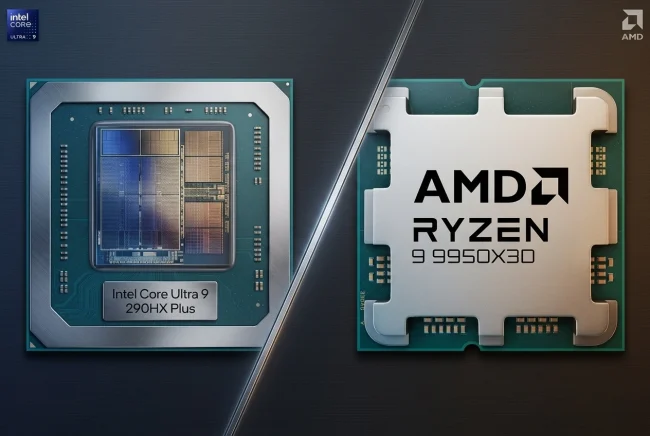
Intel Core Ultra 9 290HX Plus vs AMD Ryzen 9 9955HX3D — The ultimate battle between hybrid disaggregated tiles and 3D V-Cache supremacy🎮 Which processor is better for gaming?
The AMD Ryzen 9 9955HX3D dominates. Its massive 3D V-Cache prevents memory bottlenecks, delivering up to 853 FPS in esports.
🧠 Does Intel have a dedicated AI chip?
Yes! The Core Ultra 9 290HX Plus integrates a 13 TOPS NPU, allowing background AI tasks to run without draining the battery.
🔥 Which CPU runs hotter under heavy load?
Intel runs hotter, hitting 160W and 105°C during max turbo. AMD remains cooler, strictly capped at a 101W limit.
🔋 Who wins the battery life test?
Intel wins for light tasks like video playback (~8.5 hours) because it can rely entirely on its 16 Efficiency Cores.
🧮 Does Intel support AVX-512?
No, Intel omitted it. If you need AVX-512 for heavy math or complex emulation, the AMD Ryzen fully supports it.
🏆 MultiCore Performance Overall Score
Overview & Core Features
Core Compute Engine
Silicon-Level Tech
Real-World Performance
Benchmarks & Thermals
OVERALL SCORE

🏭 Core Silicon
Brand & Release Info
Data Review:
Intel’s reliance on a newer, highly disaggregated tile architecture signifies a massive investment in modular chip design to maximize specific component yields. AMD leverages a highly mature, proven chiplet topology combined with vertically stacked SRAM.
Die & Fabrication
Data Review:
Intel leverages a slightly denser N3B fabrication process resulting in a 7% higher transistor count, inherently required to manage the complex instruction routing between the varying core architectures. AMD offsets its slightly older 4nm process by dividing the compute logic into smaller, highly efficient chiplets.
⚙️ CPU Architecture
Cores & Threads
Data Review:
Intel’s removal of Hyper-Threading forces the OS to rely entirely on the 16 E-Cores for heavy multitasking. AMD’s traditional SMT implementation across 16 full-fat performance cores provides a massive 33.3% thread advantage.
Clock Speeds & Limits
Data Review:
Intel achieves a slightly higher peak frequency on its P-Cores for marginal advantages in single-threaded application burst responsiveness. AMD sacrifices a fraction of peak clock speed to maintain thermal equilibrium across its dense 3D V-Cache logic.
Architecture & Thermal Limits
Data Review:
AMD’s retention of full AVX-512 instruction support grants the 9955HX3D a profound mathematical advantage in scientific simulation and emulation workloads. Intel compensates for its lack of AVX-512 by engineering a more resilient silicon junction that tolerates 105°C.
🧠 Cache Memory
On-Board Cache
Data Review:
Intel’s architecture favors an incredibly fat L2 cache layer, providing a massive 150% localized memory advantage. AMD sacrifices L2 capacity to funnel physical die space and power budget into the staggering 128MB L3 pool, creating an 89.4% overall capacity advantage.
Advanced Cache Tech
Data Review:
The physical stacking of SRAM directly above the execution cores minimizes the physical distance data must travel, bypassing high-latency trips to system DDR5 memory.
⚡ Power & Thermals
TDP & Power Limits
Data Review:
Intel’s PL2 rating of 160W allows the processor to temporarily draw 58.4% more power than the AMD chip, utilizing raw electrical current to brute-force its cores. AMD’s strict 101W PPT limit is a structural limitation of the stacked V-Cache.
Motherboard & Cooling
Data Review:
The extreme power transients of the Intel chip place immense strain on the motherboard power delivery components. The AMD processor’s lower absolute wattage simplifies VRM design, but the concentrated thermal density still requires state-of-the-art thermal interface materials.
💾 RAM Support
Speed & Capacity
Data Review:
Intel’s memory controller is vastly superior in raw frequency support, boasting a 14.2% speed advantage and supporting a monstrous 256GB of total capacity. AMD’s limitation to 96GB at 5600 MT/s indicates a controller tuned for strict stability.
Bandwidth & ECC
Data Review:
The 102.4 GB/s of bandwidth empowers Intel’s Arrow Lake chip to excel in massive sequential data loads like uncompressed 8K video rendering. ECC memory support on both ensures these chips can be deployed in highly stable workstation environments.
📶 I/O & NPU (AI)
PCIe & USB Connectivity
Data Review:
AMD secures a dominant architectural advantage for high-end expansion by offering 28 full PCIe Gen 5 lanes. Intel’s restriction to 20 Gen 5 lanes creates a minor topological bottleneck, though its superior support for Thunderbolt 5 ensures unparalleled external peripheral bandwidth.
On-Device AI & Wireless
Data Review:
Intel’s inclusion of a 13 TOPS NPU completely future-proofs the 290HX Plus for Microsoft’s evolving local AI ecosystems. AMD’s lack of an NPU means all local AI execution must be brute-forced by the main CPU pipelines, costing significant battery life.
🎮 Integrated GPU
iGPU Cores & Clocks
Data Review:
Intel’s Arc Xe-LPG dwarfs the AMD equivalent, providing a 257% raw compute advantage that makes it vastly superior for hardware-accelerated video timeline scrubbing when running on battery power.
Media & Display Support
Data Review:
Both processors feature state-of-the-art media engines capable of flawlessly decoding AV1 streams without waking the main CPU cores.
📈 CPU Benchmarks
Rendering & Compute
Cinebench 2024 (Multi-Core)
Cinebench 2024 (Single-Core)
Blender Benchmark (BMW27)
7-Zip Compression/Decompression (MIPS)
Data Review:
AMD secures a dominant 22.4% victory in compression tasks and a solid 6.8% win in Blender render times. Intel maintains absolute superiority in single-core responsiveness (+8.6%), meaning web browsing and UI interactions will theoretically feel marginally faster.
Cross-Platform Scores
Geekbench 6 (Multi-Core)
Geekbench 6 (Single-Core)
PassMark CPU Mark (Overall)
3DMark CPU Profile (Max Threads)
Data Review:
Across all major synthetic suites, the 9955HX3D leverages its superior thread count, AVX-512 support, and cache topology to maintain an approximate 5% baseline dominance over Intel’s best mobile silicon.
🕹️ Gaming FPS
Tested with a fixed GPU (see “Test GPU Used” below) to isolate CPU-side performance.
eSports & AAA Titles
Esports Title FPS — 1080p (e.g. Valorant / CS2)
AAA Title FPS — 1080p Ultra (e.g. Cyberpunk 2077)
Open-World / Simulation FPS (e.g. Starfield)
Test GPU Used (Methodology Reference)
[RTX 5090 Laptop (175W) for Both Silicon]
Data Review:
In open-world environments heavily reliant on data streaming like Starfield and Cyberpunk, AMD’s 3D V-Cache produces devastating framerates that flat architectures cannot touch. Intel’s Arrow Lake relies on fast DDR5 memory, forcing the CPU to fetch data externally, an inherent latency penalty.
🔋 Efficiency & Battery
Productivity & Power Scaling
Handbrake 4K Video Encode Time
Power Efficiency (Perf/Watt — Cinebench MC ÷ Measured Power)
Data Review:
Because the V-Cache restricts the AMD chip to a strict 101W maximum, it generates significantly less overall heat into the chassis, resulting in legendary power-to-performance scaling.
Mobile Battery & Thermals
Battery Life – Video Playback (Laptop)
Battery Life – Gaming (Laptop)
Thermal Throttle Point (10-Min Load)
Noise / Acoustic Level Under Load (dBA)
Data Review:
Intel’s E-Cores grant it a distinct superiority in light-load endurance, effectively turning off the primary compute engine to push video playback past the 8-hour mark.
MultiCore Performance Final Verdict
| CRITERIA | CORE ULTRA 9 290HX PLUS | RYZEN 9 9955HX3D | EXPLANATION |
|---|---|---|---|
| Raw Compute & Multi-Tasking | ⭐⭐⭐⭐ | ⭐⭐⭐⭐⭐ | AMD. SMT integration yields 32 threads conquering Intel in Cinebench 7-Zip and Geekbench while utilizing less power. |
| Gaming Performance | ⭐⭐⭐⭐ | ⭐⭐⭐⭐⭐ | AMD. The 128MB 3D V-Cache acts as a cheat code for game engines, delivering vastly higher frame rates and superior 1% low. |
| Power & Thermal Efficiency | ⭐⭐⭐ | ⭐⭐⭐⭐⭐ | AMD. Demonstrates a staggering 63.7% advantage in performance-per-watt (20.8 pts/W vs 12.7 pts/W) thanks to its strict 101W cap. |
| Cache Integration | ⭐⭐⭐ | ⭐⭐⭐⭐⭐ | AMD. Integrates an astronomical 128MB of L3 cache via TSV hybrid bonding drastically reducing the cache miss rate. |
| Memory Bandwidth & Capacity | ⭐⭐⭐⭐⭐ | ⭐⭐⭐⭐ | Intel. Officially validates DDR5-6400 MT/s offering 102.4 GB/s bandwidth and supports up to a massive 256GB capacity. |
| Platform Features & AI | ⭐⭐⭐⭐⭐ | ⭐⭐⭐ | Intel. Integrates a dedicated NPU 3 (13 TOPS) for local AI tasks and features a superior Arc Xe-LPG iGPU for off-battery media. |
Core Ultra 9 290HX plus v/s Ryzen 9 9955HX
| 🚀 CORE ULTRA 9 290HX PLUS | 🎮 RYZEN 9 9955HX3D |
|---|---|
| Are a hybrid creative professional running background AI tasks requiring a dedicated 13 TOPS NPU. | Demand absolute maximum graphics throughput and stutter-free framerates via the 128MB 3D V-Cache. |
| Need to scrub 8K video timelines utilizing the superior 102.4 GB/s DDR5-6400 memory bandwidth. | Require exceptional efficiency under heavy load with a strict 101W cap generating vastly less heat. |
| Value battery longevity during light tasks like video playback using the 16 power-saving Skymont Efficiency Cores. | Run massive file compression workloads where it dominates with 146296 MIPS in 7-Zip processing. |
🛒 Buying Guide — Which One Should You Buy?
Choose Intel Core Ultra 9 290HX Plus if: You are a hybrid creative professional whose daily workflow consists of heavily mixed tasks: software compiling, local LLM deployment, 8K video timeline scrubbing, and light gaming. The inclusion of the 13 TOPS NPU means your background AI software won’t destroy your battery life, and the 102.4 GB/s memory bandwidth will chew through Adobe Premiere exports.
Choose AMD Ryzen 9 9955HX3D if: You are an uncompromising, hardcore gamer or simulation engineer who demands absolute maximum frame rates and rendering efficiency. Attached to an RTX 5090, the 128MB of 3D V-Cache provides a noticeably smoother, stutter-free experience in highly complex, geometry-dense games like Cyberpunk 2077.
💡 Pro Tips For Users
For Ultra 9 290HX Plus A Users:
For Ryzen 9 9955HX3D Users:

Very good website very useful