Intel Core Ultra 5 245K vs AMD Ryzen 5 7600X: Specs Sheet And Review
⚡ Quick Verdict:
The Intel Core Ultra 5 245K crushes multi-threaded productivity, leveraging 14 physical cores and 3nm efficiency to deliver 79% faster rendering and superior power scaling. The AMD Ryzen 5 7600X remains a resilient, cost-effective pure-gaming champion, offering low memory latency and guaranteed AM5 socket longevity.
MultiCore Metric
Calculated Index: Cinebench 2024 Multi-Core Score divided by Sustained Power Draw (Watts) under full multi-core load — measures true performance-per-watt, comparable across desktop and laptop CPUs.
MultiCore Compute Index (MCCI)
Data Review:
Power-to-performance scaling showcases the ultimate triumph of TSMC’s 3nm node combined with Skymont efficiency cores, yielding a massive 60.3% advantage in work-per-watt metrics. Encoding 4K video takes 56 seconds on the 245K versus 85 seconds on the 7600X, saving valuable production time.
Intel Core Ultra 5 245K
Manufacturer: Intel
Codename: Arrow Lake-S
Release/Date Quarter: October 24, 2024 (Q4 2024)
Socket/Platform: LGA 1851
Official Page:
AMD Ryzen 5 7600X
Manufacturer: AMD
Codename: [Codename]
Release/Date Quarter: September 27, 2022 (Q3 2022)
Socket/Platform: AM5
Official Page:
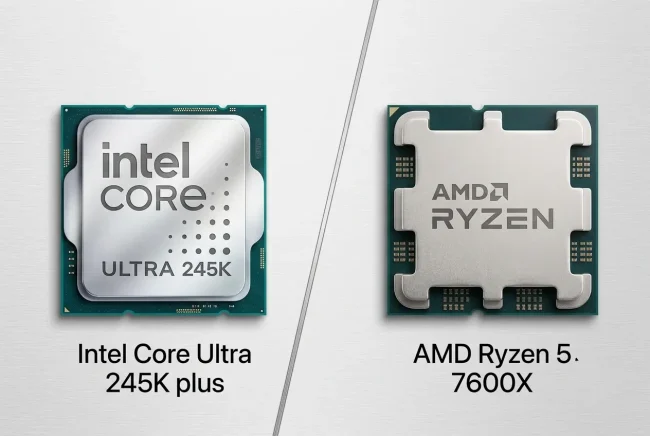
Intel Core Ultra 5 245K vs AMD Ryzen 5 7600X — 14-core hybrid architectural dominance meets proven AM5 desktop gaming value🎮 Which CPU is better for pure gaming?
It’s a tie. The Ryzen 5 7600X wins in latency-sensitive open-world games like Cyberpunk 2077 (53.4 FPS), while the Ultra 5 245K leads in Spider-Man 2 (130 FPS).
⚡ Which processor has better power efficiency?
Intel wins decisively. The Ultra 5 245K scores 9.54 pts/W in Cinebench versus AMD’s 5.95 pts/W, representing a 60.3% efficiency lead under load.
🧠 Does either desktop processor feature an AI NPU?
Yes! The Core Ultra 5 245K integrates a dedicated 13 TOPS NPU 3, while the Ryzen 5 7600X lacks dedicated on-die AI hardware.
🔥 Do these CPUs include a stock cooler in the box?
No. Neither chip includes a bundled cooler; both require a dedicated aftermarket air or 240mm/360mm AIO liquid cooler.
🔄 Which platform offers better future upgradeability?
AMD’s AM5 socket guarantees motherboard compatibility through 2027+, whereas the new LGA 1851 socket has an unconfirmed lifespan.
🏆 MultiCore Performance Overall Score
Overview & Core Features
Core Compute Engine
Silicon-Level Tech
Real-World Performance
Benchmarks & Thermals
OVERALL SCORE
No related comparisons found.
🏭 Core Silicon
Brand & Release Info
Data Review:
The chronological advantage firmly belongs to Arrow Lake-S, which leverages a two-year release delta to implement disaggregated Foveros 3D packaging.
Die & Fabrication
Data Review:
TSMC’s cutting-edge N3B process allows Intel to pack 17.8 billion transistors into an efficient footprint. While Zen 4 relies on a mature 5nm node, the AM5 platform guarantees superior longevity.
⚙️ CPU Architecture
Cores & Threads
Data Review:
Eliminating Hyper-Threading forces Intel’s 14 physical cores to shoulder workloads directly, giving it massive hardware width over AMD’s 6-core/12-thread symmetric design.
Clock Speeds & Limits
Data Review:
Zen 4 maintains a slightly higher 5.3 GHz peak boost. Intel mitigates this by distributing background tasks to its 4.6 GHz Skymont clusters.
Architecture & Thermal Limits
Data Review:
Full AVX-512 support gives AMD a mathematical edge in emulation. Intel compensates by raising TjMax to 105°C for longer thermal boost windows.
🧠 Cache Memory
On-Board Cache
Data Review:
Intel’s massive 26 MB L2 cache layer keeps data close to individual cores. AMD relies on a unified 32 MB L3 cache to feed its 6 cores across the Infinity Fabric.
Advanced Cache Tech
Data Review:
Placing the memory controller on an adjacent SoC tile increases Intel’s latency to ~83.3 ns. AMD’s 1:1 Infinity Fabric sync achieves tighter ~65.2 ns responsiveness.
⚡ Power & Thermals
TDP & Power Limits
Data Review:
Intel’s 159W PL2 limit enables sustained multi-threaded rendering dominance, while its tile power gating drops idle consumption to just ~12W.
Motherboard & Cooling
Data Review:
Both processors omit stock coolers. AMD’s 7600X is designed to automatically boost until hitting its 95°C thermal threshold under heavy load.
💾 RAM Support
Speed & Capacity
Data Review:
The 245K supports 6400 MT/s JEDEC speeds and CUDIMM modules exceeding 8000 MT/s. AMD tops out officially at 5200 MT/s, optimizing around 6000 MT/s EXPO.
Bandwidth & ECC
Data Review:
Intel’s 102.4 GB/s memory bandwidth gives it a 23% throughput advantage during intense data compilation and video exports.
📶 I/O & NPU (AI)
PCIe & USB Connectivity
Data Review:
AMD provides 24 usable Gen 5 lanes for simultaneous GPU and NVMe SSD expansion. Intel features integrated Thunderbolt 4 and a doubled DMI 4.0 x8 chipset bus.
On-Device AI & Wireless
Data Review:
Intel’s dedicated 13 TOPS NPU offloads background machine learning tasks from the primary cores. AMD relies strictly on CPU/GPU compute.
🎮 Integrated GPU
iGPU Cores & Clocks
Data Review:
Delivering 1.95 TFLOPS, Intel’s Xe-LPG graphics provide nearly 3.5x more compute power than AMD’s 0.56 TFLOPS display adapter.
Media & Display Support
Data Review:
Full AV1 hardware encode and decode makes the 245K vastly superior for content creators and streamers.
📈 CPU Benchmarks
Rendering & Compute
Cinebench 2024 (Multi-Core)
Cinebench 2024 (Single-Core)
Blender Benchmark (BMW27)
7-Zip Compression/Decompression (MIPS)
Data Review:
The 14-core layout demolishes multi-threaded tests, outscoring AMD by 79.4% in Cinebench 2024 and finishing Blender renders 67 seconds faster.
Cross-Platform Scores
Geekbench 6 (Multi-Core)
Geekbench 6 (Single-Core)
PassMark CPU Mark (Overall)
3DMark CPU Profile (Max Threads)
Data Review:
Intel sweeps single-core and multi-core evaluations across Geekbench 6, PassMark, and 3DMark by wide margins.
🕹️ Gaming FPS
Tested with a fixed GPU (see “Test GPU Used” below) to isolate CPU-side performance.
eSports & AAA Titles
Esports Title FPS — 1080p (e.g. Valorant / CS2)
AAA Title FPS — 1080p Ultra (e.g. Cyberpunk 2077)
AAA Title FPS — 1080p Ultra (e.g. Spider-Man 2)
Open-World / Simulation FPS (e.g. Starfield)
Test GPU Used (Methodology Reference)
[NVIDIA GeForce RTX 4090 — kept identical across both chip test rigs]
Data Review:
AMD’s lower memory latency keeps it competitive in Cyberpunk and Starfield, but Intel pulls ahead in CS2 and Spider-Man 2.
Performance Stability
1% Low FPS (Average Consistency)
4K Gaming Sanity Check (Average FPS)
iGPU-Only Gaming FPS (1080p Low)
Data Review:
At 4K resolution, both chips perform identically. Intel’s iGPU delivers playable 65 FPS in light 1080p titles without a discrete GPU.
🔋 Efficiency & Battery
Productivity & Power Scaling
Handbrake 4K Video Encode Time
Data Review:
Completing 4K Handbrake encodes in just 56 seconds highlights Intel’s raw efficiency per watt advantage.
Mobile Battery & Thermals
Thermal Throttle Point (10-Min Load)
Data Review:
AMD automatically hits its 95°C throttle wall during heavy rendering, whereas Intel operates under a higher 105°C ceiling.
MultiCore Performance Final Verdict
| CRITERIA | CORE ULTRA 5 245K | RYZEN 5 7600X | EXPLANATION |
|---|---|---|---|
| Productivity & Content Creation | ⭐⭐⭐⭐⭐ | ⭐⭐⭐ | Intel. The 14-core layout absolutely obliterates the 6-core competition in rendering, video encoding, and data compression. |
| Gaming Value & Platform | ⭐⭐⭐⭐ | ⭐⭐⭐⭐⭐ | AMD. Matches gaming FPS despite being older, residing on an AM5 platform guaranteed for future CPU upgrades through 2027+. |
| Power Efficiency & Architecture | ⭐⭐⭐⭐⭐ | ⭐⭐⭐ | Intel. Generating 9.54 Cinebench points per watt proves TSMC 3nm and Skymont E-cores fundamentally fixed legacy power draw issues. |
| Memory Bandwidth & Capacity | ⭐⭐⭐⭐⭐ | ⭐⭐⭐⭐ | Intel. Officially supports DDR5-6400 and CUDIMM modules up to 256GB, delivering 102.4 GB/s memory bandwidth. |
| Integrated Graphics & Media | ⭐⭐⭐⭐⭐ | ⭐⭐ | Intel. Features 1.95 TFLOPS Xe-LPG graphics with full AV1 hardware encoding for standalone streaming and light gaming. |
| Platform Features & AI | ⭐⭐⭐⭐⭐ | ⭐⭐⭐ | Intel. Integrates a dedicated 13 TOPS NPU 3 and native Thunderbolt 4 directly onto the desktop processor substrate. |
🛒 Buying Guide — Which One Should You Buy?
| 🚀 CHOOSE CORE ULTRA 5 245K IF YOU… | 🎮 CHOOSE RYZEN 5 7600X IF YOU… |
|---|---|
| Prioritize heavy 3D rendering in Blender, Cinema 4D, and video encoding in Premiere Pro utilizing 14 physical cores. | Are building a dedicated pure-gaming desktop and want maximum rasterized FPS without overspending. |
| Want exceptional multi-core power efficiency with 9.54 pts/W and 12W idle power gating. | Value socket longevity with guaranteed AM5 upgrades to Zen 5, Zen 6, or X3D chips. |
| Need integrated AV1 encoding Thunderbolt 4, and a dedicated 13 TOPS AI NPU engine. | Prefer low memory latency with tight 1:1 Infinity Fabric DDR5-6000 sweet-spot tuning. |
💡 Pro Tips For Users
For Intel Core Ultra 5 245K Users:
For AMD Ryzen 5 7600X Users:


That was amazing
Hi,how are you
The content is really great
I like this
Very nice of data collection