Intel’s Razor Lake-AX Leak: Why the 32-Core iGPU is a Death Sentence for Budget Graphics Cards
The dedicated budget graphics card has been on life support for years, slowly suffocated by increasingly capable integrated graphics (iGPUs). However, recent supply chain leaks regarding Intel’s future roadmap have revealed the weapon that might finally put the $200–$300 desktop GPU out of its misery.
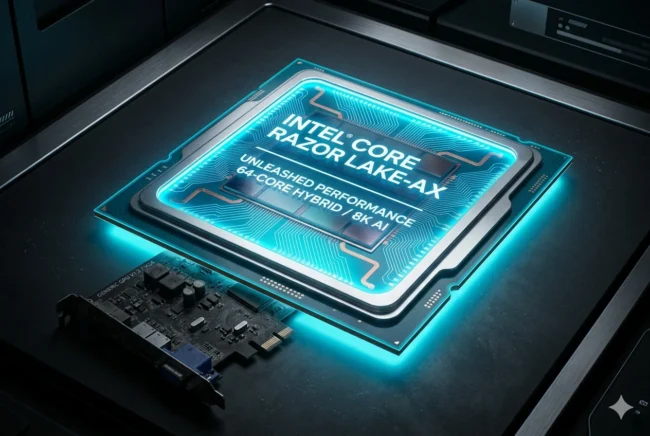
According to reliable leakers (including Jaykihn and VideoCardz), Intel is preparing a massive, “Halo-class” APU codenamed Razor Lake-AX for a 2027 release. This isn’t just a standard processor with a display adapter slapped on; it is a sprawling, multi-tile behemoth featuring up to 32 Xe3 graphics cores.
By integrating a GPU die that is physically larger than many discrete desktop cards directly onto the processor package, Intel is fundamentally altering the economics of PC building and laptop design. Here is the comprehensive breakdown of the Razor Lake-AX leaks, its massive architectural shifts, and why it represents an absolute death sentence for the entry-level graphics card market.
The “AX” Classification: The Birth of the Super-APU
To understand the threat Razor Lake-AX poses, you have to understand Intel’s shifting nomenclature. The “AX” suffix denotes an entirely new tier of Intel silicon designed to combat AMD’s “Strix Halo” and Apple’s M-Series Max chips.
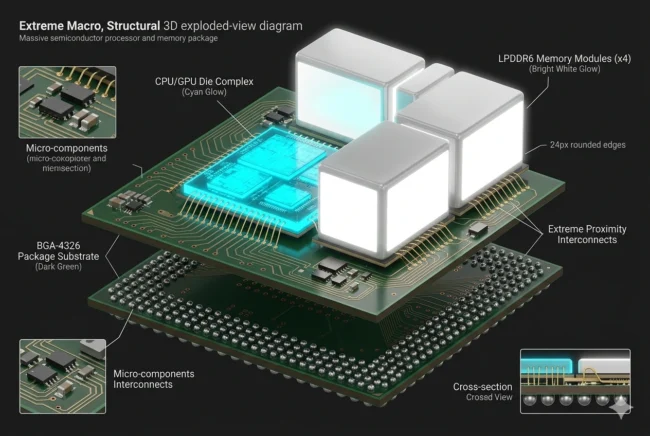
The BGA-4326 Socket: Leaks indicate that Razor Lake-AX will utilize a massive BGA-4326 package. With over 4,300 pins, this socket is roughly the size of a workstation Xeon processor (measuring a massive 37.5 x 56.5 mm). This footprint is required to provide the insane power delivery and data bandwidth the chip demands.
The Demise of Nova Lake-AX: Initially, rumors pointed to an earlier “Nova Lake-AX” chip featuring 48 GPU cores. However, supply chain manifests indicate that Intel has paused the 48-core project in favor of streamlining the architecture into the Razor Lake-AX platform for a targeted 2027 release.
Foveros 3D and EMIB Packaging: A chip this large cannot be printed monolithically. Intel will heavily rely on its advanced Foveros 3D stacking and EMIB (Embedded Multi-Die Interconnect Bridge) technologies to stitch together the CPU tiles, the massive GPU tile, and the I/O controllers with near-zero latency.
The 32-Core Xe3 Monster: Desktop Power on a Die
The defining feature of Razor Lake-AX is its integrated graphics processor. It completely shatters the historical boundaries of what constitutes “integrated” graphics.
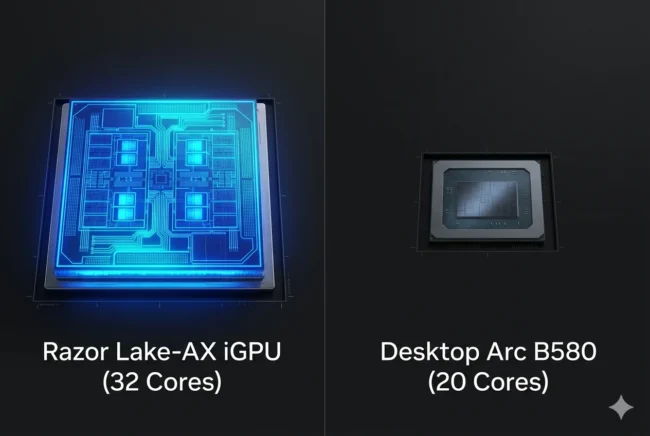
Unprecedented Scale: The flagship Razor Lake-AX configuration will reportedly feature 32 Xe3 Cores (potentially utilizing the refined Xe3P architecture). For context, Intel’s current Panther Lake mobile chips top out at 12 Xe3 cores. Razor Lake-AX represents a staggering 166% increase in raw graphical execution units over current mobile flagships.
Bigger Than Desktop Cards: The physical GPU die on Razor Lake-AX is rumored to measure roughly 162.84 mm². This means the integrated GPU on this processor is significantly larger and more complex than Intel’s dedicated desktop Arc B580 (which only features 20 Xe2 cores). To find an Intel GPU with 32 cores today, you have to buy a heavy, workstation-class Arc Pro B70 discrete card.
Theoretical Performance: If the scaling holds true, a 32-core Xe3 iGPU could theoretically output rasterization performance equivalent to a desktop GeForce RTX 3080 or Radeon RX 6800 XT. Having that level of compute power built directly into the CPU package makes purchasing a discrete RTX 4060 or RX 7600 utterly pointless.
The Memory Bandwidth Solution: On-Package LPDDR6
The historical Achilles’ heel of all high-end APUs is memory bandwidth. An integrated GPU does not have its own dedicated GDDR6 VRAM; it must share system RAM with the CPU. If the system RAM is slow, a 32-core GPU will starve for data and stutter. Intel is solving this with a controversial reversal in design philosophy.
The Return to On-Package RAM: Despite claiming that the Lunar Lake (Core Ultra 200V) on-package memory design was a “one-off” experiment due to margin complexities, Intel is reportedly bringing it back for Razor Lake-AX.
LPDDR5X and LPDDR6: By soldering massive pools of ultra-fast LPDDR5X (and potentially next-generation LPDDR6) memory directly onto the BGA-4326 package, Intel can achieve the “quad-channel” equivalent bandwidth required to keep 32 Xe3 cores fed.
Latency Eradication: Moving the memory millimeters away from the GPU die on the same substrate drastically reduces latency. While you lose the ability to upgrade your RAM down the line (no SODIMM slots), the tradeoff is desktop-class gaming performance in a shockingly thin form factor.
Why Budget Discrete GPUs are Dead
The entry-level graphics card market (the $200 to $350 tier) relies on gamers upgrading aging systems or buying budget pre-built PCs. Razor Lake-AX destroys both of these revenue streams.
The OEM Pivot: Laptop manufacturers (Dell, ASUS, Lenovo) loathe the complexity of discrete GPUs. They require separate motherboard traces, dedicated VRAM chips, massive copper heat pipes, and dual cooling fans. Razor Lake-AX allows OEMs to build a single-chip motherboard that delivers RTX 4060-level gaming performance. This drastically reduces manufacturing costs, meaning the “budget gaming laptop” with a discrete Nvidia or AMD chip will vanish.
Power and Thermal Efficiency: A discrete budget GPU often draws 115W on its own, plus the 65W of the CPU. A unified “Halo” APU can dynamically route a shared 120W power budget between the CPU and GPU cores instantly, resulting in cooler, quieter systems that offer identical framerates.
The NPU Synergy: Razor Lake-AX isn’t just for rasterized gaming; it is an AI powerhouse. Budget discrete GPUs are generally terrible at localized AI inferencing due to limited VRAM (usually 8GB). Because Razor Lake-AX shares a massive on-package memory pool (potentially 32GB to 64GB), it will handle heavy Large Language Models (LLMs) effortlessly, rendering 8GB budget GPUs obsolete for developers and creators.
The Halo Wars: Intel vs. AMD vs. Apple
Razor Lake-AX does not exist in a vacuum. It is Intel’s desperate, highly engineered response to an industry that is actively moving away from the traditional CPU+GPU layout.
The AMD Strix Halo Threat: AMD is already pioneering this space with its “Strix Halo” and upcoming “Medusa Halo” designs, combining massive Zen 5/Zen 6 core counts with huge RDNA 3.5/RDNA 4 integrated graphics. Intel must release the AX series to prevent AMD from monopolizing the high-end workstation and compact gaming PC market.
Catching Apple Silicon: Apple’s M3 Max and M4 Max chips proved that unified memory and massive on-die GPUs are the future of mobile computing. Razor Lake-AX is essentially Intel building an x86 version of the Apple M-Max chip, finally offering Windows users the same level of unified, highly efficient compute power.
Final Verdict: The Inevitable Integration
If the Razor Lake-AX leaks are accurate, 2027 will mark a massive paradigm shift in how we buy and build computers. The era of purchasing a low-end, $250 graphics card to play esports titles or render 1080p video is drawing to a close.
Intel’s 32-Core Xe3 iGPU proves that the future of mainstream gaming and productivity lies in massive, unified silicon packages. By combining desktop-class graphical compute with hyper-fast on-package memory, Razor Lake-AX isn’t just an evolutionary step in processor design; it is the executioner of the budget graphics card industry.