Is the Ryzen 7 7700X3D AMD’s Answer to the Low-End GPU Crisis?
The desktop PC hardware market in mid-2026 is trapped in a frustrating paradox. While high-end enthusiasts are reveling in the massive performance leaps of the RTX 50-series and the Ryzen 9000X3D lineup, the entry-level builder is suffocating. The low-end GPU market has devolved into a wasteland of overpriced, VRAM-starved graphics cards that struggle to justify their existence. Building a solid 1080p or 1440p gaming rig on a strict budget has never been more difficult.
However, relief might be arriving from an unexpected source. According to the latest supply chain leaks, AMD is preparing to launch the Ryzen 7 7700X3D, a highly affordable 8-core Zen 4 processor equipped with 96MB of 3D V-Cache.
At first glance, releasing a new CPU seems entirely disconnected from a graphics card problem. But if we analyze the economics of PC building and the highly specific way that 3D V-Cache interacts with bottlenecked hardware, it becomes clear: the Ryzen 7 7700X3D is not just another processor refresh. It is a calculated, strategic weapon designed to completely neutralize the low-end GPU crisis. Here is the comprehensive breakdown of the 7700X3D leaks and why this silicon fundamentally changes the math for budget gamers.
The Origin of the 7700X3D: Silicon Recycling at its Finest
Before we can understand its market impact, we must understand how the Ryzen 7 7700X3D physically exists. AMD is not spinning up new fabrication lines at TSMC to create a budget processor; they are executing a masterclass in silicon recycling.
The Binning Process: When manufacturing the legendary Ryzen 7 7800X3D, AMD produces thousands of Zen 4 Core Complex Dies (CCDs) that are fully functional but fail to meet strict quality control standards. Some dies have slightly higher voltage leakage, while others simply cannot maintain the 7800X3D’s aggressive 5.0GHz boost clocks without overheating.
The Downclocked Solution: Instead of throwing these perfectly good 8-core dies away, AMD stacks them with 64MB of SRAM (the 3D V-Cache) and artificially limits their clock speeds. The leaked specs reveal the 7700X3D operates with a 4.0GHz base clock and a 4.5GHz boost clock—a full 500MHz slower than its bigger sibling.
The 120W TDP Illusion: Despite the lower clocks, the chip retains the standard 120W TDP of the X3D family. However, in real-world gaming workloads, the massive cache combined with the 4.5GHz ceiling means this processor will likely draw incredibly low wattage, running exceptionally cool even under cheap, entry-level air coolers.
Reallocating the Budget: The $300 Savior
The true power of the Ryzen 7 7700X3D lies in how it manipulates the Bill of Materials (BOM) of a custom PC build.
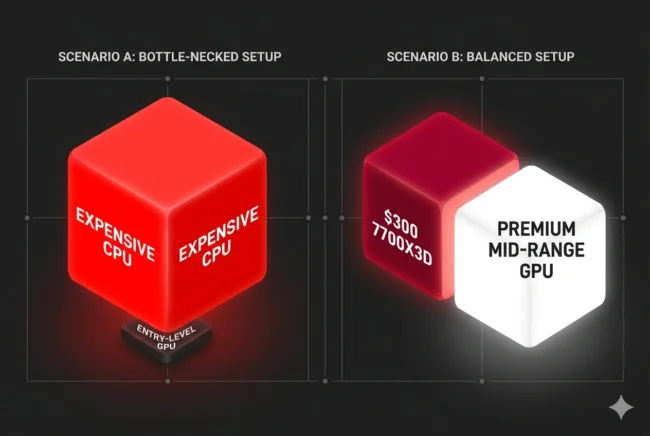
The Price Gap: Currently, the older Ryzen 7 7800X3D still commands a premium price of around $370+, while the flagship 9800X3D is significantly more expensive. Supply chain leakers estimate the 7700X3D will hit the market with an aggressive MSRP of $299 to $320.
The GPU Upgrade Path: That $70 to $100 price reduction is the exact mathematical difference between being forced to buy an abysmal entry-level GPU (with an 8GB VRAM limit and a choked memory bus) and stepping up to a vastly superior mid-range graphics card. By releasing a top-tier gaming CPU for $300, AMD allows builders to directly transfer that saved capital into their graphics card budget.
The Cannibalization Risk: At $300, the 7700X3D is so competitively priced that it essentially renders the regular 7700X obsolete for gamers. Furthermore, analysts heavily suspect that the release of the 7700X3D marks the end of life (EOL) for the 7800X3D. AMD is likely phasing out the older flagship to prevent it from eating into Ryzen 9000 sales, leaving the 7700X3D as the undisputed king of the budget AM5 tier.
The V-Cache Safety Net: Curing GPU Stutter
While the financial reallocation is important, the most critical way the 7700X3D solves the low-end GPU crisis is purely architectural. Pairing a cheap, bottlenecked GPU with a 3D V-Cache processor creates a massive, hardware-level safety net.
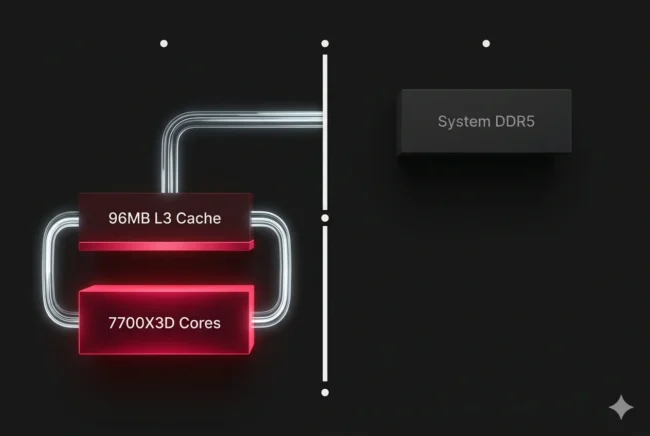
The PCIe and VRAM Bottleneck: Modern low-end graphics cards are notorious for featuring narrow 128-bit memory buses and physically restricted PCIe 4.0 x8 interfaces. When a game engine demands a high-resolution texture or a complex geometry mesh that exceeds the GPU’s small VRAM pool, it must fetch that data across the PCIe bus from the system’s DDR5 RAM. This massive latency penalty causes severe frame-time spikes, resulting in the jarring micro-stutters that ruin budget gaming experiences.
The 96MB Local Buffer: This is where the 7700X3D performs its magic. With a massive 96MB of L3 cache located directly on top of the CPU cores, a massive percentage of the game engine’s logic, physics calculations, and draw calls are handled instantaneously without ever needing to communicate with the system memory.
Rescuing the 1% Lows: By keeping the CPU perfectly fed with localized data, the processor can hand off rendering instructions to the GPU at a flawless, highly consistent rate. While a low-end GPU will still physically limit your maximum average framerate (capping you at 60FPS instead of 120FPS, for example), the V-Cache ensures that your 1% and 0.1% low framerates never drop. The result is an incredibly smooth, console-like frame pacing experience that completely masks the hardware deficiencies of a cheap graphics card.
Overcoming the 2026 RAM Crisis
As we explored in our previous coverage, the 2026 memory shortage has driven the cost of high-speed LPDDR5X and standard DDR5 memory modules through the roof due to localized AI demands. This memory inflation has heavily penalized the AM5 platform.
Mitigating Slow Memory: Standard Zen 4 and Zen 5 processors are highly sensitive to RAM speed; pairing them with cheap, slow DDR5 heavily reduces their gaming performance. However, 3D V-Cache processors are famously memory-agnostic. Because the 96MB L3 cache handles so much of the immediate data fetching, the CPU cares very little about the speed or timings of the system RAM.
The Ultimate Drop-In Upgrade: For budget builders who were forced to buy slow, entry-level DDR5 memory kits to afford an AM5 motherboard initially, the 7700X3D is the ultimate equalizer. It allows users to achieve flagship-tier gaming performance without needing to pay the exorbitant “RAM tax” required to buy a highly binned 6400 MT/s or 7467 MT/s memory kit.
The Verdict: A Masterstroke in Market Positioning
If the leaks hold true, the Ryzen 7 7700X3D is not designed to win synthetic benchmark wars against the bleeding-edge Ryzen 9800X3D or Intel’s Arrow Lake processors. Its purpose is far more pragmatic.
By taking heavily binned, downclocked silicon and pricing it aggressively at $300, AMD is providing PC builders with a direct escape route from the low-end GPU crisis. It frees up the critical capital required to buy a better graphics card, heavily offsets the skyrocketing costs of DDR5 memory, and utilizes its massive 96MB L3 cache to physically erase the micro-stutters associated with bottlenecked systems.
While the enthusiast community may mourn the likely discontinuation of the legendary 7800X3D, the reality is that the 7700X3D is exactly the processor the market desperately needs right now. In a landscape defined by overpriced hardware and compromised graphical performance, AMD’s new budget 8-core chip is the ultimate stabilizing force.