
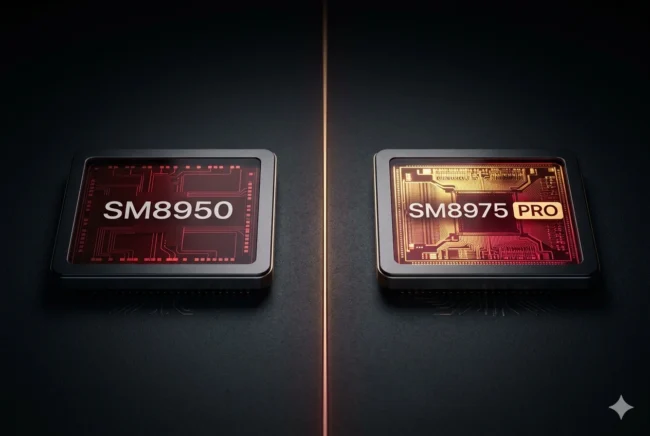
SM8975 vs SM8950: The 18MB GMEM Leak That Divides the Snapdragon 8 Elite Gen 6
For years, Qualcomm has adhered to a predictable and highly successful release rhythm: produce one dominant, uncompromising flagship Snapdragon chipset to power the entire Android high-end ecosystem for the year. However, as we move through 2026, the landscape of mobile computing has grown too complex and financially demanding for a one-size-fits-all approach. The relentless push for localized Agentic AI, desktop-tier mobile emulation, and advanced hardware-accelerated ray tracing has created a massive disparity in manufacturing costs.
According to explosive leaks from reliable industry insiders, including Digital Chat Station, Qualcomm is fundamentally pivoting its strategy for the upcoming generation. The highly anticipated Snapdragon 8 Elite Gen 6 is splitting into two distinct pieces of silicon: the standard SM8950 and the uncompromised “Pro” tier SM8975.
While both chips share a bleeding-edge CPU foundation, a massive discrepancy in graphics memory (GMEM), system-level cache, and RAM support physically separates them. Here is the comprehensive, deep-dive breakdown of the SM8975 vs SM8950 leak, and why the 18MB GMEM divide will dictate the graphical performance of the smartphone market in 2027.
The TSMC 2nm Foundation and the 2+3+3 Layout
Before dissecting where the chips diverge, we must analyze where they align. The bedrock of both the SM8975 (Snapdragon 8 Elite Gen 6 Pro) and the SM8950 (Snapdragon 8 Elite Gen 6) is their manufacturing node and core layout. Both are reportedly built on TSMC’s cutting-edge 2nm process (N2P).
This shared CPU architecture means that for basic day-to-day operations, application loading, UI navigation, and web browsing, both chips will feel virtually identical. The true division lies entirely in the graphics pipeline and the memory bandwidth.
The Graphics Divide: Adreno 850 vs Adreno 845
The defining battleground between the SM8975 and the SM8950 is the GPU. Qualcomm is aggressively separating the chips based on their ability to sustain high-fidelity, AAA gaming performance over extended periods without succumbing to thermal throttling.
The SM8950 (Adreno 845)
The standard Snapdragon 8 Elite Gen 6 will feature an Adreno 845 GPU equipped with 6 slices and 12MB of GMEM (Graphics Memory, also known as Adreno High-Performance Memory cache). While 12MB is highly capable and sufficient for the vast majority of mobile titles, it represents a step back from the uncompromised GPUs of previous ultra-flagships.
The SM8975 (Adreno 850)
The Pro variant is where Qualcomm flexes its engineering muscle. The SM8975 is equipped with the superior Adreno 850 GPU, backed by a massive 18MB of GMEM.
Why the 18MB GMEM Matters
Graphics memory on the GPU die acts as an ultra-fast, localized buffer for rendering data. When a game engine processes high-resolution textures, complex geometry, or hardware-accelerated ray tracing, it requires immediate access to data to prevent frame-time spikes.
The LPDDR6 Memory Chasm
A processor can only compute data as fast as the system memory can deliver it. In this crucial metric, the SM8975 completely leaves the standard SM8950 behind, setting the stage for the next generation of mobile memory.
The SM8950 and LPDDR5X
The Pro variant marks the official arrival of next-generation memory bandwidth. The SM8975 supports quad-channel 24-bit LPDDR6 memory. This massive increase in bandwidth ensures that the Adreno 850 and the Hexagon NPU are never starved for data.
The Agentic AI Impact
Running massive on-device Large Language Models (LLMs) requires immense memory bandwidth to generate tokens quickly. The LPDDR6 support on the SM8975 ensures that advanced “Agentic AI” features—where the phone autonomously executes complex, multi-step tasks in the background—will run smoothly and instantly. Conversely, the LPDDR5X limitation on the SM8950 may result in slight latency when executing heavy AI workloads simultaneously with active applications.
System-Level Cache (LLC) Reductions
Beyond the localized GMEM for the GPU, Qualcomm is also segmenting the chips at the system level to further separate the tiers.
The Economics of the Ultra Tier
Why is Qualcomm actively dividing its flagship tier? The answer is purely financial. Designing and manufacturing a TSMC 2nm chip with 18MB of GMEM and brand-new LPDDR6 support is incredibly expensive, and standard smartphone price points can no longer absorb that cost.
The Verdict: The Spec Sheet Matters Again
The leak of the SM8975 and SM8950 confirms that the era of monolithic Android flagship dominance is officially over. By splitting the Snapdragon 8 Elite Gen 6 into two distinct tiers, Qualcomm is giving manufacturers the flexibility to combat rising silicon costs while still pushing the boundaries of performance.
However, for the hardcore mobile gamer, the emulation enthusiast, and the power user, the smartphone spec sheet has never been more important. The 18MB of GMEM and LPDDR6 support on the SM8975 represent a massive architectural advantage that will be highly noticeable under heavy loads. When buying a premium device in 2027, simply seeing the “Snapdragon 8 Elite Gen 6” marketing badge won’t be enough; you must demand to know if you are getting the Standard model, or the true Pro.