4.8
9
votes
Article Rating
Snapdragon 8 Elite Gen 5 AI Performance And Review
Manufacturer: Qualcomm
Model Number: SM8850-AC (“For Galaxy” Variant)
Release/Date Quarter: 2026-2027 (Next-Gen Production Release)
Class/Tier: Ultra-Premium Flagship / Agentic AI Tier
Official Page: qualcomm.com/snapdragon-8-elite-gen-5
Fused Architecture: Abandons old heterogeneous DSP offloading for a unified, INT2/FP8-capable Fused AI Accelerator pushing up to 80 TOPS.
Severe Thermal Limits: The massive 4.74 GHz Oryon CPU clock demands immense voltage, drawing up to 48.3W peak package power and forcing aggressive throttling inside 4.2 minutes.
Memory Wall Constraints: While the NPU has immense compute power, the 84.8 GB/s LPDDR5X bus completely saturates when running larger models, causing an 8B model to drop to 12.0 Tokens/Sec.
Zero-Copy Photonic Pipeline: Connects the NPU directly to the Triple 20-bit AI-ISPs via Hexagon Direct Link, executing real-time 4K30 FPS semantic segmentation entirely off the main RAM.
Deep OS Integration: Features native hardware-level acceleration for Google’s LiteRT framework, executing 64 out of 72 standard benchmark models completely on the NPU.
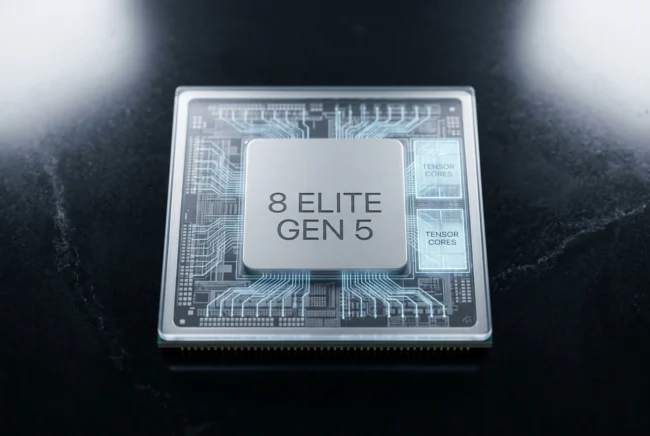
Snapdragon 8 Elite Gen 5 completely re-engineers mobile inference via a massive 80 TOPS Fused AI Accelerator block
Overview & Core Features Parameter Value Synthetic AI Benchmarks (Peak) ⭐⭐⭐⭐⭐ 97% Real-Time Camera ISP (Offline)⭐⭐⭐⭐⭐ 94% Audio/Whisper Transcribe (Offline) ⭐⭐⭐⭐⭐ 100% Local LLM/Agentic AI (Quantized) ⭐⭐⭐⭐ 91% Hardware Ray Tracing / Gaming⭐⭐⭐⭐ 94% Memory Bandwidth Overhead ⭐⭐ 40% Thermal Sustained Performance ⭐ 20%
Synthetic AI Benchmarks (Peak) ⭐⭐⭐⭐⭐97%
Real-Time Camera ISP (Offline)⭐⭐⭐⭐⭐ 94%
Audio/Whisper Transcribe (Offline) ⭐⭐⭐⭐⭐100%
Local LLM/Agentic AI (Quantized) ⭐⭐⭐⭐91%
Hardware Ray Tracing / Gaming⭐⭐⭐⭐ 94%
Memory Bandwidth Overhead ⭐⭐ 40%
Thermal Sustained Performance ⭐ 20%
Parameter Value OVERALL AI SCORE ⭐⭐⭐⭐⭐ 94/100
OVERALL AI SCORE ⭐⭐⭐⭐⭐ 94/100
🧠 AI Hardware Foundation & ComputeDefines the core neural architecture, processing nodes, and peak theoretical compute
NPU Architecture & Core Processing Power Neural Engine Name
3rd Generation Qualcomm Hexagon NPU
Hardware Architecture
Fused AI Accelerator (12 Scalar + 8 Vector + 1 Tensor with Hexagon Direct Link)
Peak Compute (INT8 TOPS)
Compute Precision Support
INT2, INT4, INT8, INT16, FP8, FP16 (Mixed Precision Supported)
🤖 Generative AI & LLM PerformanceMeasures real-time text generation speed and large language model efficiency
Tokens Per Second & Transformer Handling Parameter Value Llama 3 / Gemma (Tokens/Sec) 32.4 Tokens/Sec (Llama 3.2 3B) Time-to-First-Token (TTFT) – Lower is better 60 ms – 120 ms Stable Diffusion (Image Gen) – Lower is better 5.0 – 10.0 sec Max On-Device Context Window 4096 Tokens
Llama 3 / Gemma (Tokens/Sec) 32.4 Tokens/Sec (Llama 3.2 3B)
Time-to-First-Token (TTFT) 60 ms – 120 ms
Stable Diffusion (Image Gen) 5.0 – 10.0 sec
Max On-Device Context Window 4096 Tokens
👁️ Computer Vision & Camera AI Evaluates real-time object detection, semantic segmentation, and computational photography
Real-Time Image Processing & Recognition Direct-to-ISP Connection
Yes (Hexagon Direct Link tightly coupled to Triple 20-bit AI-ISPs)
Real-Time Object Detection
N/A (Verified latency reductions exist, exact YOLO FPS is proprietary)
Semantic Segmentation
4K @ 30 FPS (Limitless Real-time Semantic Segmentation)
AI Video Upscaling
Supported (Hardware-accelerated via Advanced Professional Video codecs)
Evaluates how neural processing assists the GPU in extreme rendering workloads
Neural Upscaling & Frame Generation Tech Neural Super Resolution
Supported (Snapdragon Game Post Processing Accelerator)
AI Frame Generation
Supported (Adreno Frame Motion Engine + Tile Memory Heap)
Semantic Segmentation
Yes (DirectX 12.2 Ultimate, Vulkan 1.4, OpenGL ES 3.2 APIs)
Ray Reconstruction (AI Denoising)
Yes (Snapdragon Shadow Denoiser native Vulkan API support)
🎙️ Audio, Speech & Sensor AI Analyzes localized speech-to-text, translation, and ultra-low power sensor processing
Voice Processing & Always-On Intelligence On-Device Speech-to-Text
Parameter Value Live Translation Latency – Lower is better(On-device translation natively supported, latency metrics unpublished) N/A Always-On Sensing Power – Lower is betterN/A (Microwatt power envelope utilized, specific telemetry proprietary) N/A
Live Translation Latency N/A
Lower is better
Always-On Sensing Power N/A
Lower is better
💾 Neural Memory & Bandwidth Analyzes the memory subsystem, which is the primary bottleneck for AI model execution
Dedicated Cache & Matrix Math Feeding Max System Bandwidth
84.8 GB/s (Quad-channel 16-bit interface)
Neural Dedicated Cache (SRAM):
18 MB (Adreno High Performance Memory – HPM)
RAM Generation Support
LPDDR5X (up to 5300 MHz) and LPDDR5T
Storage interface
Yes (64-bit memory virtualization via Tile Memory Heap)
🪄 Software Ecosystem & Frameworks Evaluates low-level API support and deep learning framework integration
Execution Layers & API Compatibility Supported Frameworks
ONNX, LiteRT (TensorFlow Lite), Core ML, Android NNAPI
Hardware Acceleration Layer
Qualcomm AI Engine Direct
Native OS Integration
Android 16 / One UI 7.1 (Deep LiteRT OS-level delegation)
Model Quantization Support
INT2, INT4, INT8, INT16, FP8, FP16 (w4a16 and w8a16 support)
📈 Synthetic AI Benchmarks “A cross-platform AI performance benchmarking tool evaluating standardized precision models
Geekbench AI & Raw Compute Scores The AnTuTu Benchmark measures CPU, GPU, RAM, and I/O performance in different scenarios to reveal real-world bottlenecks and latency issues.
Parameter Value Geekbench AI (Single Precision – FP32) – Evaluates heavy, uncompressed 32-bit math 2316 Geekbench AI (Half Precision – FP16) – The standard for mobile neural processing 2329 Geekbench AI (Quantized – INT8) – Evaluates highly compressed, fast edge AI tasks 3012 – 6080 AITuTu Benchmark (AnTuTu AI) – Overall peak mobile AI hardware score > 250000000 (CV); 90k – 1M (LLM)
Geekbench AI (Single Precision – FP32) 2316
Evaluates heavy, uncompressed 32-bit math
Geekbench AI (Half Precision – FP16) 2329
The standard for mobile neural processing
Geekbench AI (Quantized – INT8) 3012 – 6080
Evaluates highly compressed, fast edge AI tasks
AITuTu Benchmark (AnTuTu AI) > 250000000 (CV); 90k – 1M (LLM)
Overall peak mobile AI hardware score
UL Procyon AI Suite Measures inference performance of powerful on-device AI accelerators across real-world workloads
Parameter Value Procyon AI Text Generation – Standardized testing for local AI LLM use cases N/A Procyon AI Image Generation – Lower is betterMeasures Stable Diffusion inference performance N/A Procyon AI Computer Vision – Evaluates daily machine vision tasks 2613 – 3001 ETH Zurich AI-Benchmark – Deep learning ranking for Android NPU executio 16226
Procyon AI Text Generation N/A
Standardized testing for local AI LLM use cases
Procyon AI Image Generation N/A
Lower is betterMeasures Stable Diffusion inference performance
Procyon AI Computer Vision 2613 – 3001
Evaluates daily machine vision tasks
ETH Zurich AI-Benchmark 16226
Deep learning ranking for Android NPU executio
MLPerf Inference Evaluates real-world tasks using standardized MLCommons mobile and client LLM tests
Parameter Value MLPerf Client (LLM Summarization) – Using models like Llama 3.1 8B Instruct N/A MLPerf Mobile (Text-to-Image) – Using Stable Diffusion 1.5 0.47 – 0.48 MLPerf Mobile (Object Detection) – Evaluates real-time video analysis 4221 MLPerf Mobile (Image Classification) – (Absolute score: 380,000)Using MobileNetV4 networks N/A
MLPerf Client (LLM Summarization) N/A
Using models like Llama 3.1 8B Instruct
MLPerf Mobile (Text-to-Image) 0.47 – 0.48
Using Stable Diffusion 1.5
MLPerf Mobile (Object Detection) 4221
Evaluates real-time video analysis
MLPerf Mobile (Image Classification) N/A
(Absolute score: 380,000)Using MobileNetV4 netwo rks
🔒 Security, Power & Efficiency Measures data privacy hardware, neural thermal throttling, and power draw
On-Device Privacy & Thermal Stability On-Device Secure Enclave
Yes (Qualcomm Secure Processing Unit / SPU)
AI Sustained Thermal Limit
4.2 minutes (Time to severe throttling at 49.2°C surface temperature)
Parameter Value Peak NPU Power Draw – (Total SoC peaks at 48.3W under unthrottled extreme loads)Lower is better N/A Efficiency (TOPS-per-Watt) – 16% greater overall SoC efficiency; 35% greater CPU efficiency vs Gen 3 N/A
Peak NPU Power Draw N/A
(Total SoC peaks at 48.3W under unthrottled extreme loads)
Efficiency (TOPS-per-Watt) N/A
16% greater overall SoC efficiency; 35% greater CPU efficiency vs Gen 3
🛒chip name: Who Is It For?
About the Author
Latest Posts
More Info
Areas of Expertise:
Silicon & Hardware Benchmarking: Firsthand performance testing and analysis of flagship processors specifically evaluating thermal and rendering capabilities in gaming and video editing workloads.,

Is really ai matter were we can access it from cloud servers
Xgj
Igckhlh