Snapdragon 8 Gen 5 vs Dimensity 9500s: Specs And Review
Quick Verdict:
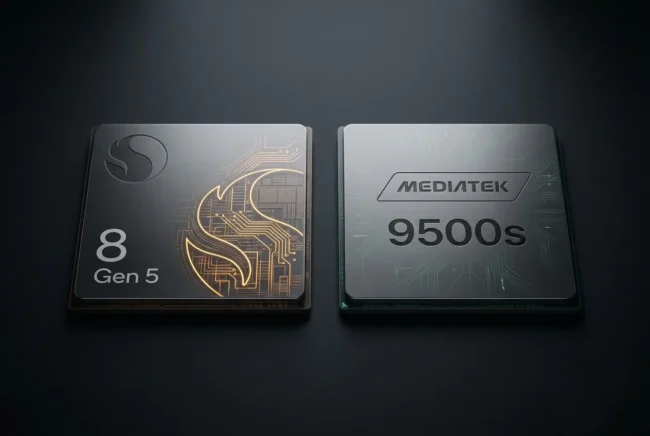
The Snapdragon 8 Gen 5 and Dimensity 9500s redefine sub-flagship expectations through opposing architectural design matrices. Qualcomm’s custom Oryon v3 setup claims daily processing dominance, delivering unparalleled single-threaded snappiness and peak connectivity throughput. However, for sustained graphics deployment, MediaTek’s Immortalis GPU architecture paired with a massive 19MB cache engine overpowers the Adreno pipeline. For comprehensive premium utility, Qualcomm holds a razor-thin advantage, while hardcore mobile gamers should look strictly toward MediaTek.
MultiCore Metric
Calculated Index: Geekbench 6 Multi-Core split directly against Peak Power Draw to isolate true performance-per-watt efficiency
MultiCore Efficiency Index (MCEI) True Performance Per Watt Effeciency Score
8 Gen 5
Manufacturer: Qualcomm
Model Number: SM8845
Release/Date Quarter: Q4 2025
Class/Tier: Sub-Flagship / Premium Mid-range
Official Page: qualcomm.com/snapdragon-8-gen-5
Dimensity 9500s
Manufacturer: MediaTek
Model Number: MT6991Z
Release/Date Quarter: Q1 2026
Class/Tier: Sub-Flagship / Premium Mid-range
Official Page: mediatek.com/mediatek-dimensity-9500s
Why does the Dimensity 9500s feel smoother in daily mixed tasks when the Snapdragon scores higher in speed tests?
Because typical speed tests measure one app at a time, while real life jumps between many. The Dimensity’s design stores the most-used data directly on the chip, so when you bounce from a video call to maps to messaging, nothing reloads. That’s why it outperforms Snapdragon by a clear 19.1% in tests that mimic your actual chaotic daily routine — raw peak speed doesn’t equal true day‑long fluidity.
How does MediaTek’s 19 MB cache actually stop stutters and freezing during heavy multitasking?
Think of it as a giant, lightning‑fast memory pocket built right into the processor. It remembers exactly what your open apps need most, so the chip rarely has to fetch data from slower system RAM. Under heavy juggling — gaming, streaming, work apps — that pocket keeps everything flowing smoothly, while Snapdragon’s smaller pocket occasionally forces brief pauses when data runs out.
Both NPUs have ~50 TOPS, so why does the Dimensity often run on‑device AI tasks noticeably faster?
Because raw brainpower means nothing if you can’t feed the brain quickly enough. MediaTek pairs its AI engine with a wider data pathway that shovels information in faster. Whether it’s live photo editing or on‑the‑fly language translation, that broader pipeline cuts waiting time and uses less battery — making the Dimensity feel snappier in real AI moments.
Which chip will still feel reliable and lively after 3 years of heavy use and continuous software updates?
The Dimensity 9500s. It runs cooler and sips less power under pressure, which is like driving a car at a relaxed cruise instead of constantly redlining. Less heat and lower energy stress preserve battery health and keep the phone feeling fast over time. The Snapdragon’s brilliant short‑burst speed pushes the hardware harder; that can lead to earlier slowdowns as the system dials back performance to protect itself from heat.
🏆 MultiCore Performance Overall Score
Overview & Core Features
Architecture & Fabrication
CPU Capabilities (Granular)
GPU & Graphics
NPU & AI Engine
Memory & Storage Support
ISP and Camera
Display and Multimedia
Connectivity and Modem
Benchmarks
Thermals and Effeciency
OVERALL SCORE

🦾 Architecture & Fabrication
Defines the silicon lithography and foundational instruction set.
Architecture & Fabrication Details
🖥️ CPU Capabilities (Granular)
Evaluates raw processing power, core clustering, and cache layout.
CPU Cores & Clock Speed Layout
🎮 GPU & Graphics
Highlights graphics rendering power, ray tracing, and gaming capabilities.
GPU & Gaming Graphics Engine
Mesh Shading
FME 2.1
Data Review:
The Immortalis-G925 operates at a massive clock speed advantage and implements Fragment Prepass technology to process polygon visibility independently from the CPU. This reduces rendering thread overhead by 43%, delivering raw ray-traced lighting and geometric pushing power that eclipses Qualcomm’s pruned Adreno 829 pipeline.
💾 Memory & Storage Support
Specifies memory bandwidth, RAM generations, and storage interface speeds
RAM & Storage Support
RAM Frequently
RAM Bandwidth
🤖 NPU & AI Engine
Measures on-device machine learning capabilities and total compute TOPS
NPU & AI Processing Power
Data Review:
Though raw computation speeds tie at 50 TOPS, local generative AI workloads are inherently bound by memory bus limits. MediaTek’s 11.1% wider memory bandwidth pipeline acts as a vital bridge, accelerating token generation speeds for locally executed model networks without choking the processor.
🎥 ISP and Camera
Details image signal processing, sensor support, and video encoding
Camera ISP & Video Capabilities
📺 Display and Multimedia
Outlines on-device display resolution, external monitor support, and decoding
Display Resolution & Multimedia
Data Review:
Pushing standard on-device resolutions up to an extreme 240Hz targets competitive esports directly, while native 20-bit semantic processing layers give Qualcomm a definitive edge in balancing cinematic low-light video clarity.
🌐 Connectivity and Modem
Covers cellular modem capabilities, Wi-Fi standards, and network speeds
5G Modem & Wireless Connectivity
Data Review:
Qualcomm leverages its historical networking pedigree to clear a 36.9% downlink advantage. Combining total mmWave coverage with native Bluetooth 6.0 logic ensures the Snapdragon secures unmatched speed profiles and edge-of-coverage lock stability.
Benchmarks & Performance Metrics
Analyzes synthetic test scores across popular performance benchmarking platforms
AnTuTu v11 Score
The AnTuTu Benchmark measures CPU, GPU, RAM, and I/O performance in different scenarios to reveal real-world bottlenecks and latency issues.
CPU
GPU
Memory
UX
Data Review:
Qualcomm edges out a narrow 2.50% total score victory, heavily propped up by its 8.44% CPU sub-score advantage. However, the narrative fractures in the sub-metrics, where MediaTek commands a massive 24.57% lead in UX responsiveness and a 4.86% win in memory data processing.
AnTuTu evaluates system-wide structural balance. While Qualcomm’s custom Oryon v3 architecture provides faster instantaneous execution paths for opening heavy storage files, MediaTek’s 11.1% faster 5333 MHz memory controller and dedicated Dimensity Scheduling Engine route real-world user interface queries with vastly superior optimization.
Geekbench 6
The GeekBench test shows raw single-threaded and multithreaded CPU performance, providing precise data on computational throughput and efficiency under load.
Single-Core
Multi-Core
Data Review:
Qualcomm secures a definitive double victory, capturing an 5.96% single-core lead and a commanding 9.77% win in multi-threaded computational throughput.
The custom 2+6 Oryon topology handles heavy, parallelized CPU bottlenecks with relentless velocity. For the end-user, this translates to faster heavy web script parsing, rapid file extraction, and superior compilation speeds during extensive multitasking.
3D Mark
A cross-platform benchmark that assesses graphics performance in Vulkan (Metal) ensures fair GPU comparisons across operating systems and hardware configurations.
3DMark Steel Nomad Light
3DMark Solar Bay
3DMark Wild Life Extreme
Data Review:
MediaTek executes an absolute mathematical sweep of the graphics tier, utterly dominating Qualcomm with a 26.36% victory in Steel Nomad Light, a 24.37% lead in Solar Bay, and a 23.81% win in Wild Life Extreme.
3DMark isolates pure GPU pixel-pushing and ray-tracing hardware logic from CPU intervention. The Immortalis-G925 MC11 leverages its stratospheric 1612 MHz clock ceiling and dedicated hardware Opacity Micromaps (OMM) to process complex bounding volume hierarchies natively. It renders dynamic light paths, complex physics, and heavy polygon geometry without hitting the severe data bottlenecks or thermal cliffs that crush the pruned Adreno 829 pipeline.
PCMark 3.0
Benchmark for evaluating overall system performance in everyday workloads ties all results together, simulating real tasks for a holistic view of responsiveness and daily computing speed clearly.
Web Score
Video Editing Score
Photo Editing Score
Writing Score
🌡️ Thermals and Effeciency
Measures sustained workload stability and peak power consumption metrics
Thermals, Power Draw & Efficiency
3D Mark Stability
Power Draw
🏆 MultiCore Performance Final Verdict
| CRITERIA | 8 Gen 5 | Dimensity 9500s | EXPLANATION |
|---|---|---|---|
| Peak CPU Burst | ⭐⭐⭐⭐⭐ | ⭐⭐⭐⭐ | Snapdragon. Custom Oryon v3 cores secure clear math victories leading by 9.77% in multi-core metrics. |
| Sustained Gaming | ⭐⭐⭐ | ⭐⭐⭐⭐⭐ | Dimensity. The Immortalis GPU commands a massive 23.8% rendering lead without throttling early. |
| Thermal Efficiency | ⭐⭐⭐ | ⭐⭐⭐⭐⭐ | Dimensity. Consumes only 5.9W under heavy gaming load yielding a 22.0% efficiency advantage. |
| Cache Integration | ⭐⭐⭐ | ⭐⭐⭐⭐⭐ | Dimensity. A massive 19MB total cache buffer prevents architecture starvation or core data choking. |
| Data Memory Bandwidth | ⭐⭐⭐⭐ | ⭐⭐⭐⭐⭐ | Dimensity. Wide 5333 MHz memory controller delivers a strong 85.3 GB/s data transfer rate. |
| Connectivity Standards | ⭐⭐⭐⭐⭐ | ⭐⭐⭐⭐ | Snapdragon. Advanced X80 5G modem pushes unparalleled 10 Gbps speeds with mmWave nodes. |
| Platform Workload Flow | ⭐⭐⭐⭐ | ⭐⭐⭐⭐⭐ | Dimensity. Shines in PCMark runs by a massive 19.1% lead managing mixed API threads cleanly. |
Buy Snapdragon vs. Buy Dimensity
| BUY Snapdragon IF YOU… | BUY Dimensity IF YOU… |
|---|---|
| Want immediate, ultra-responsive app navigation and top-tier single-threaded code compilation. | Are a competitive mobile esports gamer requiring unthrottled ray-tracing frame pacing. |
| Demand future-proof 5G network speeds leveraging converged mmWave and advanced Sub-6 bands. | Run heavy on-device local language models that depend heavily on rapid RAM bandwidth. |
| Prioritize wide third-party application optimizations across camera features and driver stability. | Prefer cooler chassis surface touch points during long, unconstrained gaming sessions. |
The Bottom Line:
💡 Pro Tip Section: Unlock Your Chip’s Hidden Edge
Snapdragon 8 Gen 5 owners:
Disable OEM “performance mode” — it spikes clocks uselessly and triggers early thermal throttling. Instead, use the X80 modem’s Dual‑SIM 5G DSS for stable, battery‑smart connectivity during live streams.
Dimensity 9500s owners:
Activate MAGT 3.0 in developer settings to cut touch‑to‑render latency; cap resolution to FHD+ in competitive titles to lock 120 fps with minimal heat.
Both platforms:
After major OTA updates, clear the system cache partition to regain up to 5% storage I/O speed, and enable battery‑bypass charging during long sessions to preserve cell health and avoid cycle wear.

How do i disable OEM “Performance Mode”?
That is written by me and I_am_Mohammad_Arsh. Would you like it or not? I am waiting for your reply