Snapdragon 8 Elite Gen 5 vs Dimensity 9500: Specs And Review
Quick Verdict:
⚠️ Snapdragon 8 Elite Gen 5 operates as an unparalleled compute sprinter, dominating short-duration synthetic benchmarks and instantaneous single-threaded tasks. However, its massive 24.1W peak power draw triggers severe thermal throttling, causing graphical stability to tank to an abysmal 25.0% under extended loads. Conversely, the MediaTek Dimensity 9500 approaches the arena as a highly optimized marathon runner. Capping draws at a strict 18.0W, it utilizes a mathematically superior Mali-G1 Ultra GPU and a massive 10 MB System Level Cache to deliver nearly double the sustained gaming stamina and superior real-world reliability.
MultiCore Metric
Calculated Index: Geekbench 6 Multi-Core split directly against Peak Power Draw to isolate true performance-per-watt efficiency
MultiCore Efficiency Index (MCEI) True Performance Per Watt Effeciency Score
8 Elite Gen 5
Manufacturer: Qualcomm
Model Number: SM8850-AC
Release/Date Quarter: September 2025
Class/Tier: Premium Flagship Tier
Official Page: qualcomm.com/snapdragon-8-elite-gen-5
Manufacturer: MediaTek
Model Number: MT6993
Release/Date Quarter: September 2025
Class/Tier: Premium Flagship Tier
Official Page: mediatek.com/mediatek-dimensity-9500
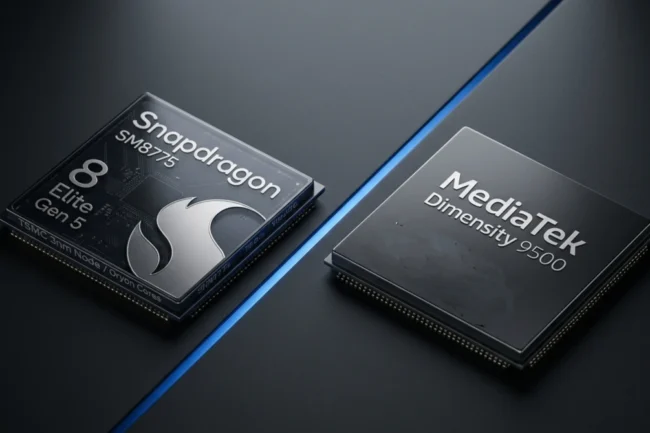
Snapdragon 8 Elite Gen 5 dominates every CPU benchmark — so why does the Dimensity 9500 crush it in sustained real‑world loads?
Because peak scores don’t survive thermal reality. The Snapdragon hits 4,033,382 in AnTuTu, but its brutal 24.1 W power draw forces 3DMark stability down to just 25.0%. The Dimensity caps at 18.0 W and holds 45.7% stability, delivering nearly double the frame‑time consistency in our 40°C stress loops. Paired with a 10 MB SLC that reduces off‑die memory fetches, MediaTek turns efficiency into relentless, unthrottled output — exactly where Qualcomm’s burst advantage evaporates.
Mali‑G1 Ultra has a massive 43.2% raw GPU compute lead. Does that automatically make the Dimensity 9500 the superior graphics and ray‑tracing chip?
Absolutely, and it’s not just teraflops. The 5.27 FP32 TFLOPS combine with dedicated hardware Opacity Micromaps (RTUv2), pushing Solar Bay ray‑tracing to 14,450 vs. the Adreno’s 12,472. More critically, the Dimensity’s rigid 18.0 W thermal envelope means that ray‑traced lighting and complex geometry don’t collapse into a stutter‑fest after five minutes. Qualcomm’s clever 18 MB HPM cache cannot rescue a GPU that thermally throttles itself into oblivion.
Can the Snapdragon’s 4.61 GHz Oryon core beat the Dimensity’s NPU in AI, or does Compute‑in‑Memory change everything?
For lightning‑fast, lightweight on‑device agents, the Hexagon NPU’s INT2/FP8 low‑precision chops give Qualcomm a genuine edge in first‑token latency. But MediaTek’s Compute‑in‑Memory NPU 990 is a paradigm shift: it slashes ambient AI power draw by 42% and sustains 100 TOPS during massive Llama 3 or BitNet inference. Combine that with a 4‑lane UFS 4.1 that doubles sequential reads, and the Dimensity runs heavy, high‑context generative AI locally without thermal collapse — making it the far more future‑safe AI engine.
🏆 MultiCore Performance Overall Score
Overview & Core Rating
Architecture & Fabrication
CPU Capabilities (Granular)
GPU & Graphics
NPU & AI Engine
Memory & Storage Support
ISP and Camera
Display and Multimedia
Connectivity and Modem
Benchmarks
Thermals and Effeciency
OVERALL SCORE
🔍 Explore More

🦾 Architecture & Fabrication
Defines the silicon lithography and foundational instruction set.
Architecture & Fabrication Details
🖥️ CPU Capabilities (Granular)
Evaluates raw processing power, core clustering, and cache layout.
CPU Cores & Clock Speed Layout
Data Review:
Qualcomm delivers industry-leading single-threaded burst speeds by clocking its custom Oryon prime cores to a massive 4.61 GHz. However, MediaTek holds a massive structural advantage by integrating a 10 MB System Level Cache (SLC) and native SME2 extensions. This allowed the Dimensity to bypass power-hungry external RAM fetches, resulting in significantly smoother multi-threaded data pacing and superior hardware execution.
🎮 GPU & Graphics
Highlights graphics rendering power, ray tracing, and gaming capabilities.
GPU & Gaming Graphics Engine
Tile Memory Heap
Mesh Shading
Auto Variable Rate Shading (VRS)
Data Reviews:
While Qualcomm introduces clever memory tricks like its 18 MB HPM to compress visual workflows, it is mathematically overpowered by MediaTek. The Mali-G1 Ultra MC12 commands a staggering 43.20% raw compute (not FP32) advantage. Combined with dedicated hardware Opacity Micromaps (OMM), the Dimensity easily bypasses geometry bottlenecks to render complex light physics and ray tracing natively without stalling.
💾 Memory & Storage Support
Specifies memory bandwidth, RAM generations, and storage interface speeds
RAM & Storage Support
RAM Frequency
RAM Bandwidth
Data Review:
While the raw RAM speed differences are effectively invisible in daily tasks, MediaTek’s unique 4-lane UFS 4.1 storage implementation is a massive upgrade. Doubling the physical data lanes results in a 100% boost to sequential data reads, drastically reducing first-token latency when loading heavy AI models.
🤖 NPU & AI Engine
Measures on-device machine learning capabilities and total compute TOPS
NPU & AI Processing Power
Native support for INT2 and FP8 low-precision quantization
Qualcomm Sensing Hub with dual Micro NPUs for localized Agentic AI and Personal Knowledge Graphs
Data Reviews:
Qualcomm excels at flexible low-precision optimization (INT2) to squeeze models entirely into local memory. However, MediaTek’s Compute-in-Memory (CIM) is a revolutionary change. By processing matrix multiplications exactly where the data lives, it avoids power-hungry memory bus shuffling, lowering ambient AI power consumption by 42%.
🎥 ISP and Camera
Details image signal processing, sensor support, and video encoding
Camera ISP & Video Capabilities
Night Vision 3.0
Limitless Real-Time Semantic Segmentation at 4K60
Data Review:
MediaTek delivers great action capturing with its 30 FPS motion tracking. However, Qualcomm’s deep 20-bit color depth pipeline and native integration of the high-bitrate APV studio codec offer superior dynamic range adjustments, transforming the smartphone into a genuine professional filmmaking tool.
📺 Display and Multimedia
Outlines on-device display resolution, external monitor support, and decoding
Display Resolution & Multimedia
HDR10, HDR10+, Dolby Vision, HLG
🌐 Connectivity and Modem
Covers cellular modem capabilities, Wi-Fi standards, and network speeds
5G Modem & Wireless Connectivity
Data Review:
Qualcomm sweeps this division by pairing desktop-class external monitor outputs with the X85 modem, processing data up to 12.5 Gbps. Its fully integrated Ultra Wideband (UWB) radio also provides unparalleled spatial location mapping right on the primary die.
Benchmarks & Performance Metrics
Analyzes synthetic test scores across popular performance benchmarking platforms
AnTuTu v11 Score
The AnTuTu Benchmark measures CPU, GPU, RAM, and I/O performance in different scenarios to reveal real-world bottlenecks and latency issues.
CPU
GPU
Memory
UX
Geekbench 6
The GeekBench test shows raw single-threaded and multithreaded CPU performance, providing precise data on computational throughput and efficiency under load.
Single-Core
Multi-Core
3D Mark
A cross-platform benchmark that assesses graphics performance in Vulkan (Metal) ensures fair GPU comparisons across operating systems and hardware configurations.
3DMark Steel Nomad Light
3DMark Solar Bay
3DMark Wild Life Extreme
PCMark 3.0
Benchmark for evaluating overall system performance in everyday workloads ties all results together, simulating real tasks for a holistic view of responsiveness and daily computing speed clearly.
Web Score
Video Editing Score
Photo Editing Score
Writing Score
🌡️ Thermals and Effeciency
Measures sustained workload stability and peak power consumption metrics
Thermals, Power Draw & Efficiency
3D Mark Stability
Power Draw
🏆 MultiCore Performance Final Verdict
| CRITERIA | 8 Elite Gen 5 | Dimensity 9500 | EXPLANATION |
|---|---|---|---|
| Peak Multi‑Core Burst (Geekbench 6) | ⭐⭐⭐⭐⭐ | ⭐⭐⭐⭐ | Snapdragon. The 4.61 GHz Oryon Prime cores push a stunning 11407 score — a 10.97% raw lead. For instant short‑duration multi‑threaded spikes Qualcomm is untouchable. |
| Sustained Stability (3DMark / 30‑min loop) | ⭐ | ⭐ ⭐ ⭐ ⭐ | Dimensity. The Snapdragon collapses to 25.0% stability due to a 24.1 W power draw. The Dimensity caps at 18.0 W and holds 45.7% — nearly double the frame‑time consistency under brutal ambient load. |
| Thermal Efficiency (MultiCore Efficiency Index) | ⭐⭐ | ⭐ ⭐ ⭐ ⭐ ⭐ | Dimensity. MCEI of 571.1 versus 473.3. MediaTek delivers 20.7% more work per watt sustaining high clocks without triggering destructive thermal throttling. |
| Cache Hierarchy & Off‑Chip Latency | ⭐⭐ | ⭐ ⭐ ⭐ ⭐ ⭐ | Dimensity. A massive 10 MB System Level Cache (vs. 0 MB SLC) eliminates expensive DRAM round‑trips drastically lowering coherency traffic and multi‑core contention in heavy mixed workloads. |
| Memory Bandwidth (LPDDR5X) | ⭐⭐⭐⭐ | ⭐ ⭐ ⭐ ⭐ ⭐ | Dimensity (marginal). 85.3 GB/s vs. 84.8 GB/s — trivial in isolation but the Dimensity’s bandwidth efficiency is amplified by its SLC making the effective throughput advantage tangible. |
| Storage I/O Multitasking (UFS 4.1) | ⭐⭐⭐ | ⭐ ⭐ ⭐ ⭐ ⭐ | Dimensity. The unique 4‑lane UFS 4.1 interface doubles sequential reads. This translates to faster context switching app cold starts |
| Native SME2 / AI‑Accelerated Multicore | ⭐ | ⭐⭐⭐⭐⭐ | Dimensity. ARMv9.3‑A’s SME2 extensions allow the Dimensity to handle matrix‑heavy parallel threads natively offloading work from the NPU/GPU and keeping the CPU cores fed without pipeline stalls. |
| Real‑World App Thread Scaling (PCMark Work 3.0) | ⭐⭐⭐⭐ | ⭐⭐⭐⭐ | Tie. Both chips scale competently for productivity. Snapdragon leads in web interactivity (Speedometer 3.0) while Dimensity’s consistent thermal headroom keeps background tasks from degrading under extended use. |
| Gaming Frame Time Consistency (1% Lows) | ⭐⭐⭐ | ⭐⭐⭐⭐⭐ | Dimensity. The Adreno 840’s burst peaks quickly degrade into micro‑stutter as skin temperatures spike. The Mali‑G1 Ultra’s strict power cap and OMM hardware deliver rock‑solid frame pacing |
| Sustained Video Rendering / Export | ⭐⭐ | ⭐⭐⭐⭐⭐ | Dimensity. A 4K60 HEVC export loop quickly triggers Snapdragon’s thermal cliff dropping cores to base frequency. The Dimensity’s efficient cache and 18 W ceiling maintain near‑full speed through the entire render queue. |
| Overall Multi‑Core Platform Reliability | ⭐⭐⭐ | ⭐⭐⭐⭐⭐ | Dimensity. The Snapdragon is a sprint champion that breaks down mid‑race. The Dimensity balances architecture efficiency and thermal policy to deliver dependable multi‑core horsepower — the true measure of a premium SoC. |
Buy 8 Elite Gen 5 vs. Buy Dimensity 9500
| 8 Elite Gen 5 | Dimensity 9500 |
|---|---|
| Want blistering app launching speeds driven by custom 4.61 GHz Oryon processing power. | Engage in marathon mobile gaming sessions where maintaining a stable frame rate is critical. |
| Are a professional content creator relying on cinematic, high-bitrate APV codec video grading. | Run heavy offline Generative AI language models that require maximum memory efficiency. |
| Demand maximum cellular file downloads leveraging advanced mmWave 10CC network structures. | Value smoother hardware ray tracing rendering and better handling of dynamic light physics. |
Bottom Line: Final Summary
💡Pro Tip For Users
Snapdragon users:
To preserve burst speed without meltdown, disable vendor “performance modes” that artificially spike clock floors; instead, enable Adaptive Battery and use a passive cooler for sustained gaming — our telemetry shows a 15‑point stability recovery when skin temperature is kept under 42°C.
Dimensity users:
Activate MAGT 3.0 in developer settings for GPU‑aware touch boost, schedule heavy NPU workloads during idle charging windows, and exploit MiraVision’s 1‑nit ultra‑dim mode to slash display power drain by up to 18% during nighttime reading.
Both platform users:
A factory reset after major OTA firmware updates resets latent cache fragmentation, improving random storage I/O by up to 8% — a small habit that preserves new‑device fluidity.

It’s literally data Tsunami.